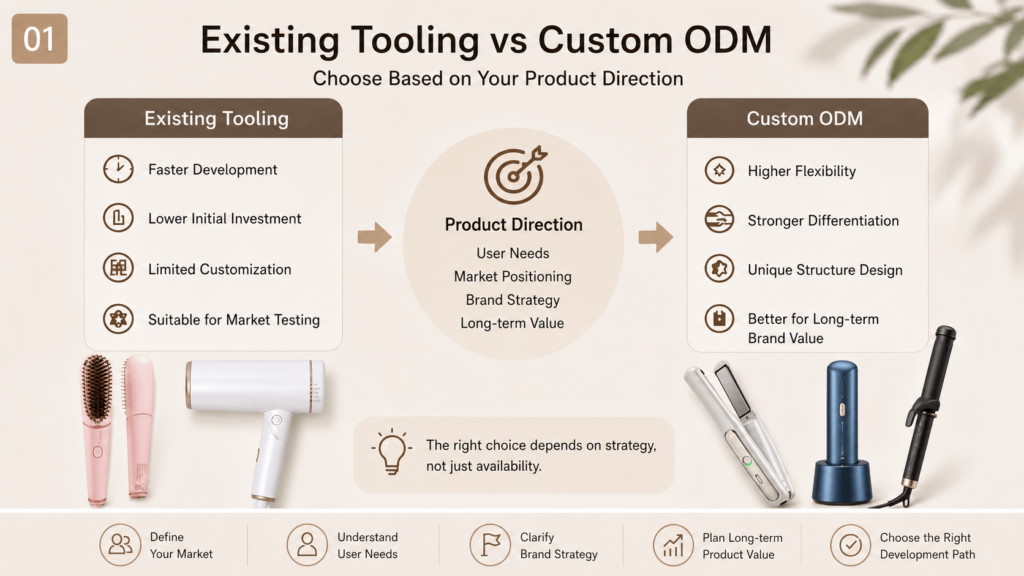
When beauty brands start a new hair tool project, one of the first decisions is often:
Should we use existing tooling or develop a custom ODM product?
There is no single correct answer.
Existing tooling is not always less professional.
Custom development is not always necessary.
The better choice depends on the brand’s product strategy, target market, launch timeline, budget, differentiation needs and risk tolerance.
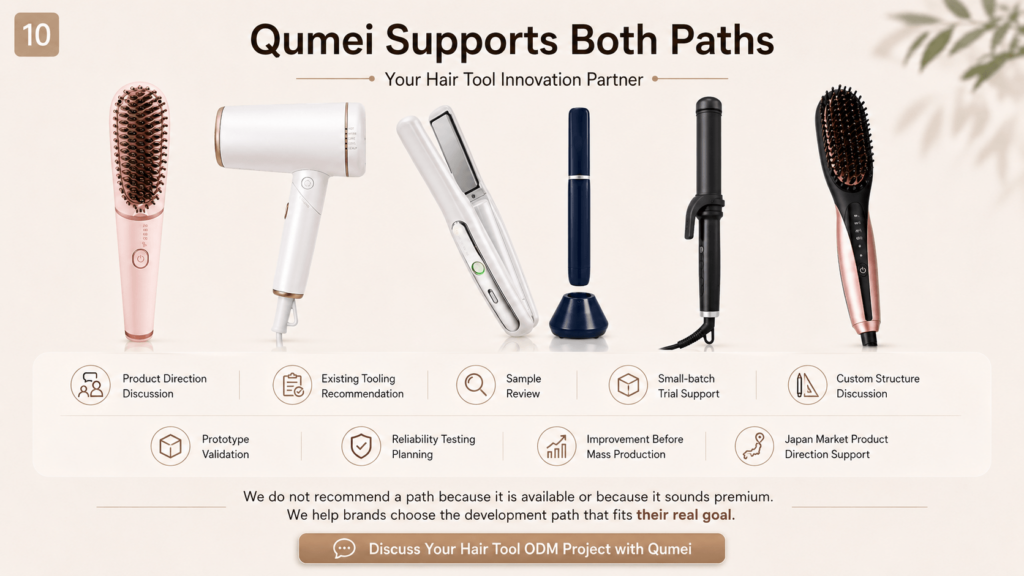
At Qumei, we support both existing tooling projects and custom ODM development.
But before recommending either direction, we first clarify the product.
A product should not be chosen only because it is available.
It should be chosen because it fits the user, the market and the brand direction.
What Is Existing Tooling?
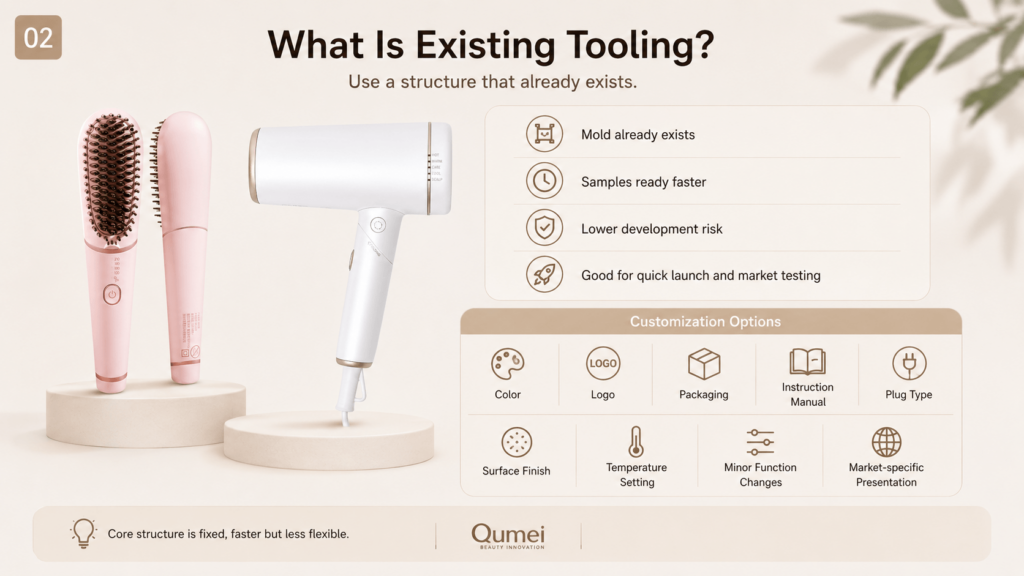
Existing tooling means using a product structure that has already been developed.
The mold already exists.
The basic product structure is available.
Samples can usually be prepared faster.
For beauty brands, existing tooling can be useful when the goal is to test a product category, launch faster or reduce early investment.
Existing tooling may still allow some customization, such as:
- Color
- Logo
- Packaging
- Instruction manual
- Plug type
- Surface finish
- Temperature setting adjustment
- Minor function changes
- Market-specific presentation
However, the core structure is usually fixed.
This means existing tooling is faster, but less flexible.
What Is Custom ODM?
Custom ODM means developing a product based on a brand’s specific product direction.
This may include:
- New structure
- New appearance
- Different heating system
- Different airflow design
- Special handle design
- Special plate or coating system
- Formula-compatible structure
- Sealing or waterproof design
- Battery and charging design
- Special user experience flow
Custom ODM gives the brand more control over differentiation, but it usually requires more time, validation and investment.
It is more suitable when the product is expected to become a long-term SKU, premium line or unique category strategy.
Existing Tooling Is Suitable When Speed Matters
Existing tooling can be a good choice when a brand wants to test market response quickly.
For example:
- A D2C beauty brand wants to add a hair tool category.
- A salon care brand wants to test home-care devices.
- A distributor wants to launch a product with lower initial risk.
- A brand wants to validate demand before deeper customization.
- A company wants to create a seasonal or campaign-based SKU.
In these cases, existing tooling can help shorten development time.
The brand can focus on market positioning, packaging, content, sales channel and customer feedback.
For early-stage validation, this can be a practical choice.
Custom ODM Is Suitable When Differentiation Matters
Custom ODM becomes more important when the brand needs stronger differentiation.
For example:
- The product needs to match a specific hair care formula.
- The brand wants a unique usage experience.
- The target market has special expectations.
- Existing tooling cannot support the desired product claim.
- The product will become a long-term hero SKU.
- The brand wants exclusivity or stronger design ownership.
- A premium positioning requires more than color and packaging changes.
For example, an ultrasonic hair care device may require custom discussion if the brand wants to combine the device with a specific serum, hair mask or treatment formula.
In that case, the product is no longer only a device.
It becomes a system:
Device + Formula + User Method + Cleaning + Repeat Use
Existing tooling may still be reviewed, but custom ODM may be needed if the formula or experience requires structural changes.
Key Differences Between Existing Tooling and Custom ODM
Comparison Point | Existing Tooling | Custom ODM |
Development speed | Faster | Slower |
Initial investment | Lower | Higher |
Structural flexibility | Limited | Higher |
Appearance uniqueness | Limited to customization | Stronger |
Market testing | Suitable | Also possible, but with higher cost |
Differentiation | Moderate | Stronger |
Risk level | Lower at the beginning | Higher early investment, but better long-term fit |
Best for | Quick launch, small-batch testing, category validation | Premium line, unique structure, long-term SKU |
Brand control | Medium | Higher |
Validation need | Sample review still needed | Prototype and testing highly recommended |
Why Existing Tooling Still Needs Product Clarity
Some brands assume existing tooling means no development thinking is needed.
This is not true.
Even when using existing tooling, brands should still clarify:
- Who is the end user?
- What market will it enter?
- What price position is expected?
- Is the product for home use, salon use or travel?
- Does the product match the brand’s design language?
- Are the temperature settings suitable?
- Is the handle comfortable?
- Is the product safe and easy to use?
- Does the product require Japanese packaging, plug or instruction support?
- Is small-batch testing needed first?
Existing tooling reduces some development risk, but it does not replace product strategy.
A suitable existing product can support a brand well.
An unsuitable existing product can still create market problems.
Why Custom ODM Should Not Start Only from Appearance
Custom ODM should not begin only from visual design.
A product that looks different is not automatically better.
Real product differentiation should come from:
- User scenario
- Functional value
- Structural logic
- Usability
- Reliability
- Market positioning
- Product storytelling
- Long-term repeat use
For hair tools, appearance is only one part of product value.
The product must also work well in daily use.
A custom hair dryer, straightening brush, curling iron, hair straightener or ultrasonic hair care device should be developed around the user’s real routine.
This is why product clarity should come before tooling, whether the project uses existing tooling or custom ODM.
How to Choose: A Practical Decision Framework
Beauty brands can use a simple decision framework.
Choose Existing Tooling If:
- You need faster launch.
- You want to test a new category.
- Your budget is limited at the first stage.
- Existing structure already matches your product direction.
- Color, logo and packaging customization are enough.
- You want to collect customer feedback before deeper development.
- You do not need exclusive structure immediately.
Choose Custom ODM If:
- You need a unique product experience.
- Your formula or function requires special structure.
- You want stronger brand differentiation.
- Existing tooling cannot support your product claim.
- You need a premium product line.
- You want long-term SKU ownership.
- You are ready to invest in prototype and validation.
Consider a Hybrid Path If:
Sometimes the best path is not one or the other.
A brand can start with existing tooling for market testing, then move to custom ODM after feedback.
For example:
- Select existing tooling.
- Customize color, packaging and positioning.
- Launch small-batch testing.
- Collect user feedback.
- Identify improvement direction.
- Develop a custom ODM version.
This path is especially useful for brands entering a new hair tool category.
It reduces early risk while keeping future differentiation possible.
Existing Tooling for the Japanese Market
For the Japanese market, existing tooling can be useful, but it should be selected carefully.
Brands should review whether the product fits Japanese user expectations, such as:
- Daily usability
- Compact size
- Lower noise
- Simple operation
- Comfortable grip
- Clear temperature logic
- Long-term reliability
- PSE-related design discussion
- Japanese packaging and instruction support
- Salon or home-care usage scenario
A product that sells in one market may not automatically fit Japan.
This is why Qumei recommends reviewing existing tooling through a market and user-experience lens, not only through price.
Custom ODM for the Japanese Market
Custom ODM may be suitable when the Japanese market requires more precise product adaptation.
For example:
- A hair dryer may need lower noise and better daily handling.
- A straightening brush may need smoother hair passage and reduced misoperation.
- A cordless or portable tool may need battery and travel-use consideration.
- An ultrasonic hair care device may need formula compatibility, sealing and cleaning review.
- A professional tool may need better durability and repeatability.
In Japan, small details can influence long-term trust.
Custom ODM can help align the product more closely with brand positioning and user expectation.
How Qumei Supports Both Paths
Qumei supports beauty brands in choosing between existing tooling and custom ODM based on product direction.
Our support can include:
- Product category discussion
- Existing tooling recommendation
- Sample review
- Market-fit discussion
- Small-batch trial support
- Custom structure discussion
- Functional prototype validation
- Reliability testing planning
- Improvement before mass production
- Japan market product direction support
We do not recommend existing tooling only because it is available.
We do not recommend custom ODM only because it sounds more premium.
We help brands choose the development path that fits their real goal.
Key Takeaways
- Existing tooling and custom ODM are both valid development paths.
- Existing tooling is suitable for faster launch, small-batch testing and category validation.
- Custom ODM is suitable for stronger differentiation, special structure and long-term product strategy.
- Japanese market projects should consider usability, reliability, packaging, PSE-related discussion and daily user experience.
- The best path depends on product clarity, not only budget or speed.
Client Decision Checklist
Before choosing existing tooling or custom ODM, brands can clarify:
- Is this product for quick launch or long-term positioning?
- Does existing tooling already match the target user?
- Is color and packaging customization enough?
- Does the product need a unique function or structure?
- Is formula compatibility required?
- Is small-batch testing recommended first?
- Is the target market Japan, Europe, the US or another region?
- Are reliability tests or certifications needed?
- Does the brand need exclusivity?
- What product risk should be reduced before production?
FAQ
Is existing tooling suitable for beauty brands?
Yes. Existing tooling can help beauty brands launch faster, test market response and reduce early development investment.
Is custom ODM always better than existing tooling?
No. Custom ODM is better only when the brand needs stronger differentiation, unique structure or long-term product ownership. Existing tooling may be more practical for early testing.
Can existing tooling be customized?
Usually yes. Color, logo, packaging, instruction manual and some specifications may be customized, depending on the product structure and project requirements.
Can Qumei support both existing tooling and custom ODM?
Yes. Qumei supports both existing tooling review and custom ODM development for hair styling tools and hair care devices.
Which path is better for Japanese beauty brands?
It depends on the product goal. Existing tooling can support quick testing, while custom ODM may be better for Japan-specific user experience, premium positioning or special functions.
Related Articles
- Why Product Clarity Comes Before Quotation in Hair Tool ODM Development
- Prototype Before Tooling: How Beauty Brands Reduce Hair Tool Development Risk
- Ultrasonic Hair Care Device ODM: Why Formula Compatibility Matters
- Japan Hair Tool ODM Development Support
Discuss Your Hair Tool ODM Project with Qumei
If you are choosing between existing tooling and custom ODM for a hair styling tool or hair care device, Qumei can help review product direction, sample validation, user scenario and stable production planning.
The right path starts with a clear product direction.