
Meta description: An ultrasonic sample can validate a function; a commercial device requires a complete, testable system.
The first prototype answers only the first question
A functional ultrasonic haircare sample can help a brand assess handling, atomization behavior and preliminary user experience. However, producing a visible mist is not proof that an active ingredient is delivered effectively to hair, or that the final product will be safe and reliable under commercial use.
Qumei has participated in ultrasonic haircare device development for Japanese customers since 2019, with further experience in 2025. Some available functional samples are intended for evaluation and may need customized appearance, functions and verification before commercial launch.
Start with the liquid, not the mist
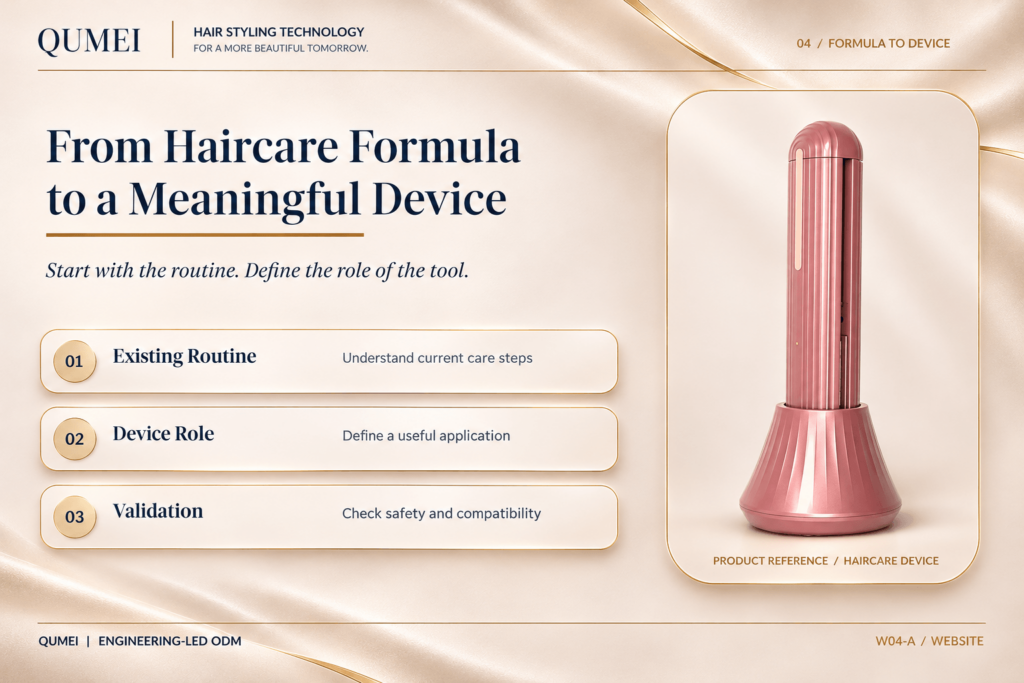
What liquid will the consumer use? Is it water-based or does it contain oils, solvents, fragrance, preservatives or suspended ingredients? Viscosity, volatility, particle size, deposits and compatibility with seals, metals and plastics can affect the system. Not every hair oil or salon formula is suitable for ultrasonic atomization. The intended formula should be disclosed and evaluated before claims are made.
The product is more than an atomizer
A practical device needs reliable liquid supply, protected electrical components, controlled droplet generation, effective sealing, and an accessible cleaning path. If the device also heats hair, the location of moisture and hot surfaces demands careful thermal and electrical safety assessment.
A separate design decision is whether the fluid reservoir, atomizer or entire module is removable. That affects leakage, serviceability, cleaning, intellectual-property risk and industrial design. Copying a familiar module layout without a patent review can create unnecessary exposure.
From the sample to production
We recommend five gates:
(1) agree on the user, formula and treatment flow;
(2) test the functional principle with the intended liquid;
(3) define industrial design and internal structure;
(4) verify leakage, electrical safety, cleaning, chemical resistance, durability and regional compliance;
(5) confirm manufacturing processes and quality controls before volume production.
What should a brand send to an ODM partner?
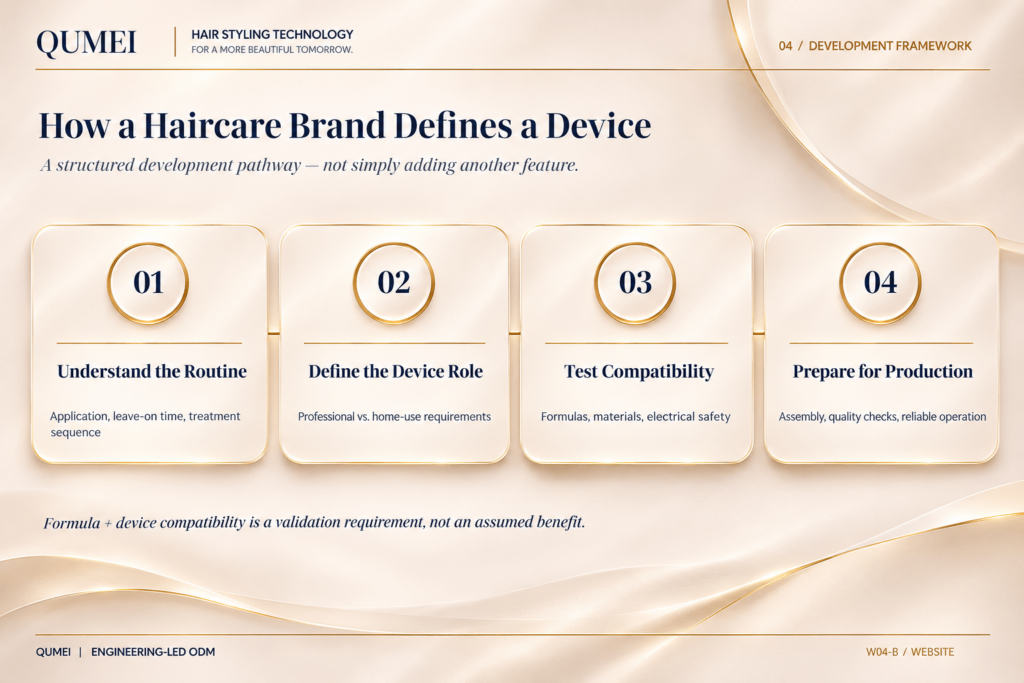
A clear product brief should include target market, expected use scenario, whether the device is sold with a formula, cleaning expectations, aesthetic direction, price target and initial order forecast. The ODM team can then identify what can be reused from a functional sample and what must be redesigned.
FAQ
Can any oil be atomized?
No. Compatibility and performance must be tested with the actual liquid.
Does a visible mist prove haircare efficacy?
No; efficacy needs separate evidence.
Can we sell the current prototype unchanged?
Not necessarily. A development sample is not automatically a fully verified final product.
Can appearance and functions be customized?
Often yes, subject to feasibility, tooling and validation.
When should testing happen?
During feasibility, at design freeze and before bulk production, with retesting after relevant changes.