
System-Level Validation for Cordless Hair Styling Devices
Why Battery, PCB and Heater Testing Must Work Together
A cordless hair styling device may look relatively simple from the outside.
It may contain a battery, heating element, temperature-control circuit, display, buttons and several protection functions.
Each component has its own specifications.
However, successful component testing does not automatically guarantee reliable operation of the complete device.
A battery may meet its capacity requirement.
A PCB may pass its functional checks.
A heater may reach the specified temperature.
But once these parts operate together, the complete system can behave differently from the individual components.
This is why system-level validation is an important part of cordless hair styling device development.
For beauty brands, understanding this distinction can help reduce unexpected engineering changes, repeated sampling and quality risks before mass production.
1. What Is System-Level Validation?
System-level validation evaluates how the complete device performs when its electrical, mechanical, thermal and control systems operate together.
This is different from component-level testing.
A component test asks:
Does this individual part meet its requirements?
A system test asks:
Does the complete product perform reliably under its intended operating conditions?
Both are necessary.
Consider a cordless hair straightener.
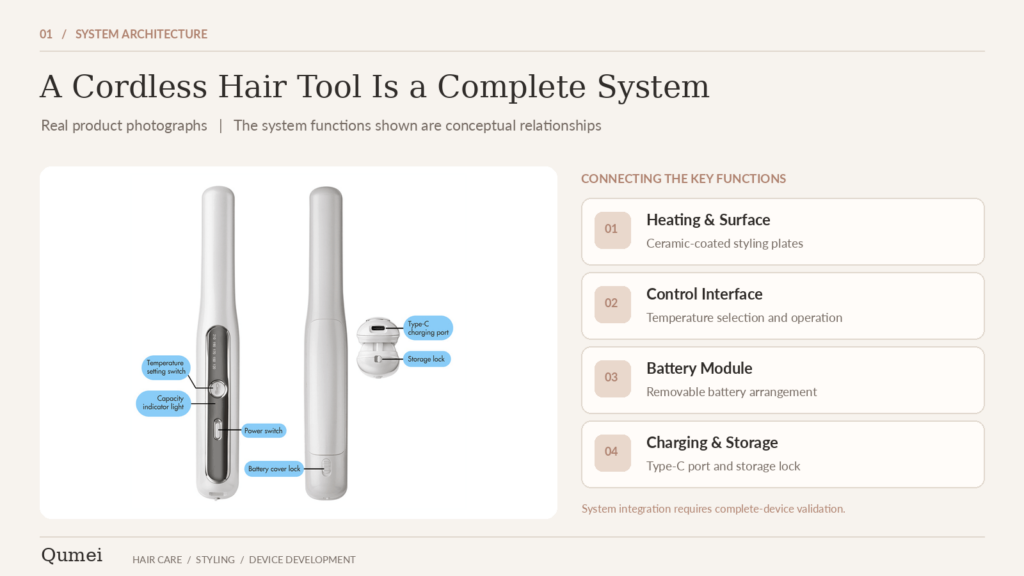
Its main systems may include:
| System | Main function | Typical validation focus |
|---|---|---|
| Battery | Supply electrical energy | Capacity, discharge behavior, temperature |
| PCB | Control device operation | Logic, electrical stability, protection |
| Heater | Generate styling heat | Heat-up time, temperature distribution |
| Temperature sensor | Provide thermal feedback | Accuracy, response, placement |
| User interface | Control operation | Buttons, display, memory, shut-off |
| Mechanical structure | Support components | Fit, assembly, contact and durability |
These systems are connected.
A change in one area can influence another.
For example, a different battery configuration may affect voltage behavior under load.
A new heater may change power demand.
A revised PCB layout may affect electrical noise or thermal conditions.
System-level validation helps identify these interactions before the design is released for production.
2. Why Can a Device Behave Differently After Integration?
Several engineering factors can contribute to differences between component-level and complete-device performance.
2.1 Shared Power Supply
In a cordless styling device, the battery supplies energy to multiple circuits.
The heating system is often one of the largest electrical loads.
Other functions may include:
- Display
- Temperature sensing
- Control electronics
- Optional ion generation
- Safety protection
When several functions operate together, the electrical conditions may differ from those observed during isolated testing.
Possible considerations include voltage stability, transient current demand and control-circuit behavior.
For this reason, power-system testing should include realistic operating combinations.
2.2 Electrical Noise and Signal Integrity
Some electronic functions generate switching activity or electrical noise.
Depending on circuit design and layout, this may influence nearby control or sensing circuits.
Potential engineering considerations include:
- Grounding
- Power filtering
- Signal routing
- PCB layout
- Component placement
- Electrical interference
These are not necessarily product defects.
They are engineering interactions that should be considered during development.
A system-level test helps determine whether the complete device remains stable under the intended combinations of functions.
2.3 Thermal Interaction
A cordless hair tool contains several components with different temperature limits.
The heater must reach a useful styling temperature.
At the same time, the battery, PCB and surrounding structure must remain within their respective safe operating conditions.
Thermal performance therefore involves more than measuring the heating plate.
Engineers may also need to evaluate:
- Battery temperature
- MOSFET and other power-component temperatures
- PCB hot spots
- Housing temperature
- Sensor response
- Temperature stability during operation
A compact design can make thermal management more challenging because components are positioned closer together.
This is especially relevant when a brand wants to reduce the overall product size.
3. Why Battery Capacity Alone Does Not Define Cordless Performance
Battery capacity is often one of the first specifications buyers compare.
For example, a product may offer different battery-capacity options.
However, capacity alone does not determine actual working time.
Operating duration also depends on factors such as:
- Battery voltage and usable energy
- Heater power consumption
- Selected temperature
- Control strategy
- Heat loss
- Battery protection limits
- Ambient conditions
- Battery condition over time
Two products with the same nominal battery capacity may deliver different operating times.
Similarly, increasing battery capacity does not necessarily produce a proportional increase in runtime.
The complete electrical and thermal system must be considered.
What should brands request?
For a cordless styling device, a useful runtime report should identify the actual tested configuration.
This may include:
Battery configuration
Cell type, nominal capacity and battery-pack arrangement.
Operating mode
Selected temperature and active functions.
Test conditions
Ambient conditions and whether the device is operating continuously or through a defined styling cycle.
Result
Measured operating duration and the condition that ended the test.
This information is more useful than a single runtime number without supporting conditions.
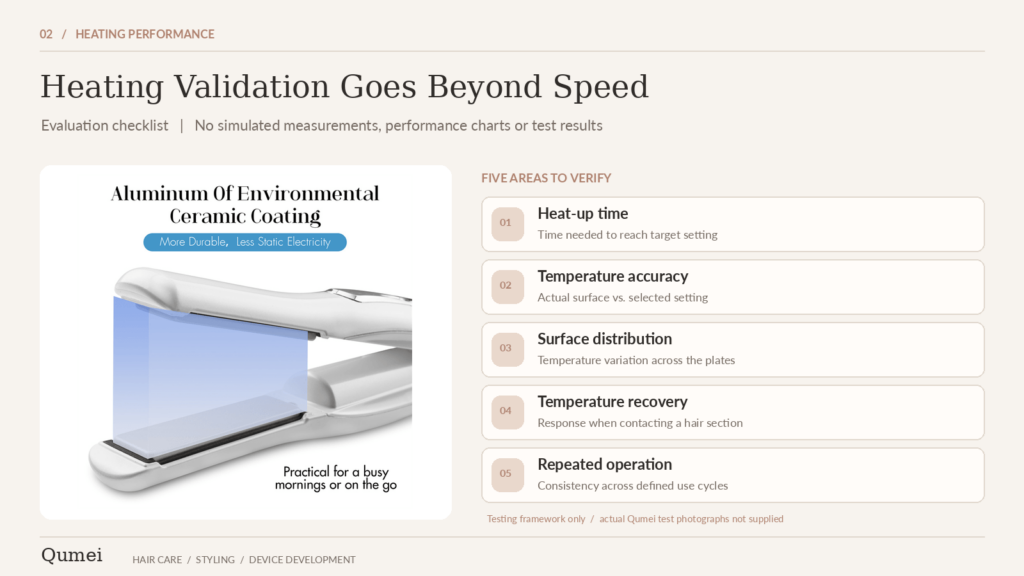
4. Heating Performance Is More Than Heat-Up Time
Fast heating is an attractive selling point.
However, reaching a target temperature quickly is only one part of styling performance.
A reliable heating system should also be evaluated for temperature control and stability.
Initial Heat-Up
How long does the device take to reach the specified temperature?
Temperature Accuracy
How closely does the actual heating surface match the selected setting?
Temperature Distribution
Are there significant differences across the heating area?
Temperature Recovery
How does the surface respond when heat is transferred to a hair section?
Repeated Operation
Does heating performance remain stable over repeated cycles?
These measurements help engineers understand the complete thermal behavior.
They also help brands distinguish between a specification that looks attractive and a performance characteristic that can be reproduced.
5. Optional Functions Create Additional Integration Requirements
Beauty brands often consider adding functions to differentiate a styling device.
Examples include:
- Negative-ion generation
- Additional temperature settings
- Battery-percentage displays
- Temperature memory
- Lock functions
- Automatic shut-off
- Charging indicators
These functions can improve the user experience when properly designed.
However, each additional function may introduce new requirements for hardware, firmware, assembly or validation.
For example, adding an electronic module may require engineers to review its interaction with the power supply and control circuit.
Changing the user interface may require additional testing of button behavior, display logic and automatic shut-off.
The appropriate question is not simply:
Can this function be added?
It is also:
Can the complete device maintain its required performance after the function is added?
This distinction is especially important when modifying an existing ODM platform.
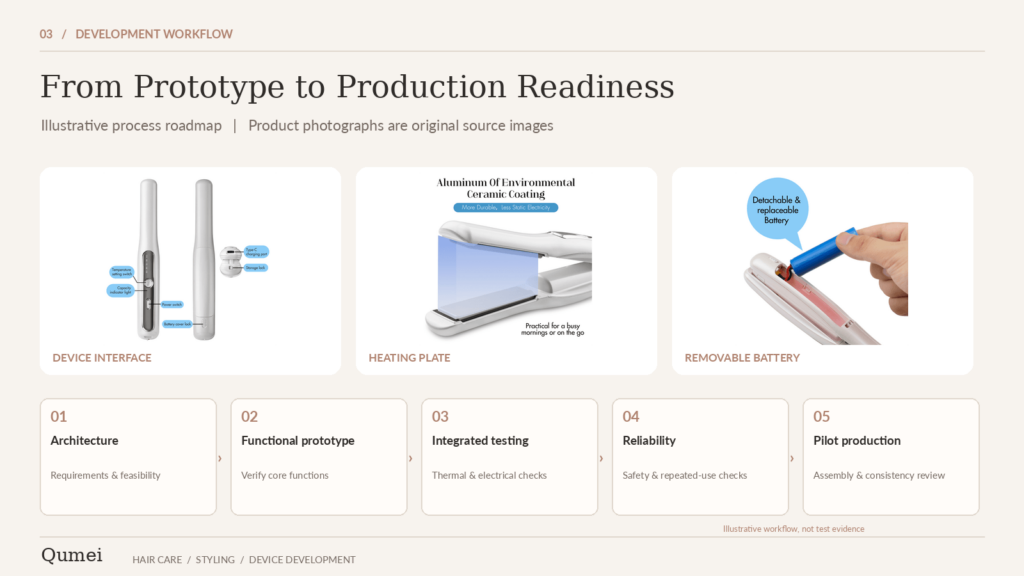
6. A Practical System-Level Test Plan
A complete validation plan should be adapted to the device architecture, intended use and target market.
The following framework illustrates how engineering teams can organize the work.
Stage 1 — Individual Subsystem Verification
Confirm the main functions of each subsystem.
Examples include:
- Battery performance
- PCB control logic
- Heater operation
- Temperature sensing
- Charging function
- Optional electronic modules
This stage helps identify basic component-level problems.
Stage 2 — Integrated Functional Testing
Operate the complete device under realistic combinations of functions.
For example:
- Heating with display active
- Heating with optional ion generation active
- Temperature adjustment during operation
- Repeated power on/off
- Automatic shut-off
- Low-battery operation
- Charging and protection behavior under the permitted operating modes
The purpose is to confirm that the functions operate together as intended.
Stage 3 — Thermal and Electrical Stability
Evaluate the device under defined operating conditions.
Depending on the design, this may include:
- Continuous operation
- Maximum permitted temperature
- Repeated heating cycles
- Low and high battery states
- Component temperature monitoring
- Supply-voltage behavior
- Control stability
Testing should follow the actual electrical architecture and safety requirements.
Stage 4 — Reliability Testing
Reliability evaluation considers how performance changes after repeated use or environmental exposure.
Possible test categories include:
- Repeated heating cycles
- Battery cycling
- Button operation
- Mechanical opening and closing
- Drop or vibration testing
- High- and low-temperature exposure
- Corrosion testing where relevant
- Charging-connector durability
The specific test methods and acceptance criteria should be defined for the product.
Stage 5 — Production Validation
A successful engineering sample is not the end of development.
Production validation must consider whether the design can be manufactured consistently.
This may require:
- Approved component specifications
- Controlled assembly processes
- Golden samples
- Defined production test procedures
- Traceability
- Change control
- Pilot-run evaluation
7. How System Validation Relates to Product Safety Standards
Engineering validation and formal compliance testing are related, but they are not interchangeable.
Different markets may require different safety and regulatory assessments.
For hair-care electrical appliances, IEC 60335-2-23 addresses particular safety requirements for appliances used for skin or hair care.
For portable lithium battery systems, IEC 62133-2 addresses battery safety under intended use and reasonably foreseeable misuse.
These standards provide important safety frameworks, but applicability depends on the specific device and market.
A product should not be described as certified simply because its development team performs similar internal tests. IEC Webstore
Internal Validation vs. Certification
Internal engineering tests help identify and reduce development risks.
Formal compliance assessment determines whether a product meets the applicable requirements under the relevant conformity-assessment process.
Both may be necessary before commercial release.
For an ODM project, it is useful to clarify the target market early so that product architecture and validation planning can reflect the relevant requirements.
8. Why Existing ODM Platforms Still Need Validation After Modification
Using an existing product platform can reduce development time and cost.
However, an established platform does not eliminate the need for engineering review.
Some modifications are primarily cosmetic.
Others can influence system performance.
Examples include:
Color and Packaging
These may involve limited technical changes, although materials, finishes and packaging requirements still need review.
Battery Configuration
Changes may affect electrical loading, thermal conditions, charging and protection behavior.
Heating Plate Material
A different surface may require review of heat transfer, durability and styling performance.
Additional Electronic Functions
New modules may affect power consumption, electrical interactions and control logic.
Structural Changes
Changes in housing, internal space or component placement may influence thermal behavior and assembly reliability.
The level of revalidation should therefore reflect the actual technical impact of the modification.
A previously tested platform is a useful starting point, not automatic proof that every customized version has the same performance.
9. What Should Beauty Brands Ask Their ODM Partner?
Brands do not need to manage every engineering measurement themselves.
However, a few questions can make development discussions more productive.
Has the complete device been tested with all intended functions operating together?
This helps distinguish isolated component testing from integrated performance testing.
Which battery configuration was used for the reported runtime?
This helps ensure that the published specification matches the intended product.
What happens under repeated operation?
This helps clarify whether testing extends beyond initial functionality.
Which modifications require additional validation?
This is particularly important when customizing an existing platform.
What evidence will be available before production release?
Depending on the project, this may include functional reports, reliability results, safety assessments and pilot-production records.
These questions are not intended to make product development more complicated.
They help establish a shared understanding of what has actually been verified.
10. How Qumei Approaches System-Level Validation
At Qumei, our product development work connects engineering, testing and manufacturing.
For cordless styling devices, we evaluate the complete product architecture rather than treating the battery, PCB and heating system as unrelated parts.
Depending on the project, our development work may include:
- Battery and power-system review
- Heating and temperature-control evaluation
- Electronic-function integration
- Mechanical structure assessment
- Reliability testing
- Production-process review
Our experience developing styling devices for Japanese customers has reinforced the importance of consistent performance and clear specifications.
A product must do more than operate successfully in a demonstration.
It must be designed for repeatable performance under its intended conditions.
This is particularly important when a brand is developing a customized product based on an existing platform.
The objective is to understand which functions are already validated, which changes introduce new risks and what additional testing is required.
Conclusion
A reliable cordless hair styling device is not simply a collection of reliable components.
It is a complete system.
Battery behavior, heating performance, PCB control, mechanical structure and user functions influence one another.
Testing these elements individually is necessary.
Testing how they operate together is equally important.
For beauty brands, system-level validation helps make product specifications more credible and development decisions more informed.
It also provides a stronger foundation for customization, reliability and production consistency.
At Qumei, we believe this is one of the most important contributions an experienced ODM development partner can make.
The goal is not simply to add functions. It is to develop functions that work reliably together.
FAQ
1. Why can a hair straightener pass PCB testing but still have operating problems?
PCB testing evaluates the circuit under defined conditions. The complete device introduces additional loads, components, thermal conditions and electrical interactions. Integrated testing is needed to verify the full system.
2. Does a larger battery always provide proportionally longer working time?
No. Runtime also depends on usable battery energy, heater power, temperature control, protection limits and operating conditions.
3. Should a cordless hair tool be tested with all functions active?
Testing should cover the permitted operating combinations defined by the product design. This helps identify interactions that may not appear during isolated component testing.
4. Is a functional prototype enough to prove mass-production reliability?
No. A functional prototype can validate important design assumptions, but final reliability and production consistency require additional testing using production-intent designs and controlled manufacturing processes.
5. Does changing a heating plate material require additional testing?
It may. Material changes can affect thermal behavior, surface durability and hair-contact performance. The necessary testing depends on the material and the extent of the change.
6. What is the difference between system validation and certification?
System validation evaluates whether the product performs according to its defined requirements. Certification or conformity assessment addresses applicable regulatory and standards requirements. Internal testing alone does not establish certification.
7. What information should a brand provide when requesting ODM customization?
Useful starting information includes the target market, intended user, product functions, battery requirements, temperature range, customization scope and expected performance.