
How Beauty Brands Can Reduce Hair Tool ODM Risk Before Tooling
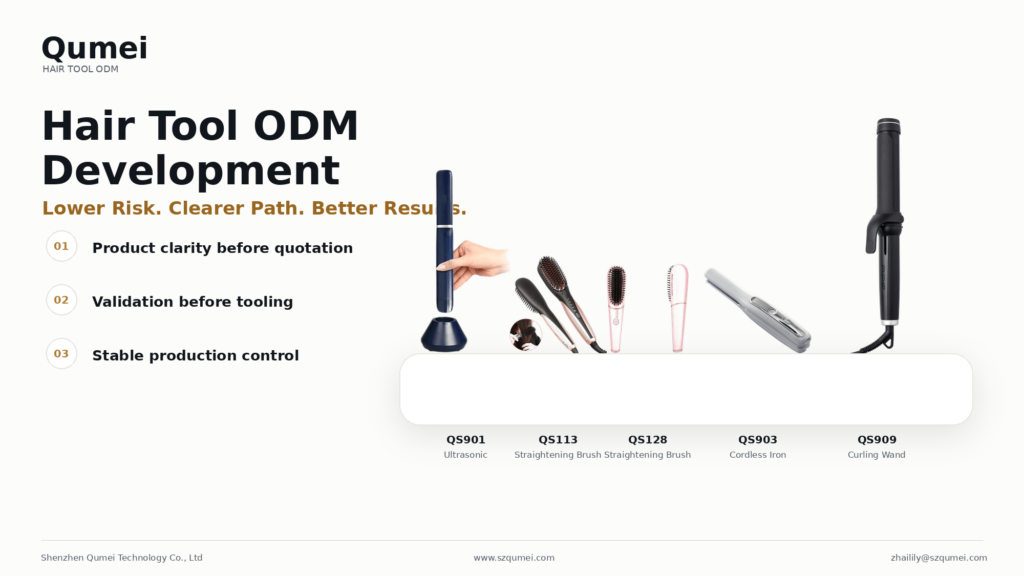
A practical guide for brands, retailers, and distributors developing hair styling devices
Developing a new hair tool is not only about finding a factory or selecting an existing model.
For beauty brands, retailers, and distributors, the bigger challenge is often this:
How can we turn a product direction into a stable, launch-ready hair tool without moving too quickly into tooling, customization, or mass production?
This is where an experienced hair tool ODM partner can create real value.
At Qumei, we believe a successful ODM project should not begin with tooling. It should begin with clarity.
Before quotation, before mold investment, and before mass production, brands need to understand whether the product direction, user scenario, channel, price range, function, structure, and production requirements are aligned.
That is why Qumei focuses on three practical development principles:
Product clarity before quotation.
Validation before tooling.
Stable production control before shipment.
Why hair tool development can become risky
Hair tools may look simple from the outside, but they involve many details that directly affect user experience, safety, reliability, and after-sales risk.
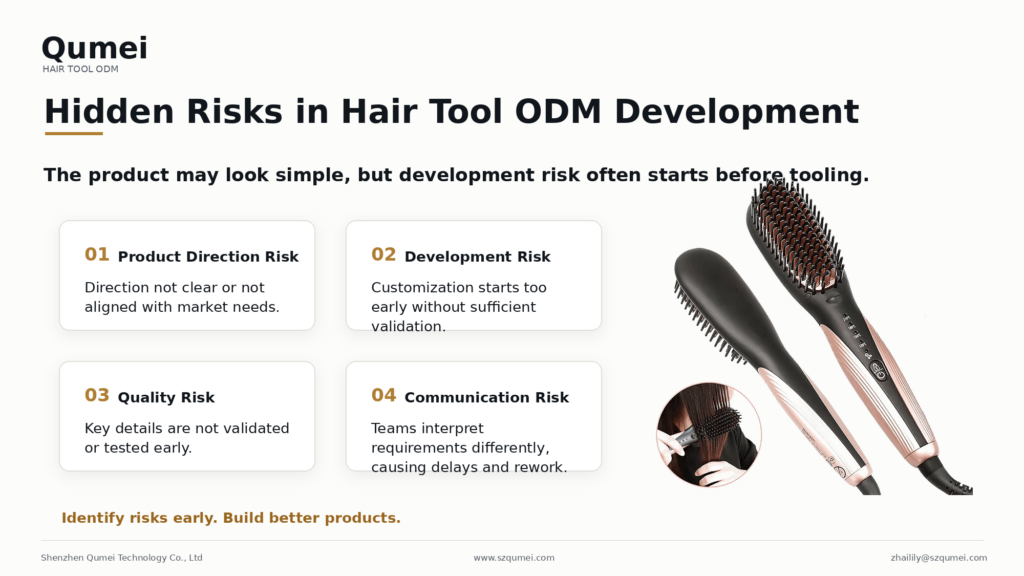
A straightener, straightening brush, cordless iron, curler, hair dryer, or ultrasonic hair care device is not only an appearance design. It is a complete product system involving:
- heating structure
- temperature control
- plate or brush surface
- battery and charging design
- weight and handling
- material selection
- internal structure
- assembly consistency
- packaging and instruction design
- certification and market requirements
If these details are not clarified early, a project may face delays, unstable samples, unclear cost, quality issues, or difficulty moving from sample approval to stable production.
In many ODM projects, the real risk is not that the product cannot be made.
The real risk is that the product direction is not clear enough before development moves forward.
What brands should clarify before developing a hair tool
Before starting a custom hair tool project, brands should first clarify several key questions.
1. What is the product’s business purpose?
Different hair tools serve different business needs.
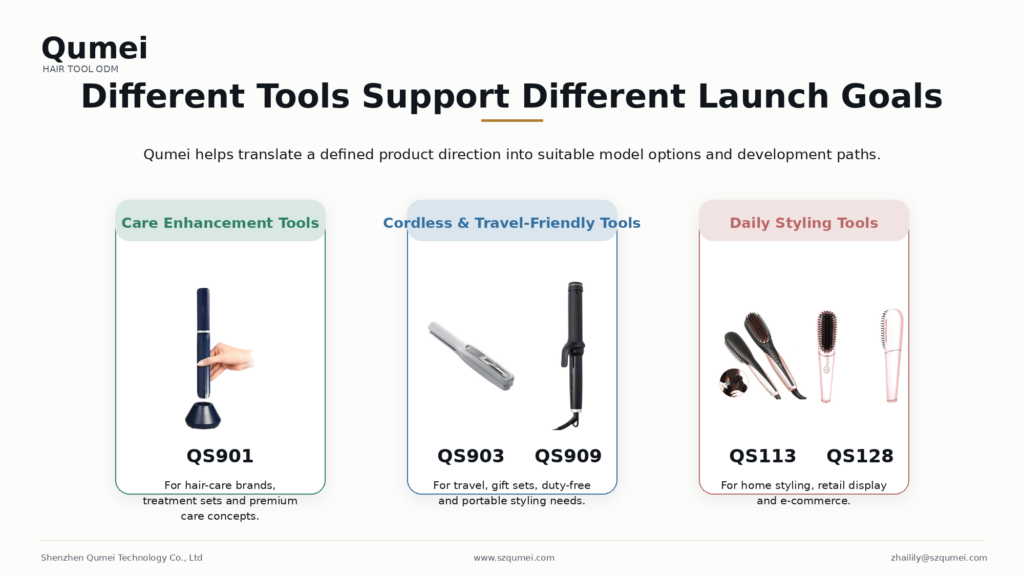
For example, a cordless hair iron may be suitable for travel, gift, and portable beauty scenarios. A straightening brush may be more suitable for daily home styling and retail education. An ultrasonic hair care device may be better positioned as a care-enhancement tool used together with treatment products or premium hair care routines.
A product should not be selected only because it looks attractive.
It should match the brand’s business purpose.
2. Who is the target user?
A professional salon-inspired hair dryer, a compact travel iron, and a home-use straightening brush are designed for different users.
Before choosing a model, brands should consider:
- Is the product for daily home use?
- Is it for travel or quick touch-up needs?
- Is it for retail display or e-commerce?
- Is it for premium beauty positioning?
- Is it for a hair care product set or gift set?
The clearer the user scenario, the easier it is to define the right specification.
3. What level of customization is really needed?
Not every brand needs full ODM from day one.
Some projects may only need logo, color, packaging, and manual customization based on a proven existing model. Other projects may require function adjustment, structure review, prototype development, or exclusive tooling.
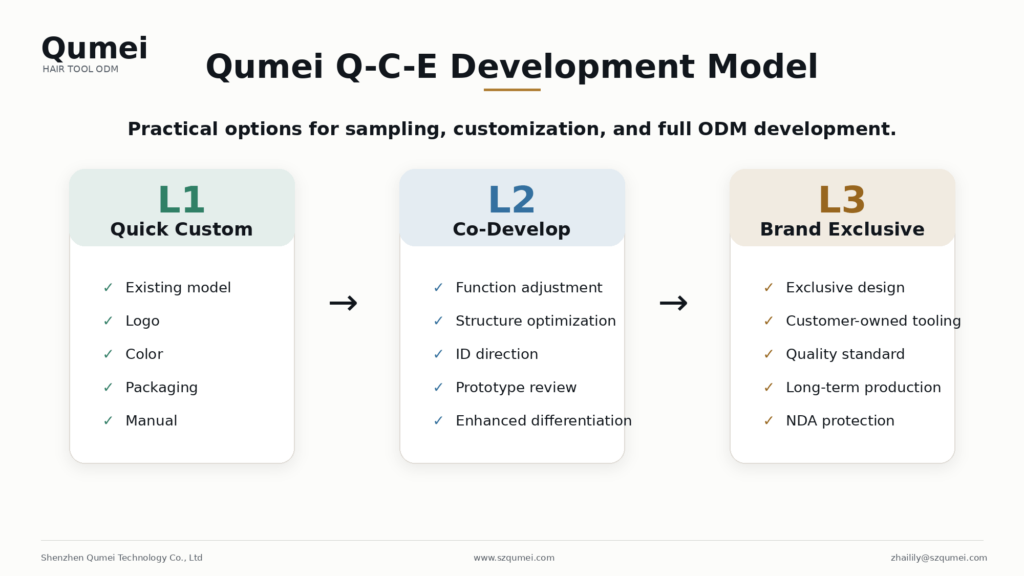
At Qumei, we usually divide projects into three development levels:
Quick Custom
For faster launch, retail testing, private label trials, and lower-risk projects using existing base models.
Co-Develop
For brands that need clearer differentiation through appearance, structure, function, or user experience adjustments.
Brand Exclusive
For long-term brand projects that require exclusive design, customer-owned tooling, NDA support, and dedicated production control.
The right development level depends on the brand’s goal, timeline, budget, and product plan.
Why validation should come before tooling
Tooling is a major step in hair tool development.
Before moving into tooling, brands should first confirm whether the product direction is technically and commercially reasonable.
A functional sample or working prototype can help evaluate:
- basic function
- size and handling
- heating or care performance
- user operation flow
- structural feasibility
- production complexity
- potential quality risks
- future customization direction
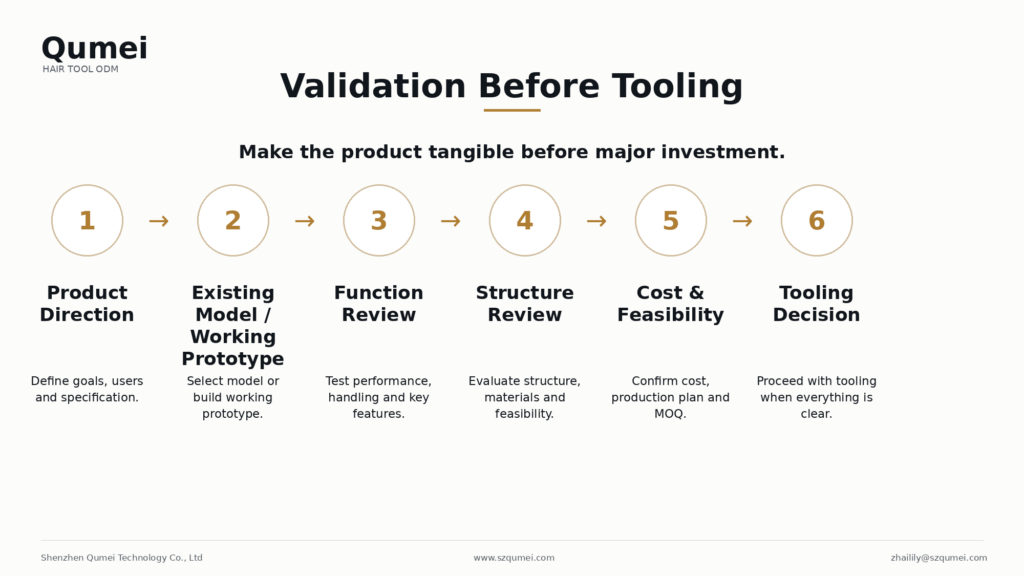
This does not mean the sample is already the final product.
It means the project becomes tangible before larger investment decisions are made.
For brands developing new product concepts, this step can reduce unnecessary risk and help internal teams make clearer decisions.
How Qumei supports hair tool ODM development
Qumei is a hair tool ODM partner supporting beauty brands, retailers, and distributors with product development, customization, testing, and production coordination.
Our product directions include:
- cordless ultrasonic hair care devices
- cordless hair irons
- straightening brushes
- flat irons
- curlers and styling tools
- hair dryers
- travel-friendly beauty tools
- retail and private-label hair tools
However, our value is not only providing models.
Qumei helps brands translate a defined product direction into a stable, launch-ready product through practical ODM support.
This includes:
Product direction support
We help review product goals, target users, channel needs, price range, and customization direction before moving forward.
Sample and prototype review
We support sample preparation, working prototype review, handling evaluation, and function discussion.
Customization support
We can discuss logo, color, packaging, manual, gift set direction, and brand-specific visual adjustments.
Function and structure review
For hair tools, small details can affect user experience and after-sales risk. We help review temperature settings, plate surface, battery and charging, voltage, weight, handling, and structural feasibility.
Reliability and production support
We focus not only on making a sample look good, but also on making production stable. This includes product life review, temperature checks, drop testing, assembly consistency, pilot run, and pre-shipment inspection.
Founder-led execution, not hand-off selling
One important difference in ODM development is communication.
In many projects, brand requirements pass through sales, engineering, factory, and production teams. If communication is unclear, details can easily be misunderstood.
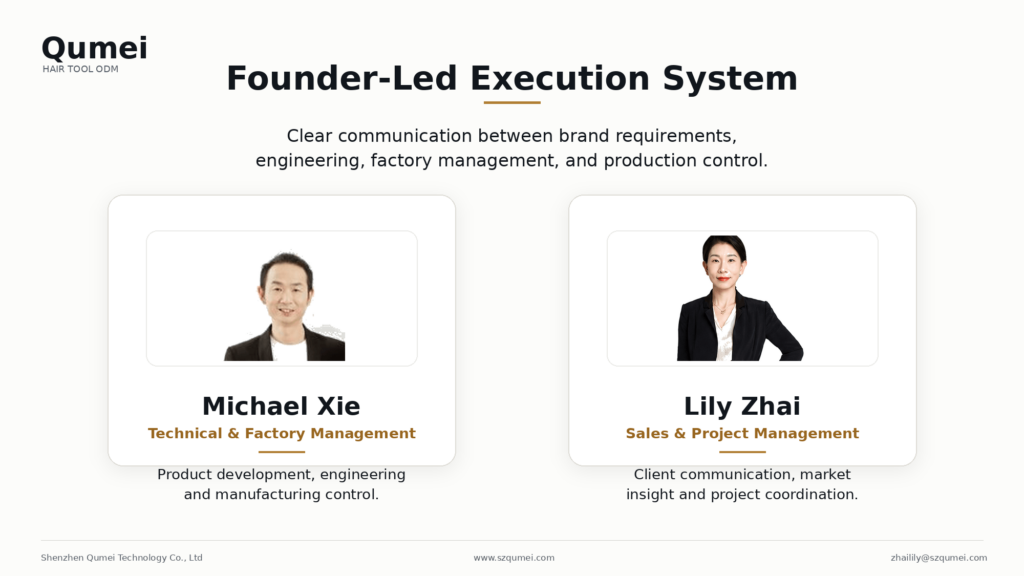
Qumei works with a founder-led execution system, connecting customer needs with engineering, factory management, and production control.
This helps reduce misunderstanding and makes the development process clearer from idea to sample, quotation, tooling, production, and shipment.
For clients, this means:
clearer decisions, fewer misunderstandings, faster sample review, and more stable production control.
A better way to start a hair tool ODM project
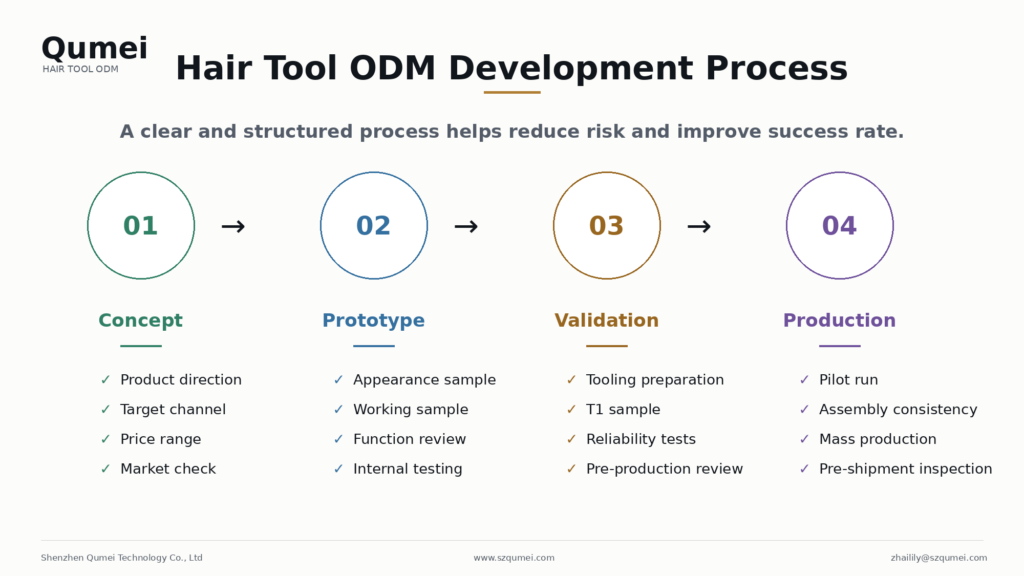
For brands considering a new hair tool project, the first step does not need to be full ODM development.
A practical starting point may be:
- Define the product direction
- Review suitable existing models or technical options
- Confirm target users, channel, and price range
- Evaluate samples or working prototypes
- Discuss customization level
- Review quotation and production feasibility
- Move step by step toward tooling or mass production if needed
This approach allows brands to control risk while keeping development flexible.
Conclusion
A successful hair tool ODM project is not only about making a product.
It is about making the right development decisions at the right stage.
For beauty brands, retailers, and distributors, the key is to avoid moving too quickly into tooling or mass production before the product direction, specification, structure, and quality requirements are clear.
Qumei supports hair tool ODM development with a practical approach:
Product clarity before quotation.
Validation before tooling.
Stable production control before shipment.
If your team is reviewing a new hair tool project, Qumei can help evaluate the product direction, sample options, customization path, and development process before major investment decisions are made.
FAQ
What is a hair tool ODM partner?
A hair tool ODM partner helps beauty brands, retailers, and distributors develop or customize products such as hair straighteners, straightening brushes, curlers, hair dryers, cordless hair tools, and hair care devices.
How can brands reduce ODM development risk?
Brands can reduce ODM risk by clarifying product direction before quotation, validating samples or prototypes before tooling, and confirming production stability before shipment.
Should a brand start with tooling immediately?
Not always. Many brands can first review existing models, functional samples, or working prototypes before deciding whether full tooling or exclusive ODM development is necessary.
What types of hair tools can Qumei support?
Qumei supports cordless hair irons, straightening brushes, flat irons, curlers, hair dryers, ultrasonic hair care devices, travel-friendly styling tools, and private-label hair tool projects.
Why is sample validation important before mass production?
Sample validation helps brands confirm function, handling, structure, user experience, and production feasibility before investing in tooling or mass production.
Need support for your hair tool development project?
Qumei supports Japan-oriented hair tool ODM development from concept discussion to stable production.

Continue Exploring Qumei Insights
Explore more articles about hair tool development and Japan-market ODM strategy.