
How user scenarios, product strategy and technical requirements change the development direction![]()
![]()
![]()
![]()
Ultrasonic hair care devices may look similar from the outside, but a product designed for home users is fundamentally different from one developed for professional salon use.
The difference is not limited to appearance, packaging or temperature settings.
It affects:
- Product positioning
- Operating method
- Treatment time
- Heating requirements
- Battery and power system
- Cleaning and sealing
- Durability
- Commercial model
- The type of prototype that should be built first
At Qumei, we have supported both professional salon and home-use ultrasonic hair care projects.
The following two anonymized cases show why the intended user scenario should be defined before frequency, heating and detailed specifications are finalized.
![]()
![]()
![]() Case A: A Professional Salon Treatment Device
Case A: A Professional Salon Treatment Device
Project Background
The client already operated in the professional hair care market and had an existing treatment product for salon use.
The objective was not simply to add another electrical tool to the product catalogue.
The client wanted to combine its treatment formula with a dedicated device and turn an existing salon process into a more structured service menu.
The product therefore needed to support:
- Professional treatment procedures
- Repeated use in a salon environment
- Clear operating steps
- Consistent treatment time
- Easy cleaning between clients
- A user experience that salon staff could reproduce
What the Brand Needed to Confirm
At the beginning of the project, the most important questions were not limited to ultrasonic frequency.
The brand needed to determine:
- Whether heating should be included
- How the treatment product would be applied
- How long one treatment should take
- Whether the operating steps could be simplified
- How the device should be cleaned after use
- Whether liquid residue could affect the treatment plates
- Whether sealing was sufficient for repeated professional use
- Whether the product could support a standardized salon menu
These decisions affected the structure, power system, materials and testing plan.
Key Development Priorities for Salon Use
1. Repeatable Operation
Salon employees may have different experience levels.
The product therefore needed an operating process that could be explained, trained and repeated without relying entirely on individual technique.
The device should help define:
- Where the treatment starts
- How the hair section is handled
- How quickly the device moves
- How long one treatment lasts
- How the device is cleaned afterward
For professional products, standardization is part of the product value.
2. Continuous and Repeated Use
A home user may use the device once per day or several times per week.
A salon device may be used repeatedly during business hours.
This changes the evaluation of:
- Battery capacity or corded power
- Component temperature
- Plate and hinge durability
- Cleaning frequency
- Charging time
- Heat dissipation
- Long-term structural stability
A product that works well for one home treatment may not be suitable for repeated professional operation.
3. Heating or Non-Heating Design
Heating can strengthen the perception of a professional treatment, but it also increases engineering requirements.
The decision needed to consider:
- The intended treatment process
- Formula stability under heat
- Target temperature
- Temperature-control accuracy
- Protection against overheating
- Power consumption
- Sealing around heated areas
- Cleaning after formula contact
Heating was therefore evaluated as part of the total treatment experience, not as an isolated selling point.
4. Cleaning, Residue and Sealing
Professional products must be cleaned frequently.
The structure needed to reduce:
- Formula buildup
- Difficult-to-reach corners
- Liquid entering the housing
- Residue around plate edges
- Changes in ultrasonic output caused by contamination
Sealing and cleaning were treated as development issues from the beginning, rather than problems to address only after production.
Qumei’s Development Role
For this project, Qumei supported the client by:
- Reviewing the original salon treatment process
- Organizing the intended operating steps
- Evaluating heated and non-heated directions
- Reviewing the plate, sealing and cleaning structure
- Producing functional samples
- Collecting use feedback
- Adjusting the product direction before production
- Supporting the project through manufacturing and shipment
The purpose of the prototype was not simply to demonstrate that ultrasonic vibration was present.
It was used to confirm whether the complete salon workflow was practical.
Project Outcome
The project moved into production and shipment.
The device became part of a professional treatment process rather than a standalone electrical appliance.
This allowed the client to present a more structured salon service built around:
- Treatment product
- Dedicated device
- Defined operating steps
- Professional care experience
What Brands Can Learn from This Case
For salon products, the core value is not the number of functions.
It is whether the device makes the treatment process:
- More consistent
- Easier to train
- Easier to reproduce
- Easier to package as a professional service
Case B: A Home-Use D2C Hair Care Device
Project Background
The second client had its own customized hair treatment formula and planned to develop a home-use ultrasonic care device.
The commercial goal was different from the salon case.
The brand wanted to create a product system combining:
- A consumer device
- A dedicated treatment product
- An initial set
- Future treatment-product repurchases
- A new home-care category
The project had previously been developed with another supplier, but the sample did not fully support the brand’s intended user experience or product direction.
Gaps in the Previous Development
The main challenges were not limited to one technical defect.
The project needed to reconsider:
- Product appearance
- Consumer operation
- Ultrasonic direction
- Heating or non-heating design
- Sealing
- Formula contact
- The relationship between the device and repeat treatment-product sales
The previous sample could demonstrate a basic function, but the overall route toward a consumer-ready product was still unclear.
This is a common situation in ODM development.
A sample may work technically while still failing to answer:
Will consumers understand it, use it correctly and continue using it?
Key Development Priorities for Home Use
1. Simple Consumer Operation
A home-use product should not depend on professional training.
The operating process needed to be:
- Easy to understand
- Easy to demonstrate
- Easy to repeat
- Difficult to misuse
- Suitable for a normal bathroom or dressing-table environment
The brand also needed to decide how much information consumers should receive about:
- Treatment quantity
- Hair sectioning
- Device movement
- Treatment time
- Cleaning
2. Acceptable Treatment Time
A long process may be acceptable in a salon where the customer receives a professional service.
It may be difficult to sustain at home.
The brand therefore needed to balance:
- Treatment experience
- Perceived results
- Device speed
- Battery duration
- Consumer patience
- Frequency of use
The intended treatment time influenced both product design and marketing communication.
3. Heating, Battery and Product Weight
For home-use cordless products, heating affects more than temperature.
It can change:
- Battery size
- Product weight
- Charging time
- Operating duration
- Housing temperature
- Safety design
- Internal space
- Final cost
A feature that appears attractive in marketing may reduce convenience if it makes the product heavier or shortens the usable time.
The correct solution depends on the consumer experience the brand wants to create.
4. Cleaning and Daily Maintenance
Home users are less likely to follow a complicated maintenance procedure.
The product therefore needed to reduce:
- Formula residue
- Difficult cleaning steps
- Risk of liquid entering the housing
- Dependence on special tools
- Confusion about whether the device can be rinsed
Clear cleaning instructions are part of product development, not only instruction-manual writing.
5. Product-System and Repeat-Purchase Logic
For a D2C brand, the device can become the entry point to a larger product system.
Possible combinations include:
- Device + initial treatment product
- Device + concentrated care set
- Replacement or refill treatment products
- Periodic intensive-care kits
- Future next-generation devices
The device therefore needed to support the brand’s treatment product rather than compete with it.
Qumei’s Development Role
Qumei supported the project by:
- Reorganizing the home-use scenario
- Reviewing the existing sample and reference direction
- Comparing frequency and heating options
- Evaluating appearance, sealing and operating logic
- Producing and adjusting functional samples
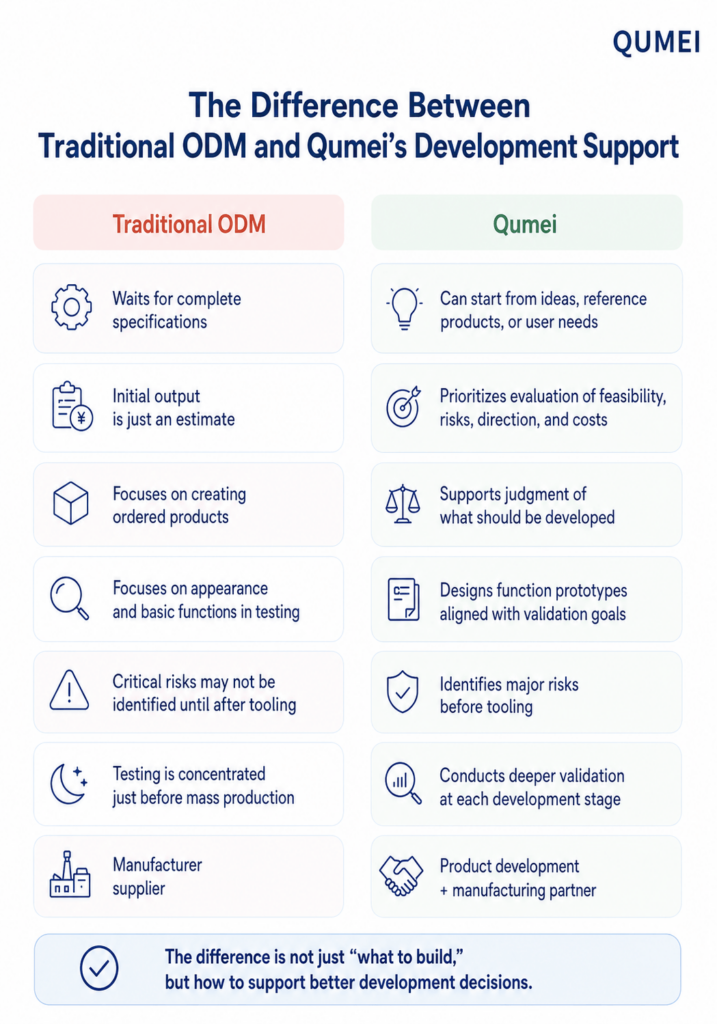
- Identifying which issues needed to be solved before tooling
- Supporting the project through production and shipment
The development process focused on both engineering feasibility and consumer acceptance.
Project Outcome
The previously stalled project was reorganized and moved forward.
The final product became part of a home-care system combining a device and treatment product.
The brand gained possible extensions into:
- Starter sets
- Treatment refills
- Intensive-care packages
- New consumer education content
- Future product generations
What Brands Can Learn from This Case
For home-use products, technology alone is not enough.
The device must make the treatment:
- Easy to understand
- Easy to perform
- Easy to maintain
- Worth repeating
Its commercial value comes from connecting the product experience with long-term brand use.
Home Use vs Salon Use: Key Development Differences
Evaluation Area | Home Use | Salon Use |
Primary user | Consumer | Stylist or trained professional |
Operating logic | Simple and intuitive | Efficient and controllable |
Treatment time | Usually shorter | Can follow a longer professional process |
Continuous use | Relatively limited | Repeated use may be required |
Product weight | Highly important | Stability and efficiency may be prioritized |
Heating | Must balance safety, weight and battery life | Can be selected around the professional treatment process |
Cleaning | Must be easy for consumers | Must support frequent cleaning |
Durability | Normal household use | Higher-frequency professional use |
Commercial model | Device + formula + repeat purchase | Device + salon menu + home-care extension |
Main success factor | Easy adoption and continued use | Consistency and reproducibility |
What Should a Brand Decide First?
Before selecting frequency, temperature or appearance, brands should first answer five questions:
- Who is the primary user: a consumer or a professional?
- Where will the device be used?
- How long should one treatment take?
- What should the device change: treatment perception, operating consistency or the commercial model?
- What must the first prototype validate before tooling begins?
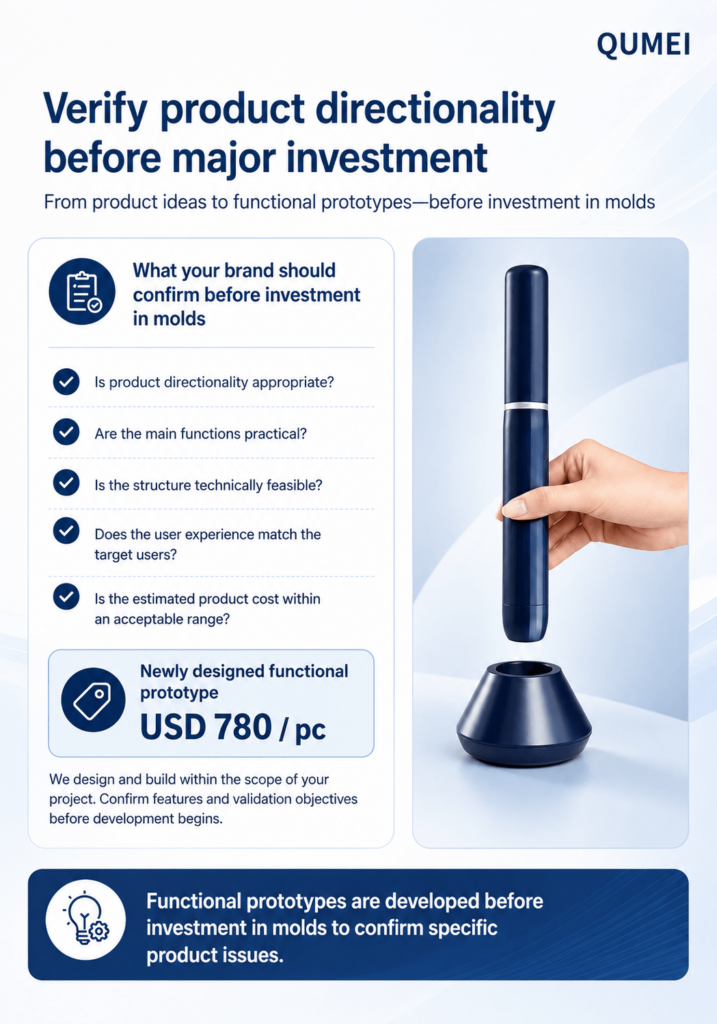
For suitable projects based on an existing structural platform, Qumei can provide early functional prototype validation starting from USD 780.
This stage is intended to confirm the product direction before larger investments in tooling and mass production.
New tooling, major new structures, certification and shipping are evaluated separately.
Conclusion
Home-use and professional ultrasonic hair care devices should not be developed from the same specification checklist.
A salon project may prioritize:
- Workflow consistency
- Repeated use
- Professional control
- Durability
- Menu creation
A home-use project may prioritize:
- Simplicity
- Safety
- Product weight
- Cleaning
- Repeat consumer use
The correct development direction begins with the intended user and treatment process—not with the frequency number.
Not sure whether your concept should be developed for home or salon use?
A reference product, an existing treatment product or a simple description of the intended care experience is enough to begin an initial discussion.