
Meta Description:
Learn what beauty brands should validate with a functional prototype before investing in hair-device tooling, from function and user routine to formula compatibility and production risk.
Functional Prototype Before Tooling: What Beauty Brands Should Validate Before Investing in a New Hair Device
When developing a new hair device, one of the most expensive decisions usually comes early: when to invest in tooling.
Before that point, there are often still many unanswered questions.
Does the basic structure work?
Is the temperature range suitable?
Does the brush create enough tension and control?
Is the product comfortable to hold?
Does ultrasonic treatment make a noticeable difference when used with a hair-care product?
Can a serum or mist work naturally with the intended device?
And ultimately, is the product experience strong enough to justify developing a dedicated device?
A functional prototype is useful because it allows these questions to be tested before the project moves into tooling.
At the same time, a prototype should not be confused with a final production sample.
Prototype materials, assembly methods, tolerances, surface finish and waterproof performance may all differ from the final molded product.
Its role is much simpler:
to answer important product questions before larger investments are made.
For beauty brands entering a new device category, this can make the development process much more controlled.
1. What Is a Functional Prototype in Beauty Device Development?
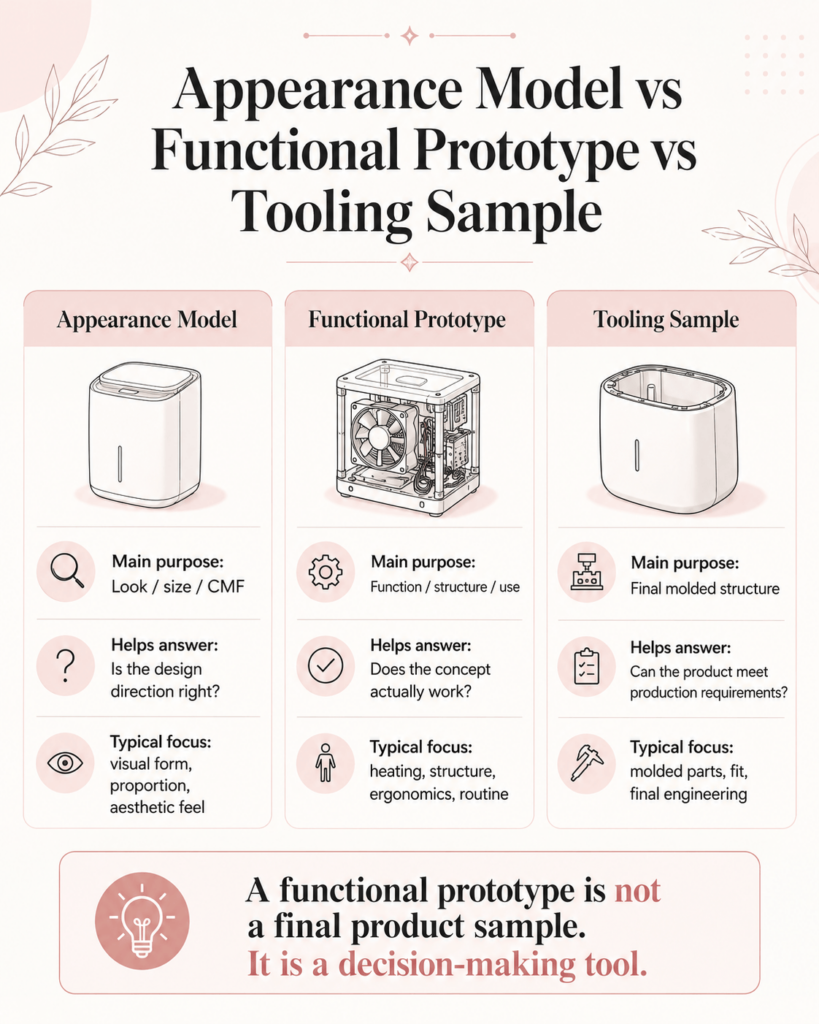
A functional prototype is an early working model used to test the essential product concept before final tooling.
It sits between an appearance model and a tooling sample, but each of these samples has a different purpose.
| Development Sample | Main Purpose | What It Helps Answer |
|---|---|---|
| Appearance Model | Shape, size, visual direction | Does the overall product direction look and feel right? |
| Functional Prototype | Function, structure, user experience | Does the product concept actually work? |
| Tooling Sample | Final molded structure and production design | Can the final product meet engineering and production requirements? |
An appearance model can look very close to a commercial product while having little or no real function.
A functional prototype may look less refined, but it can be used to test things such as:
heating
ultrasonic function
brush structure
basic electronics
liquid delivery
ergonomics
control logic
user routine
Tooling samples come later, after the product structure and key specifications are more clearly defined.
A functional prototype therefore should not be judged as a finished product.
It is mainly a development and decision-making tool.
2. Why Not Start With Tooling?
It can be tempting to move directly from an idea to industrial design and tooling.
On paper, that may seem like the fastest route.
The risk is that assumptions which have not yet been tested become fixed inside an expensive mold.
Take a new hair-care brush as an example.
Before tooling, the team may still be uncertain about:
handle length
product balance
brush tension
heating level
pin spacing
number of passes required
compatibility with the brand’s Serum Mist
If these points only become obvious after tooling, even a relatively small change may involve much more work.
Possible consequences include:
mold modification
component changes
structural redesign
additional testing
schedule delays
additional development cost
This is why prototyping is not only a technical step. It can also help control financial risk.
The product concept can first be tested and adjusted.
Once the direction is clearer, the brand can move into tooling with much more confidence.
For brands that want to reduce early-stage development risk, an ODM development process can also start from an existing platform or functional structure and gradually move toward deeper customization.
3. What Should Be Validated Before Tooling?
The priorities are different for every project.
A straightening brush, an ultrasonic treatment device and a formula-dispensing product do not need to validate exactly the same things.
Still, there are several areas that are worth reviewing before tooling.
3.1 Device Architecture
The first step is to confirm whether the basic product structure makes sense.
Depending on the device, this may include:
overall dimensions
internal space
heater position
battery position
PCB layout
ultrasonic structure
liquid path
brush-head structure
opening angle
handle length
component arrangement
At this stage, every millimeter does not need to be final.
The main purpose is to confirm that the concept can be built into a practical product.
Portable devices are a good example.
A compact concept may look attractive in a rendering, but the internal structure still needs to accommodate components such as:
battery
heater
reservoir
pump
PCB
sealing structure
Once these are added, the actual product may become larger or heavier than expected.
A prototype makes this kind of conflict much easier to identify before tooling.
3.2 Functional Performance
The next question is whether the intended function works well enough for the target use.
For a Hair Refresh brush, testing may focus on:
temperature range
heat-up behavior
heat distribution
brush tension
pass efficiency
friction
contact area
For an ultrasonic treatment device, the focus may instead be:
ultrasonic function
frequency
plate contact
operating time
heating or non-heating mode
interaction with treatment products
For a dispensing device, key areas may include:
pump performance
outlet size
liquid flow
dosage
leakage
clogging
Simply confirming that a function can switch on is not enough.
The function also needs to create a result or experience that makes sense for the consumer.
4. Consumer Routine Should Be Validated Before the Product Is Finalized
A device can work perfectly from an engineering point of view and still be inconvenient to use.
This is particularly relevant for hair-care brands because the device often needs to fit into an existing care routine.
For example:
Morning Hair Refresh
Serum Mist
↓
Hair Refresh Brush
↓
Natural, neat finish
Weekly Treatment
Treatment / Hair Mask
↓
Ultrasonic Treatment Device
↓
Rinse and dry
Scalp Care
Scalp Essence
↓
Precision Applicator
↓
Spread across target areas
Before tooling, it is useful to understand exactly how the consumer will use the product.
Questions may include:
When will the device be used?
On wet or dry hair?
Before or after drying?
Before or after applying a formula?
How long will the routine take?
How many steps are involved?
Does the device need cleaning after use?
Is the routine realistic for daily or weekly use?
These details can have a large impact on the final product.
For example, a portable Hair Refresh tool may sound convenient until the user has to:
fill a reservoir
clean the liquid path
wait for heating
carry additional accessories
dry the device after use
In some cases, a separate Serum Mist used together with a compact heated brush can create a much simpler daily routine.
These choices are much easier to evaluate while the product is still in the prototype stage.
5. Formula Compatibility Can Change the Entire Device Structure
For hair-care brands, the formula itself can strongly influence how a device should be designed.
Different hair-care products behave very differently.
A Hair Mist, Serum, Hair Milk, Hair Oil and Treatment can vary in:
viscosity
oil content
polymer content
residue
flow behavior
heat response
cleaning requirement
material compatibility
These differences can directly affect the product structure.
Hair Mist / Hair Water
A low-viscosity formula may work with a spray or micro-pump delivery system.
Hair Serum
A serum may require a different outlet or a more controlled pump.
Hair Milk
A thicker hair milk may not work reliably with a conventional fine-mist nozzle.
Hair Oil
Oil can create additional concerns around leakage, residue and cleaning.
Hair Mask / Treatment
A thicker treatment usually makes more sense as an externally applied product used together with a treatment device rather than being stored inside a small built-in reservoir.
For this reason, when a device is expected to work together with a formula, it is useful to first understand what delivery method fits both the formula and the intended consumer routine.
Prototype testing can then help determine whether the proposed formula-device combination works naturally before a more expensive structure is finalized.
You can read more about the relationship between daily routines and styling devices in our Hair Refresh device development framework.
6. Ergonomics Are Easier to Change Before Tooling
Hair devices are hand-held products, so relatively small ergonomic issues can quickly become noticeable in real use.
Before tooling, a brand may want to evaluate:
handle length
grip diameter
weight
center of gravity
button location
opening force
plate or brush angle
one-handed operation
cable position
protective cap structure
Many of these details are difficult to judge accurately from a drawing alone.
A cordless brush may look compact on screen but feel too thick once held in the hand.
A flat iron may look elegant but require too much pressure to close.
A button may appear perfectly positioned in the rendering but be easy to press accidentally during normal use.
These are exactly the types of issues a functional prototype can reveal early.
7. Is the Consumer Result Noticeable Enough?
This is often one of the most important questions in hair-device development.
A new function may be technically interesting, but that does not always mean the consumer will notice or value it.
This is particularly relevant for products such as:
ultrasonic treatment devices
low-temperature care styling tools
formula-delivery devices
scalp devices
multi-function beauty appliances
Take an ultrasonic treatment device as an example.
Measuring ultrasonic output is part of the technical validation.
But from a commercial point of view, what matters more is whether:
Treatment + Device
creates a meaningful improvement in areas such as:
smoothness
manageability
shine
combing feel
treatment experience
perceived professional care
The difference needs to be meaningful enough that consumers are willing to use the device repeatedly.
If the formula and device together do not create a sufficiently noticeable experience, moving directly into tooling may not be the best next step.
Discovering that during prototype testing can save a much larger investment later.
8. What a Functional Prototype Cannot Fully Validate
Functional prototypes are extremely useful, but they also have clear limitations.
Prototype ≠ Final Product
Some characteristics can only be properly confirmed after tooling samples and production-level components are available.
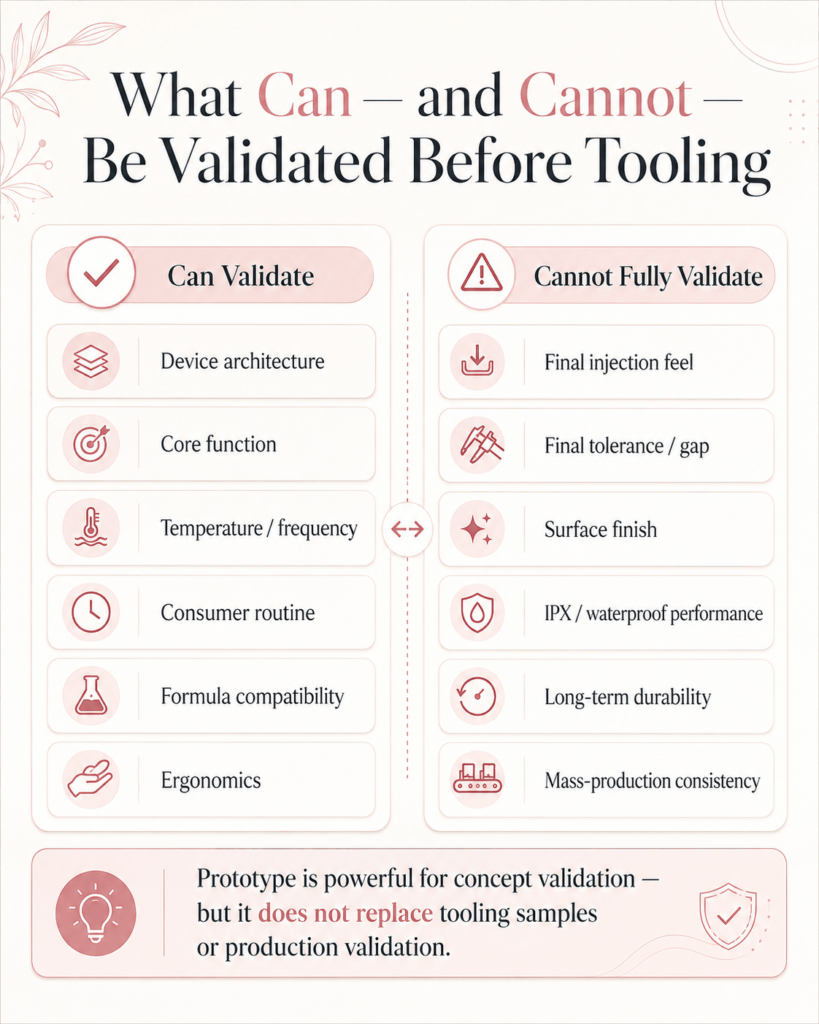
8.1 Final Injection-Molded Material Feel
Prototype materials may be different from the final injection-molded resin.
As a result, characteristics such as:
rigidity
flexibility
tactile feel
surface response
snap fit
structural strength
may feel different from the final product.
A 3D-printed prototype, for example, may feel more rigid or less refined than a molded production part.
8.2 Final Gap and Tolerance
Prototype parts are often manufactured and assembled differently from mass-production parts.
This means that:
housing gaps
plate alignment
brush-head alignment
closing tolerance
assembly fit
may not fully represent the final product.
Production tolerances should be confirmed after tooling using production-intent parts.
8.3 Final Surface Finish
A prototype can simulate finishes such as:
matte
gloss
soft-touch
plating
coating
but it may not reproduce the exact commercial appearance or tactile finish.
Surface durability also requires separate testing.
8.4 Waterproof and Sealing Performance
A functional prototype can help evaluate whether the basic sealing concept is workable.
Final waterproof performance, however, should normally be confirmed with samples that are much closer to the final molded and assembled structure.
This is particularly important when the product has a defined IPX requirement.
8.5 Long-Term Durability
A functional prototype is primarily intended to validate the product concept.
It does not replace formal durability testing such as:
life testing
battery cycle testing
repeated heating cycles
drop testing
cable swing testing
repeated opening and closing
sealing durability
long-term component aging
8.6 Mass-Production Consistency
One working prototype cannot prove that thousands of production units will perform in exactly the same way.
Stable mass production requires:
defined specifications
controlled components
golden samples
production testing
process control
traceability
change management
This is the point where prototype validation gradually moves into production-quality management.
9. Prototype Before Tooling: Three Practical Hair-Device Examples
Different device categories require different validation priorities.
Example A: Hair Refresh Brush
Before tooling, a Hair Refresh brush may need to answer questions such as:
What temperature range is actually necessary?
How many passes are required?
Is the brush tension sufficient?
Is friction acceptable?
Does the handle feel comfortable?
Is the overall size suitable for the target user?
Does Serum Mist improve or change the styling experience?
Does the result feel natural rather than over-styled?
The objective is not simply to build a brush that heats up.
It is to determine whether the device can deliver Minimum Effective Styling for the intended routine.
Example B: Ultrasonic Treatment Device
Before tooling, an ultrasonic treatment device may need to validate:
ultrasonic function
treatment compatibility
plate contact
usage time
heating vs. non-heating
operation sequence
user perception
cleaning
basic sealing concept
One of the most useful questions to answer is:
Does the treatment become meaningfully more valuable when used together with the device?
If the answer is still unclear, further formula or consumer testing may be more useful than immediately opening a new mold.
Example C: Formula-Dispensing Device
If a brand wants to integrate Serum, Milk or Scalp Essence directly into a device, prototype testing may need to cover:
viscosity
pump type
liquid path
outlet size
dose control
leakage
clogging
residue
cleaning
refill experience
The result may show that an integrated reservoir is worthwhile.
It may also show that a simpler external-application routine is more practical.
Both are useful development outcomes.
10. A Functional Prototype Should Help Make a Decision
A prototype is most valuable when it helps the team decide what to do next.
In practice, there are usually three outcomes.
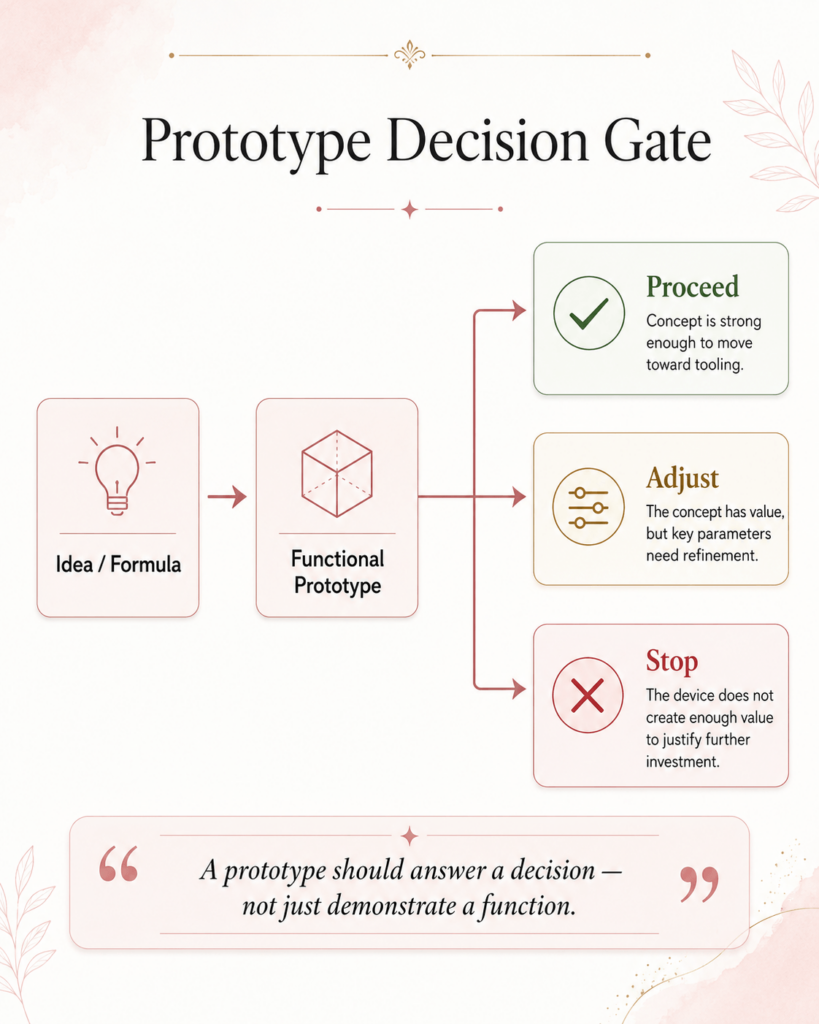
Proceed
The core concept works well enough to move toward tooling.
Adjust
The concept has value, but certain parameters or structures still need refinement.
This may involve:
reducing temperature
changing brush spacing
modifying handle length
changing the liquid outlet
simplifying the user routine
Stop
Testing shows that the device does not add enough value to justify further investment.
This may initially look like a negative result, but from a commercial perspective it can still be a successful prototype.
If the prototype prevents unnecessary spending on tooling, certification and inventory, it has already done an important job.
11. When Is a Beauty Device Ready for Tooling?
Before moving into tooling, we normally look at five areas.
1. Product Need
Is the consumer problem clear?
Does the device solve a real need rather than simply add another SKU?
2. Functional Result
Does the core function work well enough?
Can the intended result be achieved consistently during prototype testing?
3. Usage Routine
Can the product fit naturally into the intended daily or weekly routine?
4. Key Parameters
Are the main variables reasonably defined?
For example:
temperature
frequency
dimensions
brush structure
formula interaction
operating time
battery requirement
5. Business Logic
Does the product concept make commercial sense?
This may include:
target retail price
expected device cost
MOQ
target consumer
sales channel
positioning
expected market size
If too many of these points are still uncertain, additional validation is usually more useful than rushing into tooling.
12. How Much Customization Should Happen Before Tooling?
Full ODM is not always necessary at the beginning of a project.
If an existing platform already solves most of the core technical requirements, it may be more efficient to test the concept through a smaller number of focused changes first.
A typical route may look like this:
Existing Platform
↓
Brand-Fit Adjustment
temperature
brush geometry
surface
coating
CMF
controls
grip
formula compatibility
↓
Functional Prototype
↓
Consumer Validation
↓
Brand-Specific ODM
This allows the level of customization to increase together with confidence in the product.
A brand does not necessarily need a completely new exterior and structure just to find out whether consumers want the category.
Once the concept has been validated, deeper industrial design and structural development can become a more deliberate investment.
Learn more about our ODM development process and how Qumei moves from existing platforms toward deeper product customization.
13. From Prototype to Stable Mass Production
Prototype, tooling and quality management each answer a different question.
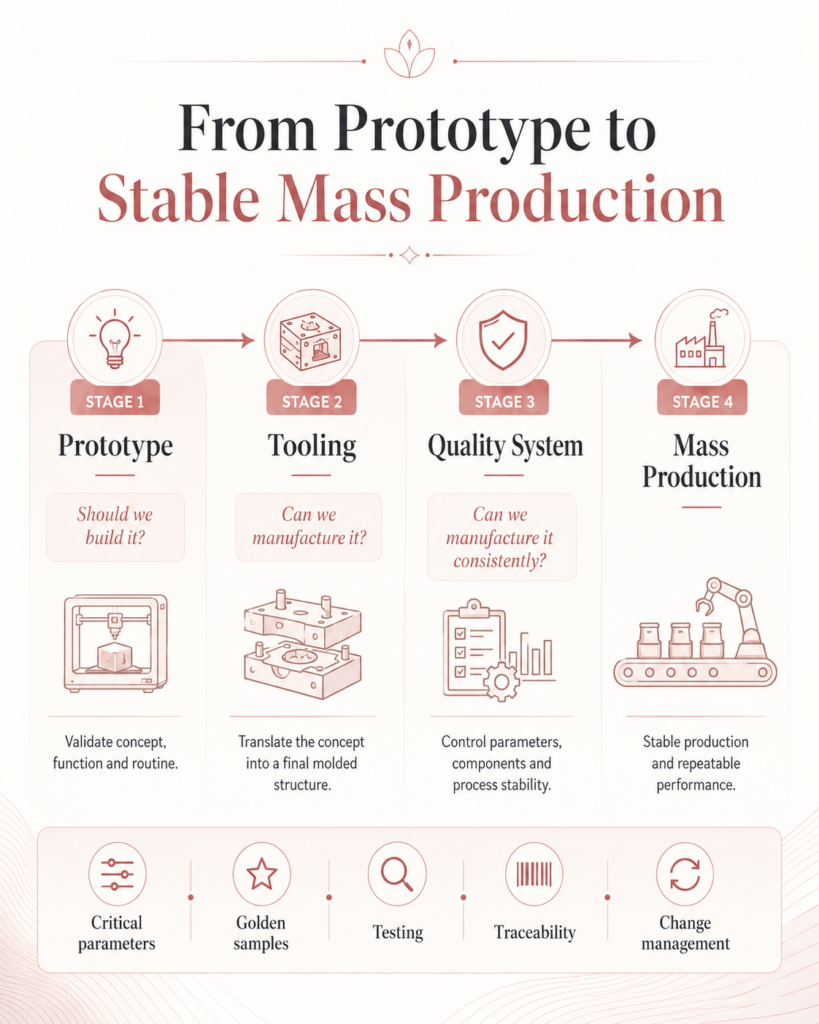
Prototype
Should we build it?
Does the concept make enough sense to continue?
Tooling
Can we manufacture it?
Can the defined product be translated into a final molded structure?
Quality System
Can we manufacture it consistently?
Can the same performance be maintained across repeated production batches?
These stages are related, but they are not interchangeable.
A successful prototype does not remove the need for engineering validation after tooling.
In the same way, a good tooling sample does not automatically guarantee stable mass production.
Long-term consistency depends on areas such as:
critical parameter control
component specifications
incoming inspection
assembly standards
testing
golden samples
traceability
change management
corrective-action systems
You can learn more about this in our Testing & Quality approach.
14. How Qumei Uses Functional Prototypes in ODM Development
At Qumei, a functional prototype is mainly used to make the next development decision clearer.
A typical project may move through the following stages:
Brand Idea or Existing Formula
↓
Product Definition
What consumer problem are we trying to solve?
↓
Existing Platform Assessment
Can an existing structure already answer part of the requirement?
↓
Functional Prototype
Build the minimum structure needed to test the key questions.
↓
Key Question Validation
Evaluate:
function
user routine
formula compatibility
ergonomics
consumer result
↓
Proceed / Adjust / Stop
↓
Tooling
Once the core direction is sufficiently clear.
↓
Testing and Engineering Validation
↓
Stable Mass Production
The aim is not to push every project into tooling as quickly as possible.
The aim is to reduce the chance of entering tooling with the wrong product definition.
A useful prototype should make the next investment decision easier to make.
FAQ
What is the difference between a functional prototype and a tooling sample?
A functional prototype is mainly used to test the product concept, function, structure and user experience before final tooling.
A tooling sample is produced after the mold is made and is much closer to the final commercial product.
Materials, tolerances and surface finish on a functional prototype may differ from final molded parts.
Can a functional prototype show the final product gap and tolerance?
Not completely.
Prototype parts are often produced using different manufacturing methods from injection-molded parts.
They can help identify major structural issues, but final housing gaps, fit, alignment and production tolerances should be confirmed with tooling samples.
Can waterproof performance be confirmed with a prototype?
A prototype can help evaluate the sealing concept.
Final waterproof performance normally needs to be confirmed with production-intent tooling samples and the final assembly structure.
For products with a defined IPX requirement, verification should be based on appropriate testing using near-production or production samples.
Should a beauty brand make a functional prototype before opening molds?
For products with meaningful technical or consumer uncertainty, a functional prototype can reduce development risk.
It can be particularly useful when a project involves:
new heating logic
new brush geometry
ultrasonic function
liquid delivery
formula compatibility
new usage routines
unfamiliar ergonomics
If an existing proven platform already meets almost all of the requirements, a completely new functional prototype may not always be necessary.
The appropriate validation level depends on the risk and uncertainty of the project.
How long does a functional prototype take?
Timing depends on the complexity of the device, component availability and how much new engineering is required.
A relatively simple platform adjustment can usually be evaluated faster than a completely new project involving electronics, liquid delivery, ultrasonic architecture or structural development.
The more useful question is not only how quickly the prototype can be made, but whether it has been designed to answer the right development questions.
What should be tested before investing in a new hair-device mold?
Typical areas include:
product architecture
core function
temperature or frequency
user routine
formula compatibility
ergonomics
pass efficiency
consumer result
key dimensions
basic business logic
The exact validation plan should depend on the device category and the main uncertainties of the project.
Conclusion
Beauty-device development does not always need to begin with a final mold.
For many new concepts, it is more useful to first identify what is still uncertain.
A functional prototype can help answer those questions before they become part of:
tooling
certification
MOQ
inventory
launch costs
The most useful prototype is not necessarily the one that looks closest to a finished commercial product.
It is the one that gives the brand enough information to make a better decision.
That decision may be to proceed.
It may be to adjust the concept.
Or it may be to stop.
All three outcomes can be valuable when they happen before larger investments are made.
At Qumei, functional prototypes are part of a broader ODM development process that connects product ideas, consumer routines, hair-care formulas and manufacturable device solutions.
Exploring a New Hair Device Concept?
If your brand is considering a new:
Hair Refresh Brush
Straightening Brush
Cordless Styling Device
Ultrasonic Treatment Device
Formula-Dispensing Device
Scalp Care Device
but is not yet ready to invest directly in full tooling, we can first discuss which parts of the concept should be validated.
Contact Qumei to discuss:
product concept
existing platform options
functional prototype
formula compatibility
key parameters
development risk
ODM customization
About the Author
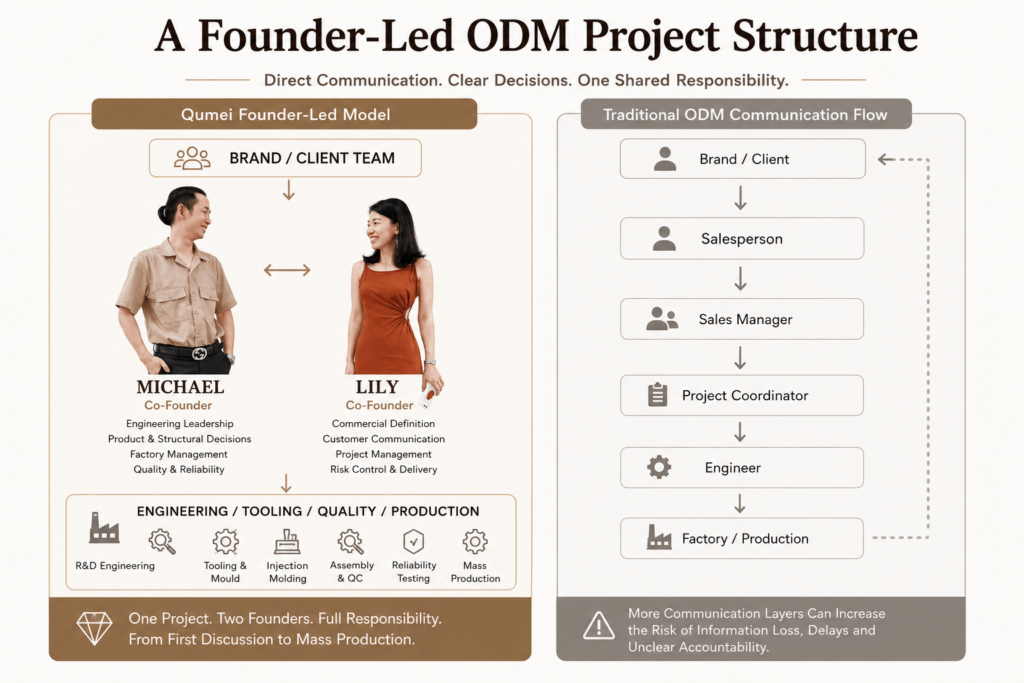
Lily | Shenzhen Qumei Technology Co., Ltd.
Lily works with beauty and hair-care brands on ODM product development, with long-term experience supporting projects for the Japanese market. Her work focuses on connecting consumer routines, hair-care formulas and manufacturable device solutions.
Technical Review:
Michael | Product Development, Qumei