
Precision Mini Hair Styling Tools: Designing for Bangs, Face-Framing Hair and Ends
Quick answer
A precision mini hair styler should be defined by the hair sections it needs to reach, not by a target length alone. Bangs, face-framing hair and ends create different requirements for head width, active heating area, protective spacing, grip orientation and control. Shrinking a full-size tool proportionally can make it easier to carry without making it easier to use.
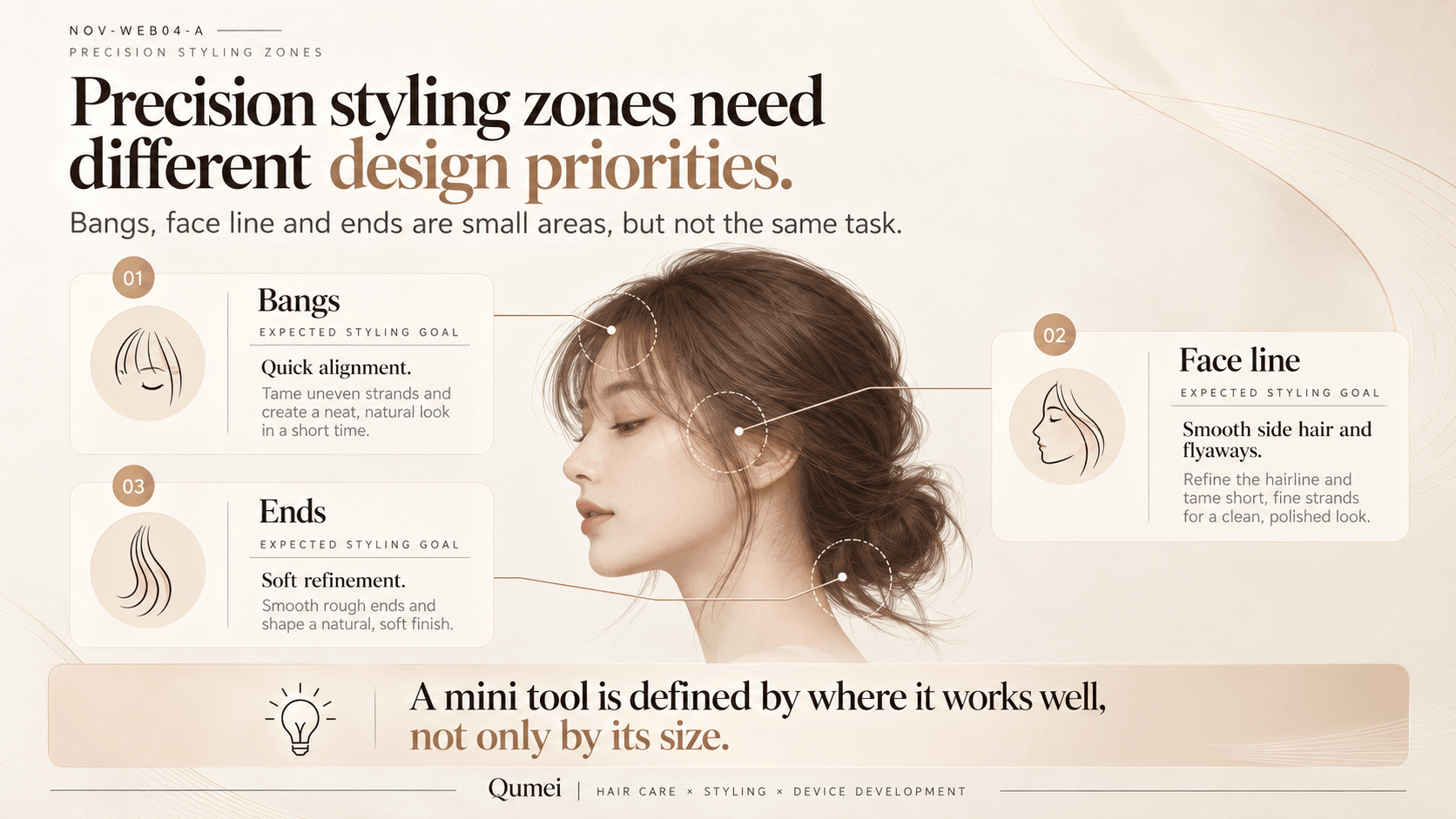
For a beauty brand, the first development question is: which small styling task should feel noticeably easier? Once that is clear, the engineering team can make better decisions about geometry, power, safety and cost.
1. Three small tasks, three different access problems
Bangs: The user may need to correct a narrow section close to the forehead. The tool must offer controlled contact and an appropriate separation between the active heater and the skin.
Face-framing hair: The user often approaches from an angle, changes wrist position and works around the ear. A bulky head or poorly positioned controls can make the task awkward even when the tool is short.
Ends: The user may want a slight inward or outward shape rather than a perfectly straight result. Plate or brush contact length, edge geometry and the ability to rotate the wrist can matter more than headline maximum temperature.
These tasks should be observed separately. A device that performs one well may not automatically be the best choice for all three.
2. “Mini” should describe a job, not only a measurement
Overall length is useful for packaging and portability, but it does not describe working precision. Consider four dimensions instead:
- Head width: how much hair the active region engages in one pass.
- Tip-to-active-area distance: how closely the tool can approach the intended section while preserving safe spacing.
- Handle-to-head relationship: whether the user can see and guide the contact area.
- Storage envelope: how the product fits into a pouch, drawer or travel case when closed and protected.
The best dimensions depend on the target user and hair length. A concept should not be called “more precise” until it has been compared in realistic tasks.
3. Miniaturization creates engineering trade-offs
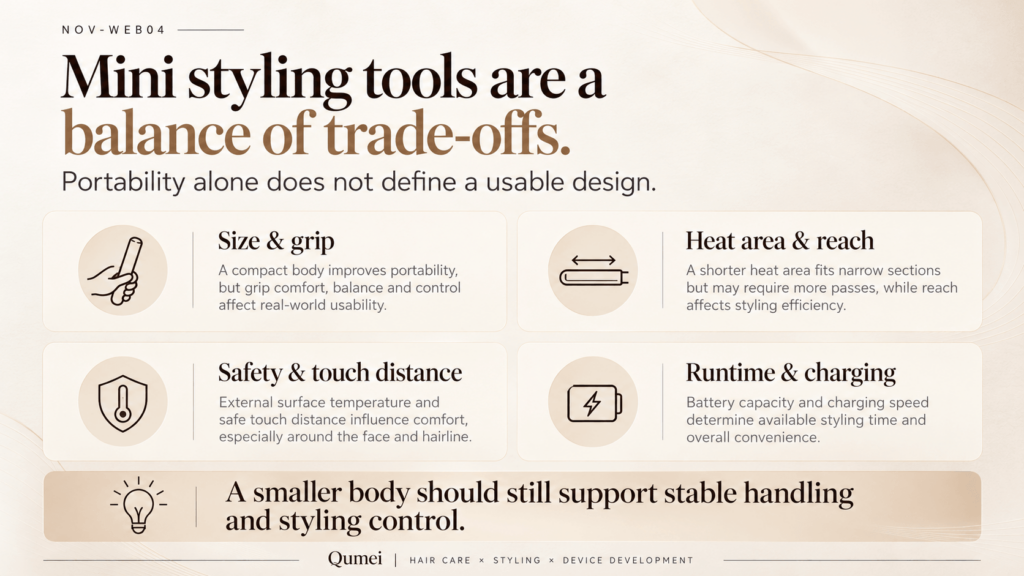
A smaller enclosure leaves less room for the heater, sensor, thermal insulation, battery, PCB, charging structure and mechanical reinforcement. These components still need safe operating conditions.
For cordless devices, battery energy and heater power are a particularly important trade-off. A small battery may reduce weight but also limit usable styling time or require a different heating strategy. A shorter head may improve access but reduce the amount of hair treated per pass.
The result can be a more convenient tool for touch-ups and a less efficient tool for full-head styling. That is not necessarily a defect: it may simply be a different product job.
The ODM brief should state whether the product is intended for partial touch-ups or complete styling. Trying to promise both without enough power, surface area or runtime can weaken the concept.
4. Temperature is one variable in a styling task
A temperature label does not tell a brand how a mini device will perform on hair. The result also depends on contact, pass speed, pass count and the hair’s starting condition. Academic work on thermal flat ironing has examined these interacting variables; see Purdue’s study (https://docs.lib.purdue.edu/open_access_dissertations/1736/).
A useful evaluation should define a realistic touch-up routine and record the number of passes needed to achieve an agreed result. It should also document temperature stability, user handling and any relevant thermal safety conditions. Avoid assuming that the lowest available setting always creates the lowest overall exposure if it requires repeated passes.
Claims about lower damage, fewer passes or improved hair health require their own comparative testing. A concept sketch cannot establish them.
5. A task-based prototype plan
Before tooling, create a simple comparison protocol:
Task | What to observe | Possible design response |
Narrow bangs | Access, control, unwanted contact, pass count | Head width, protective geometry |
Side sections | Wrist angle, visibility, comfort | Grip orientation, button position |
Ends | Ease of creating a small curve, repeatability | Contact length, edge profile |
Storage | Closed size, accidental activation, hot-surface protection | Lock, cover, shut-off logic |
Repeated use | Temperature behavior, runtime, handling fatigue | Heater, battery and control architecture |
Use matched hair tresses and a consistent method wherever possible. For user-handling checks, record more than a single person’s preference. A structured comparison helps identify whether the new geometry solves the intended problem.
6. Protect the user without making the head bulky
A precision device works close to the face, ear or neck. That makes protective spacing, cool-touch zones, controls and storage design central to the product brief. A very narrow head is not automatically better if it reduces protection or makes hair capture inconsistent.
Potential features such as a protective cap or travel lock must be designed around the actual hot-surface and electrical architecture. They should be verified for the defined use case rather than added as decorative specifications.
7. Where does a hair-care brand fit?
A brand with established hair mist, milk or treatment products may be interested in a small daily touch-up device as a category extension. The opportunity is the routine: a convenient tool for a specific styling moment.
However, a standard high-temperature styling tool should not be presented as directly compatible with an untested formula. If a brand wants a formula-connected or low-temperature care device, that is a separate R&D question requiring appropriate material, thermal, safety and efficacy work. Qumei’s existing Hair Refresh framework (https://www.szqumei.com/hair-refresh-device-development-for-hair-care-brands-qumei/) discusses the broader routine opportunity; this article focuses on precision-tool geometry and verification.
8. Existing platform or new tooling?
An existing platform can be a useful reference for testing hand position, temperature control and basic styling behavior. It may also offer a faster route to an initial concept. But a genuinely different head width, internal layout or protective structure may require deeper design changes and new tooling.
The decision should follow a functional prototype or task-based evaluation. Qumei’s prototype-before-tooling guide (https://www.szqumei.com/functional-prototype-before-tooling-for-hair-device-odm-qumei/) explains why a working concept and a production-ready design are different milestones.
Qumei’s development perspective
Qumei’s existing straightening-brush platforms provide practical reference points for exploring a more precise touch-up category. We see a potential development direction around bangs, side sections and ends, but a new precision mini is not being presented here as a validated mass-production model.
The most productive first step is to define three real styling tasks and compare them against the current tool. If a smaller head does not improve the target task, making the body shorter is not enough.
FAQ
Is a mini hair styler simply a shorter straightener?
No. Precision use depends on head width, access, grip, protective spacing and the intended task.
Is cordless always better for a mini tool?
Not necessarily. Cordless operation adds battery and charging constraints; the right choice depends on use duration and portability needs.
Does a lower setting guarantee less hair damage?
No. Pass count, contact, time and hair condition also affect exposure. Claims require appropriate testing.
Can a mini styling tool be used with hair milk or mist?
Not without validating the specific formula, temperature, residue, exposure and intended routine.
What should a prototype prove before new tooling?
That the intended task is easier or more repeatable, with acceptable safety, handling, thermal behavior and commercial trade-offs.
Sources / editorial evidence
S14 Qumei Hair Refresh framework (2026-08-12) — https://www.szqumei.com/hair-refresh-device-development-for-hair-care-brands-qumei/
S10 Hahn, Purdue thermal flat ironing study (2018) — https://docs.lib.purdue.edu/open_access_dissertations/1736/
S21 Heat transfer in human hair (2019) — https://onlinelibrary.wiley.com/doi/10.1111/ics.12553
S02 Panasonic EH-NB70 press release (2026-09-29) — https://news.panasonic.com/jp/press/jn260929-2