
Cleaning and Sealing in Ultrasonic Hair Treatment Devices: A Design-for-Use Checklist
Quick answer
An ultrasonic hair treatment device used with masks or treatments should be designed around the complete routine: application, contact, operation, wiping, drying, storage and charging. Water ingress protection is important, but it is only one part of that experience. A device may resist a defined water test and still be inconvenient to clean or vulnerable to residue in poorly accessible areas.
For an ODM project, cleaning access, liquid-contact materials, sealing architecture and charging design should be considered together before tooling. This article focuses on usability and engineering risk, not on claims that ultrasound increases ingredient penetration.
1. Start with the actual treatment routine
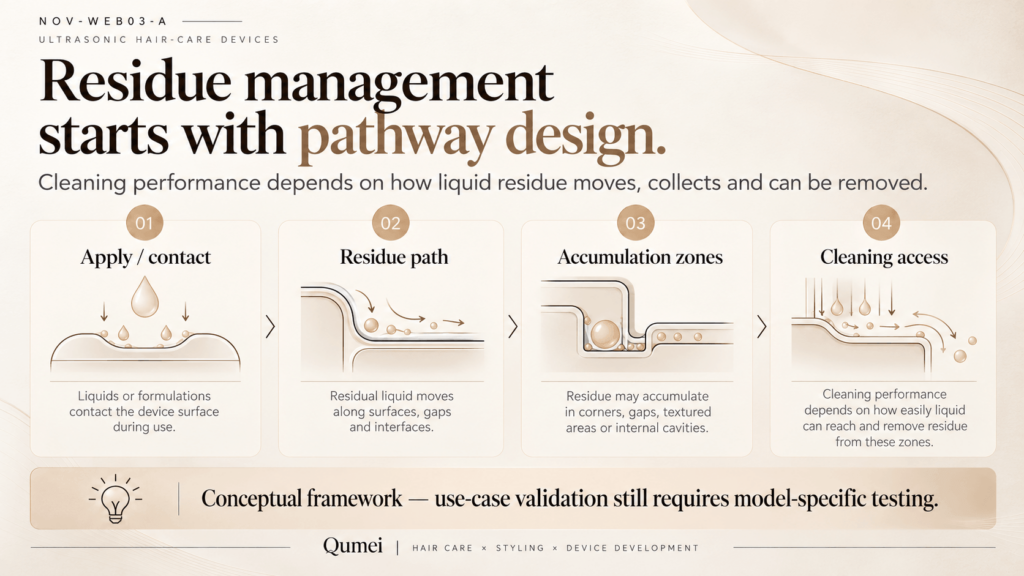
A typical home-use scenario may involve applying a treatment to hair, passing the device over the treated sections, then wiping or cleaning the contact surfaces after use. The formulation may be thick, oily, water-based or rich in conditioning polymers. Each category can leave a different residue pattern.
A product brief should state the permitted formula types, amount applied, wetness of the hair, operating duration, cleaning method and storage environment. Without this information, it is difficult to judge whether the device has an appropriate gap, hinge or surface geometry.
The most useful early observation is often simple: where does the treatment go after it touches the product?
2. Map every liquid-contact zone
A practical design review can divide the device into four zones.
Zone A: intended contact surfaces. These are the plates or surfaces that intentionally touch treated hair. They should be accessible for the specified cleaning method and compatible with the approved formulation range.
Zone B: adjacent crevices. Hinges, plate edges, seams and decorative grooves may collect residue even if they are not intended as contact surfaces. Their geometry affects cleaning time and long-term appearance.
Zone C: enclosure boundaries. Gaskets, joints, button membranes and fasteners form potential ingress paths. Their performance depends on assembly tolerances and material condition, not just the gasket drawing.
Zone D: charging and storage. A direct charging port and a charging stand create different interfaces. Either can be appropriate when the architecture, permitted use and protection strategy are defined.
A visual zone map can help engineering, quality and marketing teams discuss the same physical risks without exposing confidential internal drawings.
3. Waterproof ratings answer a narrower question
The IEC 60529 (https://webstore.iec.ch/en/publication/2452) IP Code classifies protection provided by enclosures under defined conditions. It does not establish that a device is hygienic, easy to wipe, compatible with every treatment or suitable for immersion during cleaning.
IPX6 addresses powerful water jets; IPX7 addresses temporary immersion. These are different test conditions. An IPX7 result should not be treated as automatic evidence of IPX6 performance without the appropriate assessment. DEKRA’s testing explanation (https://www.dekra.us/en/digital-product-solutions/ingress-protection-testing/) highlights this distinction.
The intended product claim must match the actual test report, model, configuration and use conditions. “Waterproof” without a defined scope is a risky consumer message.
4. A cleanable surface is not the same as a sealed surface
Sealing keeps water away from protected internal areas under specified conditions. Cleanability concerns whether the user can remove residue without damaging the product or spending unreasonable effort.
These goals can conflict. For example, a tight seam may help keep the enclosure closed but create a narrow residue trap. A decorative recess may look premium in a rendering but be difficult to wipe. A charging-port cover may provide a barrier while also adding a daily handling step.
The design review should therefore include physical wipe tests on near-realistic samples, not just CAD inspection. Observe residue at edges, cleaning access with the supplied instructions, drying behavior and visible changes after repeated cleaning.
5. Define formula compatibility by actual materials
Compatibility is not a single yes/no label. It involves the materials that contact the formulation: plate surface, housing, seal, adhesive, coating and any exposed components.
A useful screening program identifies representative formulas or ingredient families, exposure duration, temperature, cleaning procedure and acceptance criteria. Possible observations include discoloration, swelling, surface changes, residue, odor and functional changes. Final compatibility must be based on the specific product and formula, not a generic statement about all hair masks.
This is especially important when a brand wants to build a treatment-plus-device program. For the broader business and technical choices, see Qumei’s existing Formula × Device development guide (https://www.szqumei.com/formula-x-device-hair-care-4-development-paths-qumei/). The present article focuses specifically on post-use maintenance and design interfaces.
6. Charging architecture deserves its own decision
A device with a direct USB-C port may be convenient for some users. A charging stand may simplify the routine in other cases and allow the device body to avoid an exposed direct-charge opening. Neither option is universally superior or automatically waterproof.
Questions to review include where wet hands may touch the device, whether the product must be dry before charging, how contacts are protected, how the device is stored between uses and what the instructions must say. The final answer depends on the sealing strategy, electrical design and target-market requirements.
The charging method should be explained accurately in product literature. If a model charges only through its base, do not describe it as direct USB-C charging simply because the base uses a USB-C cable.
7. A practical verification plan
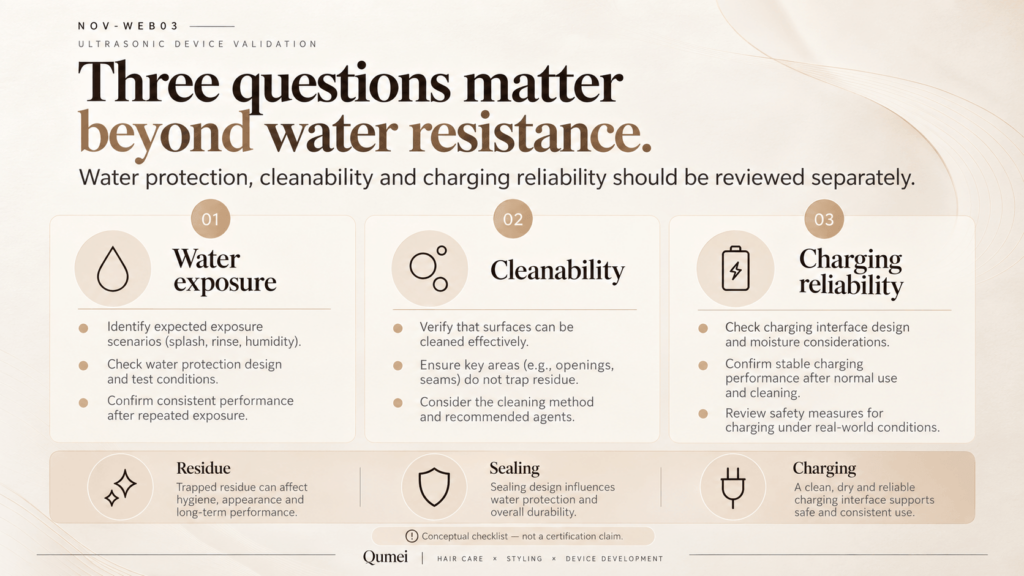
A useful validation plan separates three questions that are often mixed together:
Question | Example checks | What the result does not prove |
Does liquid enter protected areas? | Defined IP test, seal checks, post-test inspection | Ease of cleaning or formula compatibility |
Can users clean it as instructed? | Residue removal, access, repeated wiping, visual inspection | Sterilization or antimicrobial action |
Does the device remain functional over time? | Repeated operation, charging interface, hinge and seal aging | Universal performance with every formula |
For an early functional prototype, some tests can screen design assumptions. Final water-ingress and durability claims require the appropriate production-intent configuration and documented test conditions. Qumei discusses this stage distinction in its functional prototype guide (https://www.szqumei.com/functional-prototype-before-tooling-for-hair-device-odm-qumei/).
8. Home-use and professional routines may need different answers
Home users may prioritize simple cleaning, intuitive storage and a low-maintenance routine. Professional operators may use the device more frequently, with different formulations and more repeated cleaning cycles. The intended context can change the choice of materials, hinge structure, cleaning instructions and maintenance schedule.
This does not mean that one market requires a universally higher IP rating. It means the engineering brief should reflect actual exposure and frequency.
Qumei’s development perspective
Qumei has experience developing ultrasonic hair-care platforms for home and professional applications. In customized projects, we treat ultrasonic function, treatment-contact structure, sealing, cleaning and charging as related but separately verifiable requirements.
A successful treatment-device concept should be evaluated from the moment the user opens it until the moment it is cleaned and stored. That complete routine is where many small design decisions become visible.
FAQ
Does an IPX7 rating automatically include IPX6?
No. Temporary immersion and powerful water jets are different conditions; the intended claim needs the appropriate evidence.
Can an ultrasonic treatment device be rinsed under a tap?
Only if the model’s instructions and verified protection allow that cleaning method. An unspecified “waterproof” claim is insufficient.
Does waterproofing mean the device is hygienic?
No. Ingress protection is different from residue removal, cleaning efficacy or antimicrobial performance.
Should cleaning be tested before tooling?
Early prototypes can reveal inaccessible areas and residue traps; final durability and ingress performance require production-intent verification.
Is a charging stand always more waterproof than USB-C direct charging?
No. Both architectures depend on their actual sealing, electrical and use design.
Sources / editorial evidence
S07 IEC 60529 IP Code (2013 consolidated) — https://webstore.iec.ch/en/publication/2452
S13 Qumei ultrasonic device development guide (2026-07-31) — https://www.szqumei.com/ultrasonic-hair-care-device-development-guide/
S18 DEKRA ingress protection testing (Current) — https://www.dekra.us/en/digital-product-solutions/ingress-protection-testing/
S16 Qumei Testing & Quality page (Current) —