
Detachable vs Built-In Batteries in Cordless Hair Tools: An ODM Design Guide
Quick answer
A detachable battery is an architecture decision, not simply a portable-styling feature. It changes how the battery is retained, how power reaches the heater, who may access the pack, how the device is serviced and which tests are needed. A built-in battery can simplify the user interface and sealing strategy, but may complicate repair or replacement. Neither architecture is automatically safer, longer-lasting or more suitable for international travel.
For a beauty brand, the right choice depends on the intended use, target market, service model and total product design—not the battery label alone.
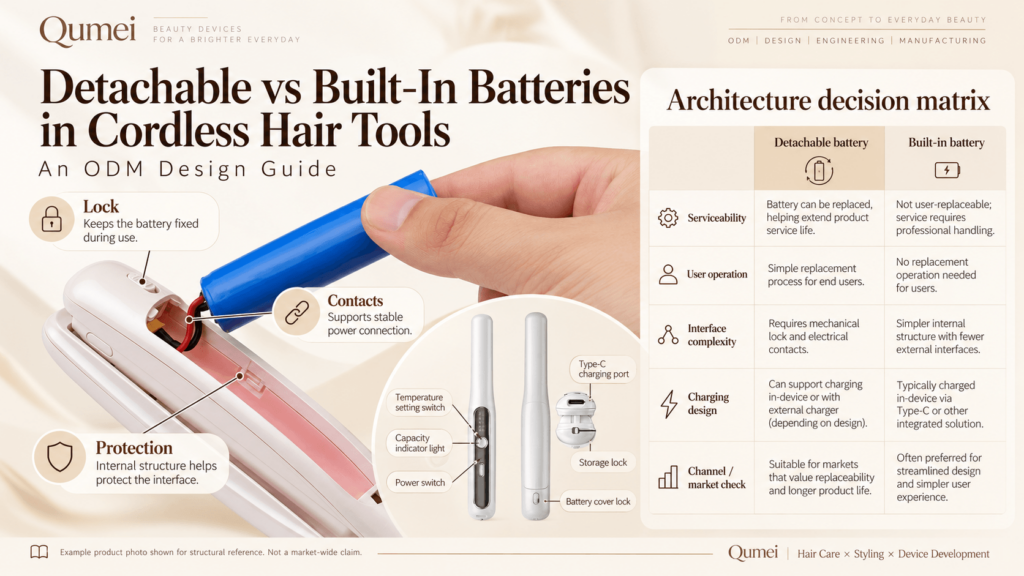
1. Begin with the person who will remove the battery
The term “detachable” can mean three different things. In one design, an end user is expected to remove a battery during ordinary use. In another, a trained service technician can access a pack for repair. In a third, the battery is only separated during factory assembly or end-of-life processing. These are not interchangeable propositions.
If a brand wants a consumer-replaceable battery, the product needs a deliberate interface: a clear removal action, protected terminals, reliable polarity management, a secure lock and instructions that explain the permitted replacement pack. A service-only pack may be engineered around a different opening method and controlled replacement procedure. A factory-removable pack should not be marketed as a consumer convenience.
This distinction should be made before industrial design is frozen. Otherwise a product can look removable without having a safe, practical user replacement process.
2. Compare the two architectures across the complete device
A built-in pack can reduce the number of exposed user interfaces. It may help a team simplify enclosure continuity, control accidental access and maintain a compact visual design. However, the pack still needs appropriate electrical protection, thermal management and a defined end-of-life route.
A detachable pack adds a physical connection. Engineers must consider contact resistance, contact wear, retention force, impact behavior, alignment tolerance and the possibility of partial insertion. Repeated removal also introduces a use cycle that a permanently installed pack may not face.
A useful early comparison is:
Design question | Built-in battery | Detachable battery |
User access | Usually limited | Must be explicitly defined |
Electrical interface | Internal connections | Additional mating contacts or connector |
Housing/sealing | Potentially simpler exterior | Lock, opening and sealing may be more complex |
Replacement/service | May require disassembly | Can be easier if designed for safe replacement |
Incorrect assembly | Mostly factory controlled | May include user insertion and wear scenarios |
Market and transport review | Required | Required; removal does not grant automatic approval |
These are design tendencies, not universal outcomes. Actual performance depends on the final structure and verification results.
3. Heating performance still depends on battery behavior
Cordless hair tools are unusual because the heating load can be substantial relative to the available battery energy. A battery’s nominal capacity does not tell the whole runtime story. Voltage under load, usable energy, protection thresholds, heater duty cycle, set temperature, ambient conditions and aging all affect operation.
A detachable pack may introduce additional resistance at the mating interface. The significance depends on the contact design and current profile. The team should evaluate heat generation at the contacts, voltage drop during demanding operating modes and stability after repeated insertion cycles.
The pack and heater must be considered together. For a broader explanation of integrated testing, see Qumei’s existing article on system-level validation for cordless hair styling devices (https://www.szqumei.com/system-level-validation-for-cordless-hair-styling-devices-beyond-battery-and-pcb-testing/).
4. Build safety around realistic misuse, not ideal handling
A development plan should consider foreseeable mistakes. Can the user insert the pack at an angle? Can the device start heating while the pack is incompletely locked? Are metal contacts accessible to fingers or loose items? What happens after a drop? Can an incompatible pack fit mechanically?
The answers depend on the design, but the questions belong in the risk review. Protection can involve mechanical keying, terminal layout, interlocks, electrical control logic, labeling and service instructions. A visual lock icon is not proof that the interface has been validated.
For portable lithium cells and batteries, IEC 62133-2 (https://webstore.iec.ch/en/publication/70017) is one relevant safety framework. Applicable appliance and market requirements must be assessed separately. Compliance cannot be inferred from the use of a particular cell format.
5. Do not confuse detachable with travel-approved
Travel claims require particular care. Battery transport rules depend on watt-hours, installation status, spare-battery treatment, airline rules and destination requirements. IATA’s 2026 passenger lithium battery guidance (https://www.iata.org/contentassets/6fea26dd84d24b26a7a1fd5788561d6e/passengers_travelling_with_lithium_batteries.pdf) provides a useful starting point, but it is not a universal product approval.
Retail-platform rules can impose additional restrictions that are different from airline rules. A product may meet one set of requirements and still face a channel-specific listing limitation. For a Japanese-market cordless iron, the brand should confirm the current marketplace policy for the exact battery configuration before committing to tooling or stock.
Avoid marketing statements such as “airline safe,” “global compliant” or “EU-ready” until the claim is supported by the applicable documentation and the intended use conditions.
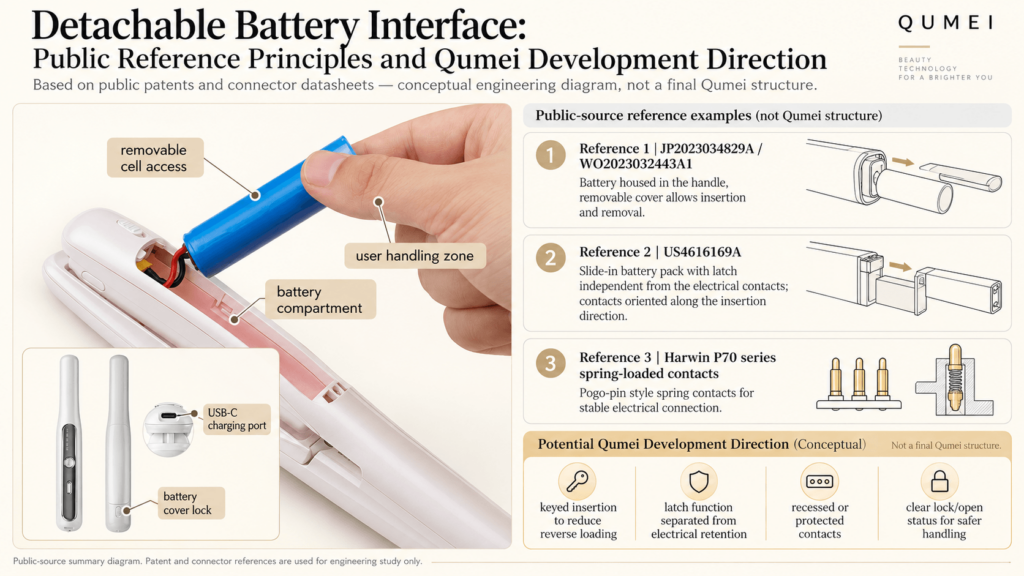
6. A practical ODM verification matrix
Rather than beginning with a long generic test list, connect each test to a design risk.
Risk | Example verification question |
Incomplete engagement | Does the device operate safely when the pack is partially inserted? |
Contact wear | Does electrical performance remain stable after the defined insertion cycles? |
Thermal interaction | Do the battery, contacts and adjacent structures remain within defined limits under permitted modes? |
Mechanical retention | Does the pack remain secured after defined handling and drop scenarios? |
Low battery | Does control behavior remain predictable near protection thresholds? |
Serviceability | Can the intended user replace the pack without damaging the device or exposing hazards? |
Documentation | Do instructions, labeling and pack identification match the actual design? |
The test conditions, sample size and acceptance criteria must be agreed for the specific project. A functional prototype can screen architectural assumptions, but production-intent samples are needed for final reliability and compliance assessment.
7. When is each choice commercially sensible?
A detachable battery may be worth exploring when a brand values a defined service model, replaceable energy module or product differentiation through maintenance. A built-in pack may fit a compact, sealed or simplified daily-use device better. Neither is inherently premium.
The strongest development brief states who uses the product, who services it, where it is sold, how long it should operate, what temperature profile is needed and which claims the brand intends to make. From that brief, the ODM team can compare architectures with real trade-offs.
Qumei’s development perspective
Qumei works with cordless styling platforms that include detachable-battery structures. For new projects, we recommend treating the battery interface, heater, electronics, enclosure and target-market requirements as one design system. The goal is not to add a removable feature for its own sake; it is to make the chosen architecture credible and repeatable in production.
A useful first discussion is simple: who needs to remove the battery, and why? The answer will shape almost every subsequent engineering decision.
FAQ
Is a detachable battery automatically safer?
No. Safety depends on the complete pack, contacts, mechanical interface, control design and applicable testing.
Does a removable pack always extend product life?
Not necessarily. It can support serviceability only when suitable replacement packs, instructions and a practical support process exist.
Can a detachable-battery hair straightener always go on a plane?
No. Airline, battery, baggage and destination requirements must be checked for the specific configuration.
Can a functional prototype validate battery replacement durability?
It can identify early problems, but final durability needs production-intent samples, defined cycles and acceptance criteria.
Is a higher mAh rating enough to predict styling runtime?
No. Usable energy, voltage under load, heater duty cycle, protection behavior and operating conditions all matter.
Sources / editorial evidence
S08 IEC 62133-2 lithium battery safety (2017 + 2021 amendment) — https://webstore.iec.ch/en/publication/70017
S09 IATA passenger lithium battery guidance (2026) — https://www.iata.org/contentassets/6fea26dd84d24b26a7a1fd5788561d6e/passengers_travelling_with_lithium_batteries.pdf
S11 Qumei system-level cordless validation (2026-10-15) — https://www.szqumei.com/system-level-validation-for-cordless-hair-styling-devices-beyond-battery-and-pcb-testing/
S22 Qumei factory and ODM homepage (Current) — https://www.szqumei.com/