
Formula × Device Hair Care: How Brands Can Choose the Right Development Path
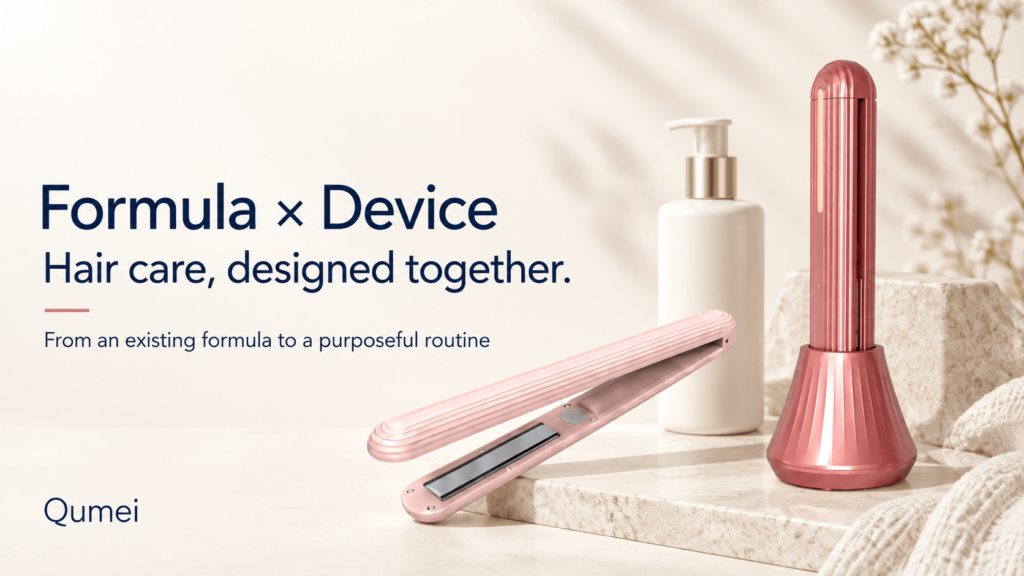
A hair-care brand with an established serum, milk or treatment already has a starting point for device development: a formula consumers know and a routine the brand understands. The next question is what a tool could add—easier application, more controlled distribution, styling support or a more convenient treatment experience.
Formula × Device hair care means designing a formula and a physical tool to perform complementary roles within one routine. It can involve a manual brush, a powered tool used after application, an integrated applicator, or a device that dispenses the formula itself.
The appropriate route depends on the intended result, how the formula is applied, and what the brand can demonstrate through testing. A reservoir or a new electronic function is only useful when it improves that routine.
Four development paths at a glance
At Qumei, we use the following framework to discuss product concepts. These are working development categories, not an industry standard or a ranking of product quality. Hybrid designs are possible.
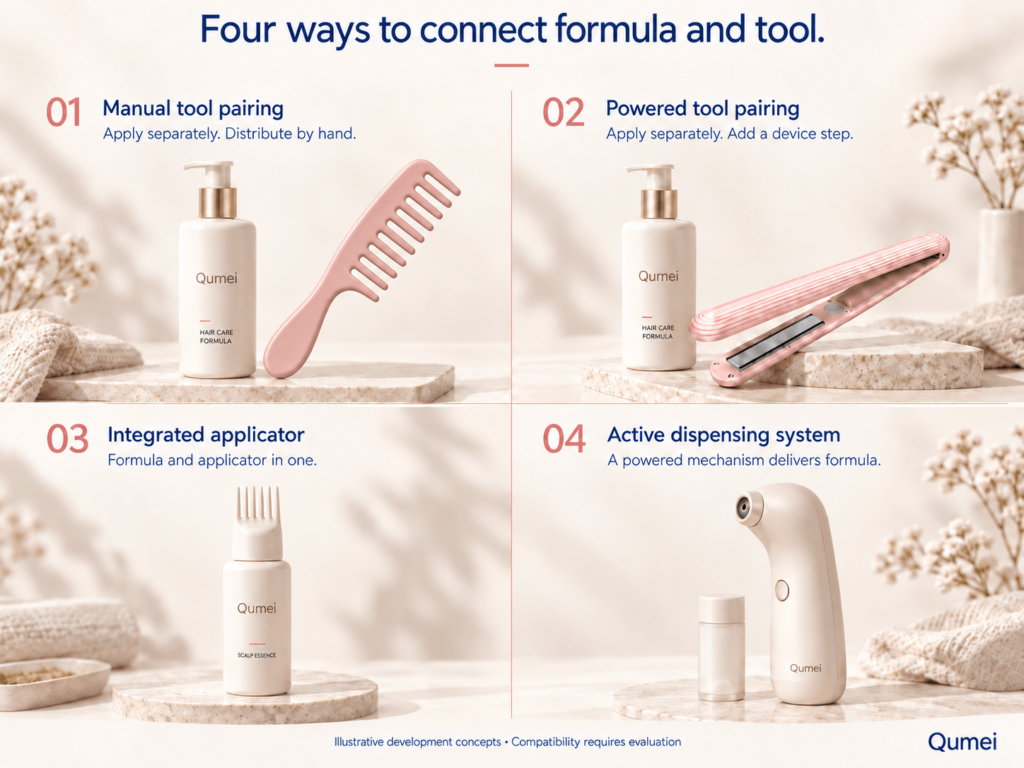
| Development path | How formula and tool interact | Example concept | Main question to validate |
|---|---|---|---|
| 1. Manual tool pairing | The formula is applied separately; a non-powered tool supports the routine | Treatment + distribution comb | Does the tool improve application or ease of use? |
| 2. Powered tool pairing | The formula is applied separately; a powered tool adds a defined action | Compatible hair milk + temperature-controlled styling brush | Does the combined routine improve the intended result? |
| 3. Integrated applicator | The formula passes through an attached applicator, without powered delivery | Scalp essence bottle with a dispensing comb | Is application more precise, consistent and convenient? |
| 4. Active dispensing system | A powered mechanism dispenses or atomizes the formula | Dedicated serum + mist-dispensing device | Can the formula, liquid path and mechanism work reliably together? |
Selling two products in a set is a commercial choice that can apply to any of these paths. It does not, by itself, define the engineering relationship between them.
Path 1: Manual tool pairing
A manual comb or brush can support an existing formula without introducing charging or electronic controls. A treatment comb, for example, may help users work through sections of hair during application.
This route is worth exploring when the missing action is physical: reaching the scalp, separating hair or distributing a product. Tooth geometry, grip, comfort and cleaning still need attention.
The first comparison is straightforward: does using the tool improve the routine compared with applying the same formula by hand? Packaging the products together is not evidence of an additional benefit.
Path 2: Powered tool pairing
Here, the user applies the formula first, then uses a powered device. The formula does not pass through an internal reservoir, although it may contact the device surface.
For a brand with a leave-in milk suitable for use before heat styling, one concept could be a compact brush for morning touch-ups. The formula and tool would each retain a clear role: the milk provides its substantiated conditioning benefits, while the brush helps arrange the hair.
Another development concept is a treatment paired with an ultrasonic hair-care device. The benefit of that specific combination would need to be established; “ultrasonic” alone does not demonstrate better treatment performance.
Key questions include the formula’s intended use, hair moisture at the time of use, contact time, operating conditions and residue on the tool. A lower temperature setting does not automatically establish lower damage or compatibility with every formula.
This path can avoid an internal liquid system while still requiring meaningful compatibility and performance work.
Path 3: Integrated applicator
In this path, the container becomes part of the tool. A scalp essence bottle with a dispensing comb could help users part the hair and place the formula closer to the intended application area.
The development focus is the relationship between formula flow and applicator geometry: outlet size, squeezing force, dose, contact comfort and leakage in storage. Repeated contact with hair or scalp also makes applicator hygiene part of the design brief.
It may be a suitable route when application is the main difficulty and powered functions add little value. Packaging and formula partners should be involved early.
Path 4: Active dispensing system
This path introduces a powered mechanism that moves or atomizes the formula. Liquid storage, output control and maintenance become part of the product architecture.
An illustrative market example is ReFa TREATMENT IRON and its dedicated TREATMENT SERUM. ReFa describes ultrasonic conversion of the serum into a fine mist, combined with a pin structure and heat sensing. This is the brand’s published description of its own system; it does not establish equivalent performance for other devices or formulas. Source: ReFa product information.
For a new project, useful questions include whether output remains consistent, whether residues affect repeated operation, and how easily consumers can refill and clean the system. Compatibility with one serum should not be generalized to an entire product category.
Which path fits an existing hair-care line?
The following are starting hypotheses for development discussions, rather than finished product recommendations.
| Brand starting point | Potential consumer job | Route to explore | First decision |
|---|---|---|---|
| Leave-in milk intended for pre-styling use | Tidy fringe, face-framing hair or ends during a morning routine | Powered tool pairing | Can the formula and tool be used together under clearly defined conditions? |
| Rinse-off treatment or mask | Make treatment distribution easier | Manual pairing; powered pairing if there is a specific testable benefit | Does the additional step improve the result enough to justify it? |
| Scalp essence | Apply product to the intended area with less handling | Integrated applicator | Can it deliver a repeatable dose comfortably? |
| A new formula developed for a dispensing device | Combine application and grooming | Active dispensing system | Can formulation and device teams develop and test the system together? |
An existing formula does not necessarily need to be reformulated. That decision follows from the proposed action and compatibility results. A separate application routine may preserve more flexibility; an internal liquid path may impose tighter requirements.
How to test whether the combination adds value
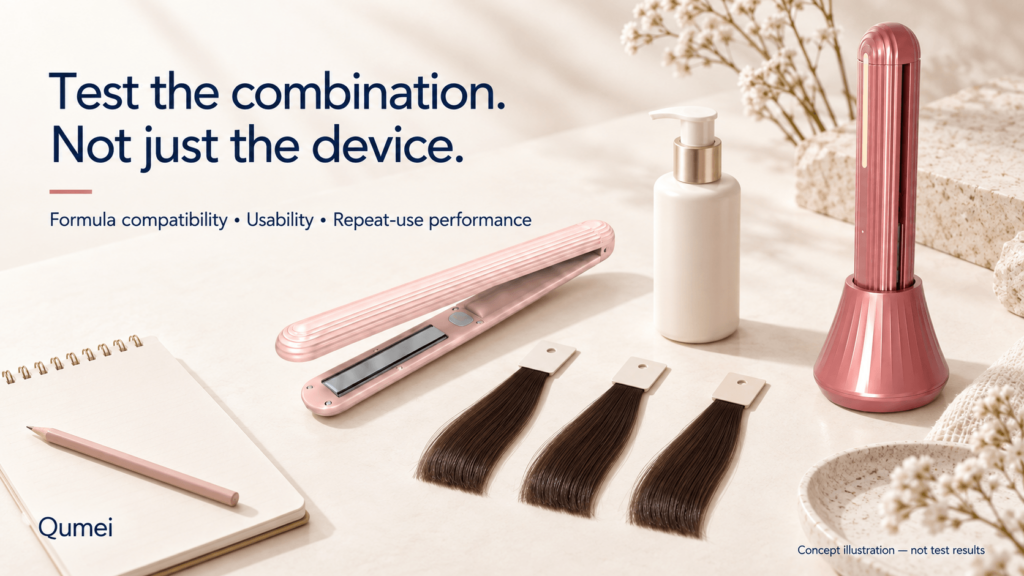
A prototype becomes more useful when it answers a comparison question. For an initial controlled evaluation, a brand could consider four conditions:
| Condition | What it helps investigate |
|---|---|
| Baseline routine, without the candidate formula or device | The starting result |
| Formula only | What the formula contributes under the test conditions |
| Device only | What the device contributes under the test conditions |
| Formula + device | Whether the combined routine adds a meaningful benefit |
Only include conditions compatible with the product’s intended operation. A device requiring a dedicated liquid should not be run dry merely to complete this matrix; the test design needs an appropriate control.
For a styling comparison, record hair type and condition, formula dose, initial moisture, temperature, contact time, brushing speed, pass count and ambient conditions. Select outcomes that match the project: combing force, visible alignment, residue, total routine time or user-rated ease of use.
Replicated hair-tress testing can help compare performance under controlled conditions. User evaluation can reveal handling and maintenance problems. Neither should be presented as proof of an unrelated claim.
If the combined routine performs well, the next question is whether the improvement justifies the extra time, price and maintenance for the intended consumer.
What should be checked before tooling?
Early feasibility work should use the intended formula whenever possible. Water can help check basic liquid movement, but it cannot establish compatibility with a finished serum or treatment.
The scope depends on the architecture:
| Area | Early development question |
|---|---|
| Formula and materials | What happens to plastics, seals, coatings and contact surfaces after exposure? |
| Heat and contact | Does the proposed routine create unwanted residue, odor or inconsistent performance? |
| Dispensing, where applicable | Does dose or output change with orientation, fill level or repeated use? |
| Cleaning and storage | Can users remove residue and store the product as intended? |
| User handling | Are preparation, grip, contact and maintenance practical? |
| Production feasibility | Can the proposed structure be assembled and inspected consistently? |
These checks guide a tooling decision. Full durability, safety and production validation continue with representative materials, production tooling and pilot units.
A visible mist, a working heater or an operating ultrasonic component confirms a function. Claims such as “better penetration,” “repair” or “less damage” require evidence designed around those specific outcomes. The brand and its relevant testing specialists should agree on the intended claim and comparison before finalizing the evaluation plan.
Plan the daily routine and the business model together
A device can create an additional product category or support sales of a compatible formula. Repeat purchasing, however, depends on continued use and perceived value.
Before choosing a dedicated refill system, consider the amount used per session, refill price, availability and cleaning burden. For a paired tool, consider whether consumers understand when to use it and what result to expect.
A useful early user trial records the entire routine—from preparation to putting the product away. A shorter treatment step may offer little convenience if refilling and cleaning take longer.
The commercial objective should be explicit: a new device sale, stronger use of an existing formula, a refill system, or expansion into a new routine. Each objective leads to different design choices.
Developing a formula-compatible hair tool with Qumei
Qumei is a Shenzhen-based hair-tool ODM/OEM manufacturer working with Japanese and international brands. Our work includes product definition, structural and functional development, prototypes and preparation for production.
For a formula-related project, the first discussion can focus on three inputs:
Your existing formula or product category.
The routine or result you want to improve.
Your target market and intended device price range.
From there, we can discuss whether an existing device platform is worth evaluating, which features require custom development, and what the first prototype should demonstrate. Formula development and specialist efficacy testing should be scoped with the relevant partners.
Learn more about our ODM development approach and testing and quality work.
Have a hair milk, serum or treatment you would like to pair with a tool? Share your product and intended routine with Qumei. A short product description is enough to begin the discussion.
Frequently asked questions
Can an existing hair-care formula be used with a device?
Potentially. Compatibility depends on the formula’s intended use, the device action and the contact conditions. External application and internal dispensing create different requirements, so the intended combination should be evaluated directly.
Does formula-and-device development require a reservoir?
No. A manual or powered tool can be used after separate formula application. A reservoir is relevant when dispensing through the device serves a defined purpose.
Is an ultrasonic treatment device the same as an ultrasonic mist device?
The term “ultrasonic” does not define the complete mechanism. A project may involve direct contact during treatment or atomization of a liquid into mist. The architecture, operating conditions and evidence must be specified for the actual product.
Should a brand begin with an existing platform or a custom device?
An existing platform is worth evaluating when its geometry, operating conditions and intended use fit the routine. Custom development becomes relevant when the required interaction, application method or physical design cannot be achieved through suitable modifications.
What should a brand prepare for an initial ODM discussion?
Start with the formula category, intended routine, target market and price positioning. Formula samples and more detailed compatibility information can follow once the project scope is clearer.