Meta Description
Learn how hair mist, serum, milk, oil, treatment and scalp essence can lead to different device architectures, and what beauty brands should validate before developing a formula-connected device.
From Formula to Device: How Different Hair-Care Products Require Different Device Architectures
Hair-care brands often approach device development by asking:
“What kind of beauty device can we add to our product line?”
But for brands that already own a Treatment, Serum Mist, Hair Milk, Hair Oil or Scalp Essence, there may be a better starting point:
“What kind of device, if any, makes sense for this formula and the way consumers already use it?”
That difference matters.
A water-like Hair Mist, a Hair Milk, an oil-based serum and a high-viscosity Treatment do not behave in the same way.
They may require different:
- delivery mechanisms
- pumps
- outlets
- liquid paths
- sealing structures
- cleaning methods
- materials
- user routines
For this reason, we believe:
The formula should help define the delivery mechanism — not the other way around.
For a hair-care brand, the strongest opportunity may therefore not be simply adding a device.
It may be creating a more complete:
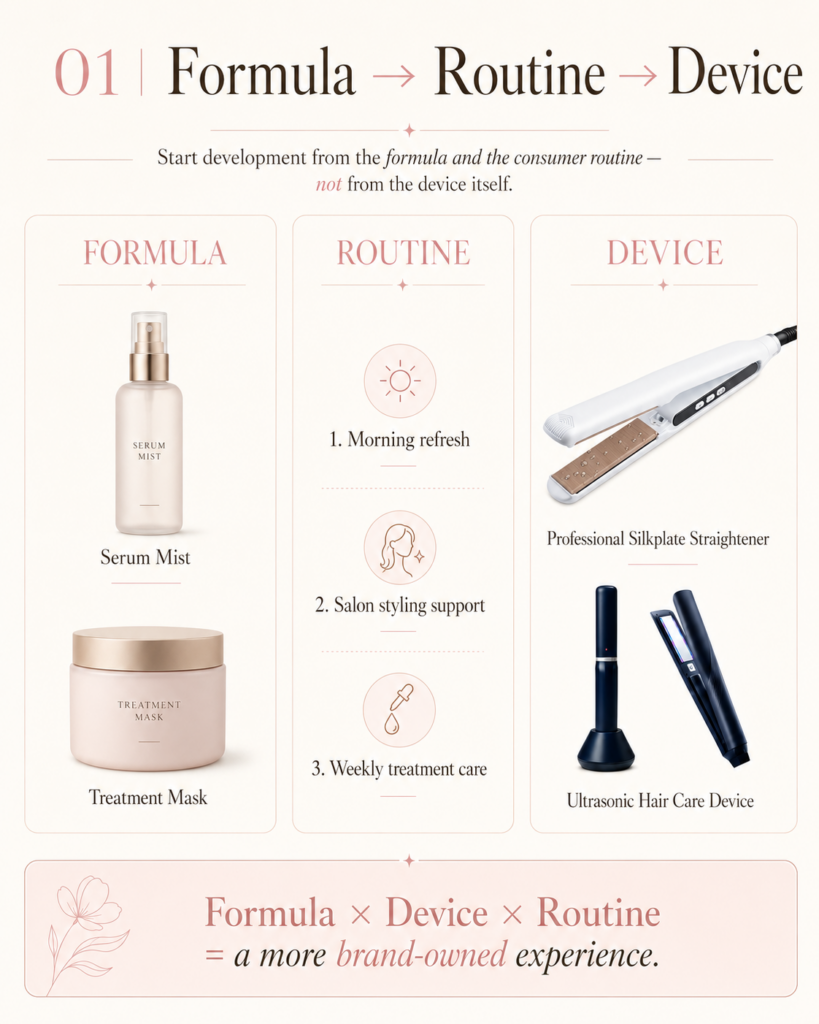
Formula × Device × Routine
system around products the brand already owns.
1. Why Device Development Can Start From the Formula
A traditional hair-tool company may begin product planning from the device itself.
For example:
- straightening brush
- flat iron
- curling iron
- hair dryer
The device is the main product.
For a hair-care brand, however, the commercial starting point may be different.
The brand may already have:
- Shampoo
- Treatment
- Hair Mask
- Serum Mist
- Hair Milk
- Hair Oil
- Heat Protectant
- Scalp Essence
Consumers already know these formulas and may already use them every day.
The opportunity is therefore not necessarily:
“How can we sell another electrical product?”
A more useful question may be:
“Can a device make an existing formula easier to use, more distinctive, or part of a stronger daily routine?”
For example:
Serum Mist
↓
Hair Refresh Brush
↓
Morning smoothing routine
or:
Treatment
↓
Ultrasonic Treatment Device
↓
Weekly or salon care routine
or:
Scalp Essence
↓
Precision Applicator
↓
Targeted scalp-care routine
The device then becomes an extension of the brand’s existing care philosophy rather than an isolated SKU.
2. Five Formula Characteristics That Can Change Device Design
Before choosing a device architecture, we recommend understanding several basic characteristics of the formula.
These variables can directly affect how the device should be designed.
2.1 Viscosity
Viscosity describes how easily the formula flows.
A water-like mist may move easily through a fine outlet.
A Hair Milk or thicker serum may require:
- a larger channel
- a different pump
- controlled dispensing
- a roller or comb outlet
A Treatment or Hair Mask may be too viscous for practical use inside a compact device reservoir.
This means:
The same liquid-delivery system cannot automatically be used for every hair-care formula.
2.2 Oil, Silicone and Polymer Content
Hair-care formulas often contain ingredients designed to create:
- smoothness
- coating
- shine
- conditioning
- film formation
These characteristics can affect device components.
Depending on the formula, repeated use may create:
residue
slippery surfaces
blocked outlets
contamination around seals
more difficult cleaning
The important issue is not whether the formula is “good” or “bad.”
The issue is whether the device architecture is appropriate for the formula.
2.3 Flow and Dispensing Behavior
Two formulas with similar viscosity can still behave differently during dispensing.
A device concept may therefore need to evaluate:
- continuous flow or pulse dispensing
- droplet size
- spray pattern
- pump pressure
- dose consistency
- outlet position
This is particularly important when the product needs to apply formula directly to the scalp or distribute it evenly through hair.
2.4 Residue and Cleaning
Every formula-connected device creates a practical question:
What happens after repeated use?
Will formula remain inside:
- the nozzle?
- the pump?
- the liquid path?
- the brush head?
- the reservoir?
- Can the consumer clean it easily?
If a device creates a complicated cleaning routine, its technical sophistication may reduce rather than improve consumer convenience.
2.5 Interaction With Heat
If the formula is used before a heated brush or iron, brands should consider the intended usage instructions and whether the formula is suitable for that routine.
Relevant questions may include:
- Is the formula intended for use before heat styling?
- Is it applied to wet or dry hair?
- Does it leave significant residue on heated surfaces?
- What temperature range is appropriate for the intended routine?
- Does the formula change the feel of repeated passes?
These questions should be evaluated during product development rather than assumed.
3. Hair Mist and Hair Water: Usually the Simplest Formula Type
Water-like Hair Mist or Hair Water is often one of the easiest formula categories to connect with a device concept.
Possible directions include:
Option A: External Mist + Device
The consumer uses the brand’s existing spray bottle first.
Then:
Spray
↓
Brush
↓
Refresh
This may work particularly well for a morning Hair Refresh routine.
Advantages include:
- no reservoir inside the device
- lower weight
- smaller product size
- easier cleaning
- lower leakage risk
- easier market validation
For portable products, this is often worth evaluating before developing a more complex integrated liquid system.
You can read more about this use case in our Hair Refresh device development framework.
Option B: Integrated Fine-Mist Delivery
A low-viscosity formula may also make an integrated spray system technically possible.
However, the development team still needs to validate:
- nozzle size
- spray distribution
- clogging
- sealing
- refill structure
- cleaning
- materials
An integrated reservoir should only be added when it creates enough consumer or brand value to justify the additional complexity.
4. Hair Serum: Similar to Mist, but Not the Same
Hair Serum can vary significantly from brand to brand.
Some serums are almost water-like.
Others are noticeably thicker.
That difference may change the device architecture.
Possible solutions include:
- micro-pump dispensing
- controlled-dose outlets
- comb-channel delivery
- external application followed by device use
The right choice depends on the actual formula.
This is why the word “Serum” alone is not enough to define the device.
Before designing a liquid system, it is useful to evaluate the real formula rather than developing only from a category name.
5. Hair Milk: Why Fine Mist May Not Be the Right Answer
Hair Milk is typically more viscous than Hair Water or many Serum Mists.
That can make conventional fine-mist delivery less suitable.
If the brand wants to connect Hair Milk to a device, possible directions may include:
External Application + Styling Device
Apply Hair Milk with the hand first, then use a Care Styling Brush.
This is structurally simple and may fit the consumer’s existing habit.
Controlled Dispensing
A larger outlet or controlled pump may deliver a small amount of formula.
Comb-Channel Distribution
Formula can potentially be introduced through channels near the brush or comb structure.
However, this requires more attention to:
- dose control
- residue
- cleaning
- outlet blockage
The key point is:
A more integrated device is not automatically a better device.
If external application already creates a simple and natural routine, adding a liquid path may introduce complexity without enough additional value.
6. Hair Oil: Why a Reservoir Is Often Not the First Choice
Hair Oil can be especially challenging for integrated device systems.
Depending on the formula, oil may create issues around:
- leakage
- residue
- sealing
- surface contamination
- cleaning
- uncontrolled dosing
Consumers also usually need only a relatively small amount of oil.
For many hair-oil routines, a simpler structure may be:
Apply Oil
↓
Smooth or Finish With Device
rather than storing the oil inside the device itself.
This does not mean an integrated oil-delivery product is impossible.
It means the commercial value should justify the engineering complexity.
A useful product-development question is:
Does placing the oil inside the device make the routine meaningfully better than the existing bottle?
If not, external application may remain the better architecture.
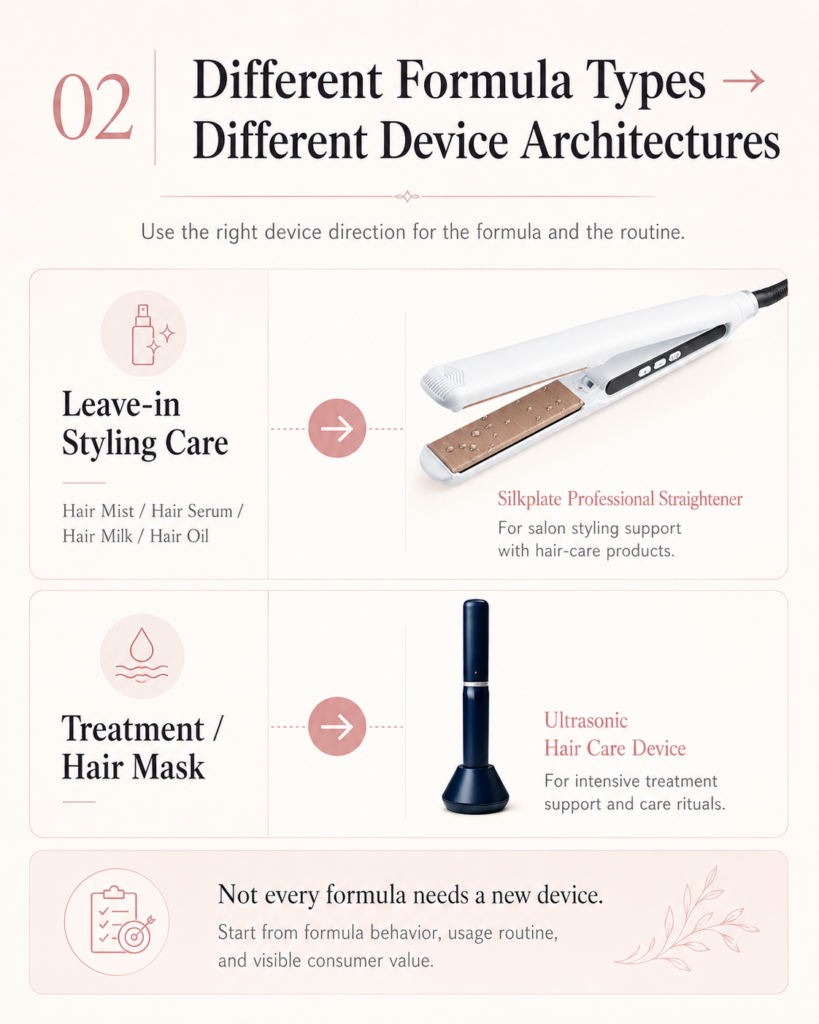
7. Treatment and Hair Mask: Device Supports the Formula Rather Than Dispenses It
Treatment and Hair Mask formulas are usually very different from lightweight mists.
They can be:
- thick
- creamy
- high in conditioning ingredients
- difficult to pump through small channels
- more difficult to clean from internal components
For these formulas, the device often does not need to contain the treatment.
Instead, the routine can be:
Apply Treatment to Hair
↓
Use Treatment Device
↓
Complete the Care Routine
This is one reason an ultrasonic hair-care device can make more sense as an external treatment-support tool than as a treatment dispenser.
The key development question then becomes:
Does the Treatment + Device combination create enough additional consumer value?
Possible validation areas include:
combability
smoothness
perceived softness
gloss
friction
treatment experience
ease of use
The technology alone is not the product value.
The combination of:
Formula + Device + Routine
needs to make sense to the consumer.
8. Scalp Essence and Scalp Serum: A Precision Application Opportunity
Scalp-care formulas create a different consumer problem.
The challenge is often not simply “absorption.”
It is application.
Hair can make it difficult to deliver a product directly to the scalp.
Consumers may experience:
- formula landing on hair instead of scalp
- liquid running down
- difficulty controlling the dose
- sticky hands
- repeated hair parting
- uneven application
This creates a possible device opportunity around precision application rather than another generic scalp massager.
A formula-connected scalp device might use:
- narrow parting combs
- point outlets
- multiple dispensing points
- controlled dosage
- removable liquid paths
Optional vibration may help spread the product, but the fundamental value proposition can remain:
Help the consumer place the formula where it is intended to go.
This changes the competitive logic.
Instead of competing mainly with complex EMS or massage devices, the device competes with the brand’s current:
- dropper
- spray bottle
- nozzle
The question becomes:
Can the device make scalp application significantly easier and more controlled?
9. Three Ways to Connect Formula and Device
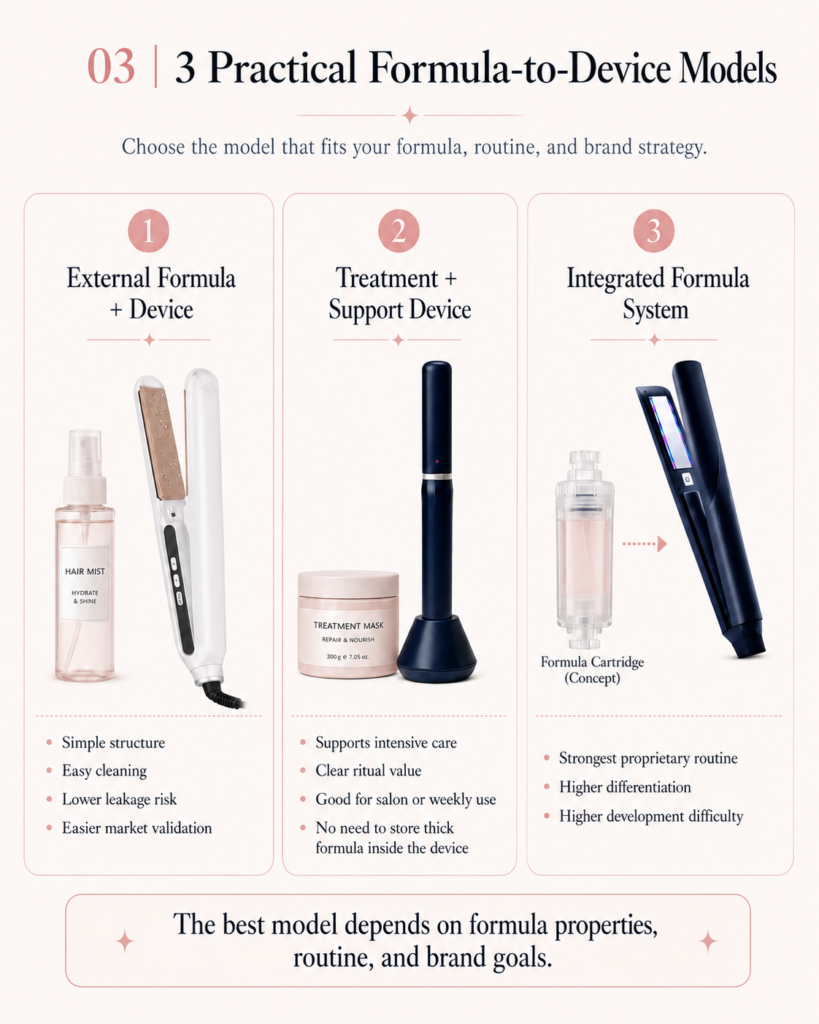
Most formula-connected beauty-device concepts can be grouped into three broad development models.
Model 1: External Formula + Device
Example:
Serum Mist
↓
Gentle Heat Brush
or:
Treatment
↓
Ultrasonic Device
Advantages
- lower structural complexity
- smaller device
- easier cleaning
- lower leakage risk
- easier prototype validation
existing formula packaging can remain unchanged
- This is often a practical first step.
Model 2: Water Reservoir + Device
Example:
Water Reservoir
↓
Steam Styling
This can support moisture-assisted styling without requiring the brand’s formula to travel through the device.
The technical system may be simpler than dispensing a complex cosmetic formula.
However, the commercial connection between the device and the brand’s existing formula portfolio may also be weaker.
Model 3: Brand Formula Integrated Into the Device
Example:
Brand Serum Cartridge
↓
Integrated Applicator or Styling Device
This can create the strongest formula-device relationship.
Potential brand benefits may include:
- proprietary routine
- controlled formula dosage
- stronger differentiation
- consumable repurchase
- ecosystem value
But it also introduces the highest development requirements.
Typical engineering questions include:
- Can the formula move through the pump?
- Will the outlet clog?
- Can dosage remain consistent?
- Will the formula leak during storage?
- Can the consumer clean the system?
- Are sealing materials compatible?
- Can the cartridge be replaced easily?
- Does the formula remain stable in the intended usage environment?
For this reason:
Integrated formula delivery should be treated as a product architecture decision, not simply an added feature.
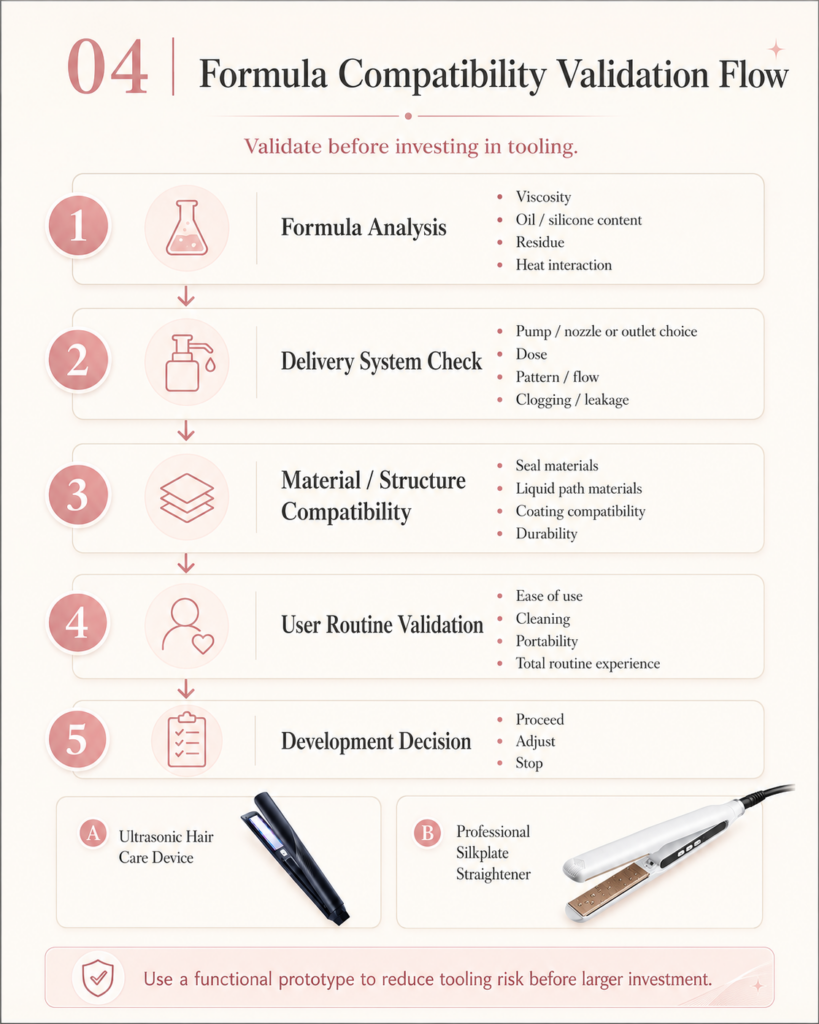
10. What Should Be Tested Before Integrating a Formula Into a Device?
Before committing to tooling, a formula-connected device may need functional validation.
Typical areas include:
Formula Behavior
- viscosity
- flow
- residue
- separation
- interaction with heat where relevant
Delivery System
- pump type
- outlet size
- spray pattern
- dose
- flow consistency
Reliability
- clogging
- leakage
- repeated dispensing
- storage behavior
Cleaning
- removable parts
- residual formula
- user cleaning steps
- accessibility of liquid path
Material Compatibility
- seals
- reservoir
- tubing
- plastics
- coatings
Consumer Routine
- filling
- dispensing
- usage time
- cleaning
- portability
- convenience
This is where a functional prototype before tooling can become valuable.
The objective is not to make the project look finished.
It is to identify whether the formula-device relationship is strong enough to justify further investment.
11. Not Every Hair-Care Formula Needs a Device
This may be the most important principle in Formula-to-Device development.
A device should not be created simply because it is technically possible.
The product should add meaningful value.
We usually look for at least one of the following opportunities.
11.1 A New Usage Occasion
Can the device extend the brand into a new moment?
For example:
Night care
→ Morning Hair Refresh
or:
Home care
→ Salon treatment
11.2 Better Convenience
Can the device make the existing formula easier to:
- apply
- distribute
- control
- use consistently
11.3 A More Noticeable Consumer Experience
Does the formula + device combination create a result consumers can meaningfully perceive?
11.4 A Proprietary Routine
Can the brand create a routine that is harder to compare directly with generic competitors?
For example:
Serum Mist + Hair Refresh Brush
rather than:
“another straightening brush.”
11.5 Stronger Formula Repurchase
If the device is naturally connected to the brand’s existing consumable product, it may create more repeated opportunities to use that formula.
However, this should result from a useful routine.
It should not be forced into the product only to create consumable sales.
12. Formula + Device Can Create a Different Kind of Brand Differentiation
Beauty-device differentiation is often discussed through:
- exterior design
- color
- packaging
- feature quantity
But hair-care brands may have another advantage.
They already own formula knowledge and consumer care routines.
That means differentiation can come from:
Formula × Device × Routine
For example, two brands may use similar brush architectures.
But Brand A simply sells:
Straightening Brush
while Brand B builds:
Serum Mist
+
Temperature-Tuned Hair Refresh Brush
+
Morning Balance Care Routine
The physical devices may begin from similar technical platforms.
But the consumer proposition is very different.
This is where ODM can move beyond appearance customization.
A brand can gradually adjust:
- temperature
- heating curve
- brush geometry
- contact surface
- friction
- controls
- grip
- device size
- formula compatibility
- usage instructions
to make the product behave more like part of the brand.
The strongest differentiation is often found in how the product works — not only how it looks.
13. A Practical Example: Serum Mist to Hair Refresh Device
Imagine a hair-care brand already offers:
- Shampoo
- Treatment
- Hair Mask
- Hair Milk
- Hair Oil
- Serum Mist
The consumer follows the brand’s routine at night.
But the next morning, she wakes up with:
- bed hair
- light waves
- puffiness
- flyaways
- messy bangs
At this point, she may leave the brand’s care system and use a conventional high-heat styling tool.
That creates a possible product gap.
Instead of immediately developing a completely new styling device, the brand could first explore:
Existing Serum Mist
↓
Gentle Heat Hair Refresh Brush
↓
2–3 Minute Morning Routine
↓
Naturally Neat Finish
Then validate:
- Is the result noticeable?
- Is the routine convenient?
- What temperature is required?
- How many passes are required?
- Does the Serum Mist change the feel?
- Does the device need to be cordless?
- Does a reservoir actually improve the experience?
Only after these questions are clearer does deeper ODM become necessary.
The device does not replace the brand’s existing formula.
It gives the formula another moment in the consumer’s day.
14. How Qumei Approaches Formula-to-Device Development
At Qumei, we do not begin Formula-to-Device projects by asking:
“Which device do we want to sell?”
We prefer to begin with:
“What device, if any, makes sense for this formula, consumer routine and brand?”
A typical development process may look like this:
Step 1 — Understand the Brand Portfolio
What does the brand already own?
Treatment?
Mist?
Milk?
Oil?
Scalp Essence?
Step 2 — Understand the Consumer Routine
When is the formula used?
Morning?
After washing?
Before drying?
Before styling?
Weekly treatment?
Salon treatment?
Step 3 — Review the Formula
Where relevant, we consider:
- viscosity
- flow behavior
- residue
- application method
- interaction with heat
- cleaning requirement
Step 4 — Define the Device Architecture
Possible directions may include:
- Hair Refresh Brush
- Cordless Styling Device
- Ultrasonic Treatment Device
- Precision Scalp Applicator
- Integrated Formula-Dispensing Device
Sometimes the conclusion may also be:
No new device is needed.
That can be a valid development decision.
Step 5 — Assess Existing Platforms
If an existing Qumei platform already addresses much of the requirement, it can be used as a lower-risk starting point.
Step 6 — Build a Functional Prototype Where Necessary
Validate the important uncertainties before tooling.
Step 7 — Evaluate Formula × Device × Routine
The question is not simply:
“Does the device function?”
It is:
“Does this combination create enough value for the brand and consumer?”
Step 8 — Increase Customization With Market Certainty
Once the direction is validated, customization can move from:
Existing Platform
↓
Brand-Fit Adjustment
↓
Semi-ODM
↓
Brand-Owned ODM
rather than requiring full tooling from the beginning.
FAQ
Can any hair-care formula be put inside a beauty device?
No.
Different formulas have different viscosity, residue, flow, material compatibility and cleaning requirements.
A formula should be evaluated before selecting the pump, outlet, reservoir and liquid-path structure.
Is a built-in formula reservoir always better than external application?
No.
A built-in reservoir can increase product differentiation, but it also adds size, sealing, clogging and cleaning requirements.
If external application already creates a simple consumer routine, it may be the better first solution.
Which hair-care formulas are easiest to use with a device?
Low-viscosity products such as Hair Water or some Serum Mists are generally easier to evaluate for dispensing than thick Hair Milk, Hair Oil or Treatment.
However, the actual formula should still be tested because products within the same category can behave differently.
Can Treatment or Hair Mask be placed inside an ultrasonic hair-care device?
For many concepts, it is more practical to apply Treatment directly to the hair first and then use the ultrasonic device.
High-viscosity formulas can create challenges around pumping, internal residue and cleaning.
The device can therefore support the Treatment rather than dispense it.
Can a Serum Mist be used before a heated Hair Refresh brush?
Potentially, yes, if the formula is intended for that type of use.
The brand should evaluate the formula instructions, temperature, residue, hair feel and intended wet/dry usage during product development.
When should a hair-care brand consider an integrated formula device?
An integrated structure may make sense when it creates a meaningful advantage in:
- convenience
- dosage
- application accuracy
- proprietary routine
- brand differentiation
- formula repurchase
and when the additional engineering complexity can be justified commercially.
Does Formula-to-Device development require full ODM from the beginning?
No.
A brand can begin with an existing device platform, validate the formula and consumer routine, adjust key parameters, build a functional prototype where needed, and move toward deeper ODM only after the concept is clearer.
Conclusion
For hair-care brands, device development does not always need to start with a device.
Sometimes the better starting point already exists inside the brand:
the formula.
A Serum Mist may reveal an opportunity for Morning Hair Refresh.
A Treatment may reveal an opportunity for an ultrasonic care routine.
A Scalp Essence may reveal an opportunity for precision application.
But not every formula needs a device.
And not every formula should be placed inside a reservoir.
The most useful development question is therefore not:
“What device can we add?”
It is:
“What consumer problem can this formula solve better when combined with the right device?”
When the answer is clear, Formula × Device × Routine can become more than a product bundle.
It can become a brand-owned usage system.
Exploring a Formula-to-Device Opportunity?
If your brand already has a:
- Treatment
- Serum Mist
- Hair Milk
- Hair Oil
- Heat Protectant
- Scalp Essence
and you are considering whether a device could extend the product into a stronger consumer routine, Qumei can help evaluate the development direction.
We can begin by discussing:
- your existing formula
- consumer usage scenario
- possible device architecture
- external vs integrated formula delivery
- functional prototype
- formula compatibility
- ODM customization level
About the Author
Lily | Shenzhen Qumei Technology Co., Ltd.
Lily works with beauty and hair-care brands on ODM product development, with long-term experience supporting projects for the Japanese market. Her work focuses on connecting consumer routines, hair-care formulas and manufacturable device solutions.
Technical Review:
Michael | Product Development, Qumei