
Ultrasonic Hair Care Device Development Guide
Frequency, Heating, Sealing, Waterproofing and Reliability Before Mass Production
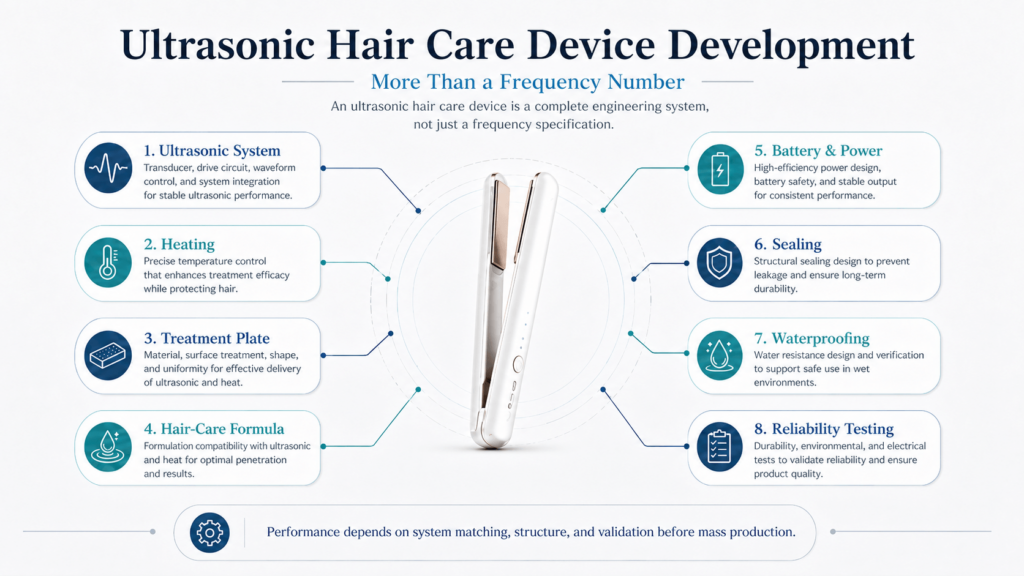
An ultrasonic hair care device is not defined by a single frequency number.
A reliable product is a complete engineering system combining:
- Ultrasonic transducer
- Driving circuit
- Waveform
- Impedance matching
- Treatment plate
- Mechanical coupling
- Battery and power architecture
- Heating, when included
- Sealing and waterproof design
- Hair-care formula
- User operation
- Production consistency
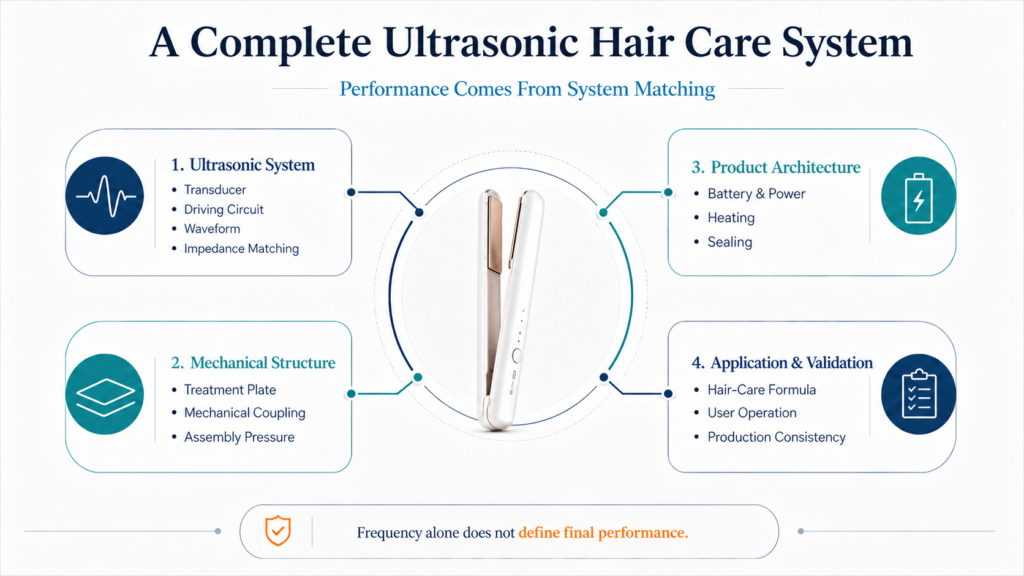
This guide explains the main technical questions brands should understand before developing a 1.0–1.2 MHz ultrasonic hair treatment device.
1. Is 1.0 MHz or 1.2 MHz Better?
Both 1.0 MHz and 1.2 MHz can be reasonable development directions.
Neither number is automatically superior.
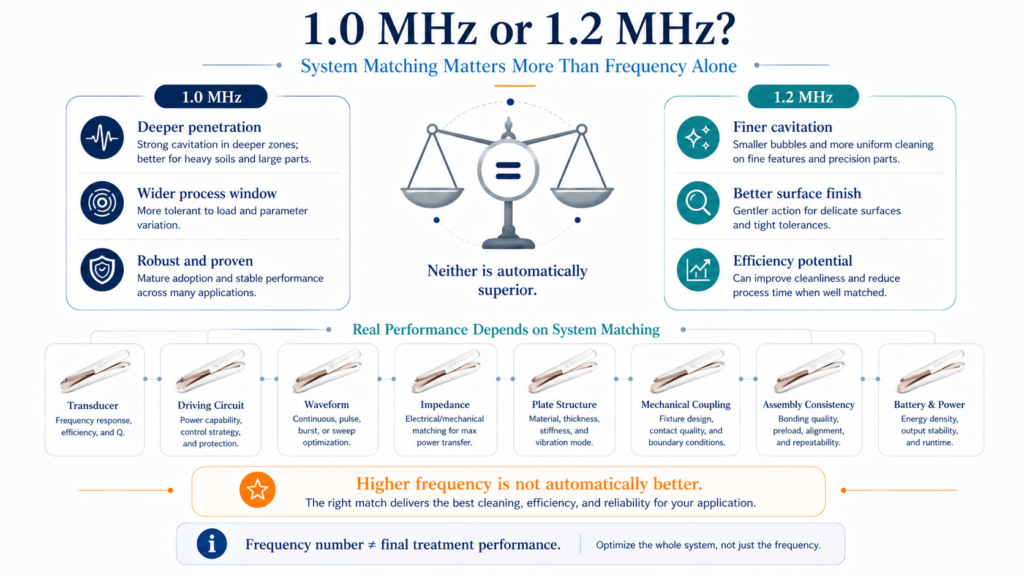
The final performance depends on how the complete system is designed and matched.
Important factors include:
- Transducer size and characteristics
- Driving-circuit design
- Waveform
- Impedance
- Treatment-plate material
- Plate thickness
- Mechanical coupling
- Assembly pressure
- Battery voltage
- Product dimensions
- Hair-contact structure
- Production consistency
A 1.0 MHz device with appropriate matching and stable assembly may perform more consistently than a device advertising a higher frequency without sufficient system control.
Why Higher Frequency Is Not Automatically Better
A higher frequency number does not independently prove:
- Better formula penetration
- Stronger repair performance
- More visible consumer results
- Better long-term stability
Frequency must be evaluated together with:
- Ultrasonic output
- Mechanical transmission
- Formula condition
- Contact method
- Treatment time
- Product structure
Claims about penetration, repair or formula efficacy require appropriate experimental or independent validation.
The specification alone is not sufficient evidence.
2. What Should Be Verified in the Ultrasonic System?
A professional evaluation should go beyond observing whether the product vibrates.
Important checks may include:
Driving Waveform
An oscilloscope can be used to observe the signal supplied to the ultrasonic system.
The waveform helps engineers review whether the driving circuit is operating as intended.
Impedance and Matching
The transducer, treatment structure and driving circuit must work as a matched system.
Poor matching may affect:
- Output efficiency
- Heating
- Stability
- Battery consumption
- Unit-to-unit consistency
Output Stability
The system should be evaluated under conditions such as:
- Different battery levels
- Continued operation
- Assembly variation
- Ageing
- Temperature changes
- Pre- and post-reliability testing
Production Variation
A development sample may be adjusted manually by an engineer.
Mass production requires the same result to be reproduced across many units.
This is why assembly tolerances and testing standards are essential.
3. Does Water-Drop Movement Prove Ultrasonic Performance?
Water-drop movement is a useful visual demonstration.
It may indicate that vibration is reaching the treatment surface.
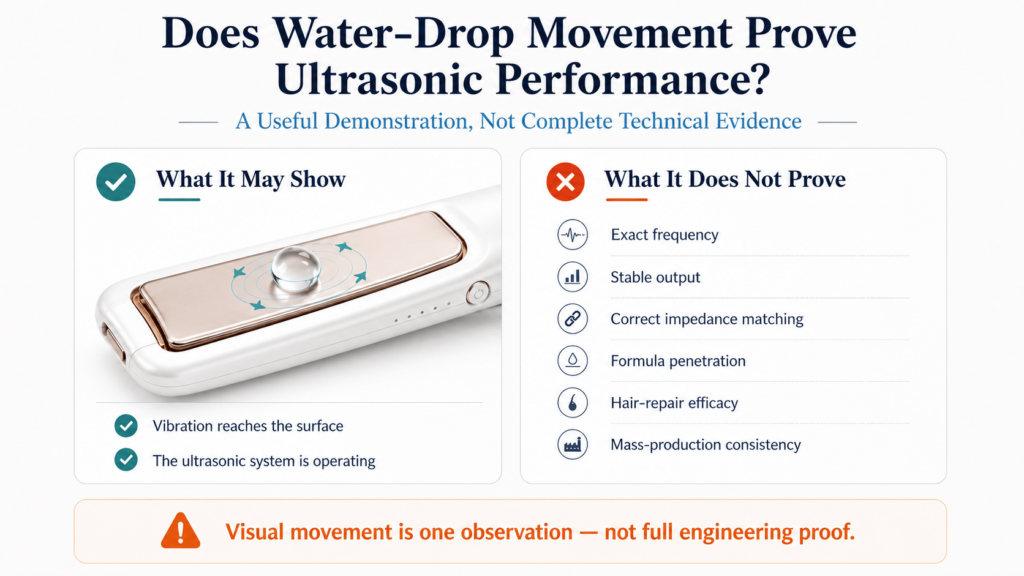
However, it does not independently prove:
- Exact frequency
- Stable output
- Correct impedance matching
- Formula penetration
- Hair-repair efficacy
- Long-term reliability
- Mass-production consistency
The water-drop demonstration should be treated as one observation, not as complete technical evidence.
For a serious ODM project, it should be supported by engineering measurements and reliability evaluation.
4. Should the Device Include Heating?
Heating and non-heating designs can both be appropriate.
The decision should be based on the intended treatment experience and product structure.
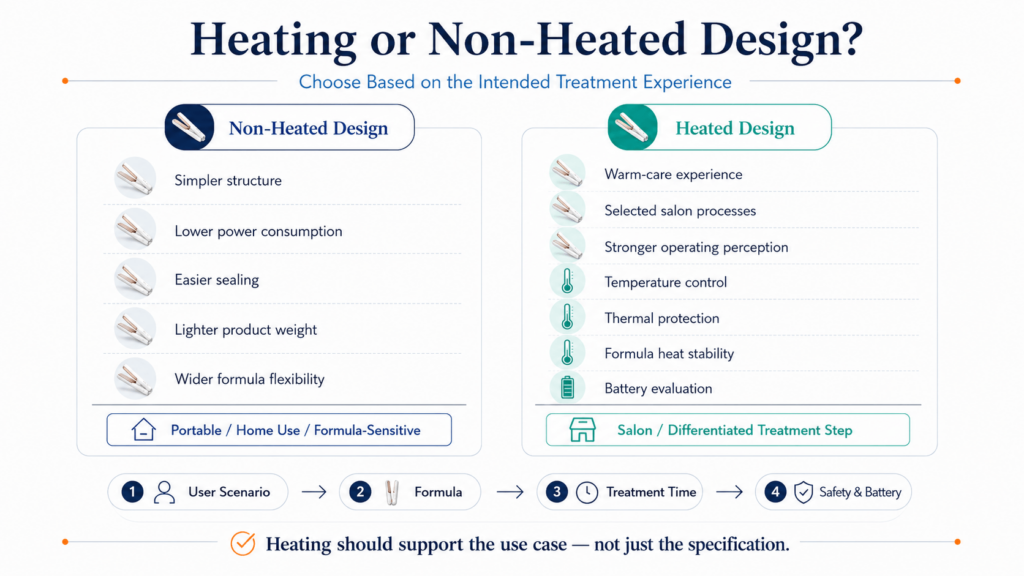
Non-Heated Design
Potential Advantages
- Simpler internal structure
- Lower power consumption
- Easier battery-duration control
- Lower temperature-safety risk
- Wider flexibility for formula evaluation
- Easier sealing around critical areas
- Potentially lighter product weight
Possible Limitations
- Less noticeable warmth during use
- The brand may need other ways to communicate the treatment experience
- Some professional processes may prefer a temperature-controlled step
A non-heated device is not necessarily a lower-level product.
It may be the more appropriate solution for a portable, consumer-friendly or formula-sensitive system.
Heated Design
Potential Value
- Creates a noticeable warm-care experience
- May support selected salon treatment processes
- Can strengthen the consumer’s perception that the device is operating
- May help differentiate the treatment routine
Additional Engineering Requirements
- Temperature sensor and control
- Over-temperature protection
- Material heat resistance
- Battery and power evaluation
- Housing-temperature control
- Formula stability under heat
- Sealing around heated areas
- Thermal expansion considerations
- Market-specific safety and certification review
Heating should be selected because it supports the intended use—not because it makes the specification appear more advanced.
Questions to Ask Before Adding Heating
- Is the device intended for home or salon use?
- What temperature range is actually needed?
- Is the formula suitable for controlled heating?
- How long will one treatment take?
- Will heating make the product too heavy or reduce battery duration?
- Can the temperature remain consistent across mass production?
5. Why the Treatment-Plate Structure Matters
The treatment plates are where ultrasonic energy, hair and formula meet.
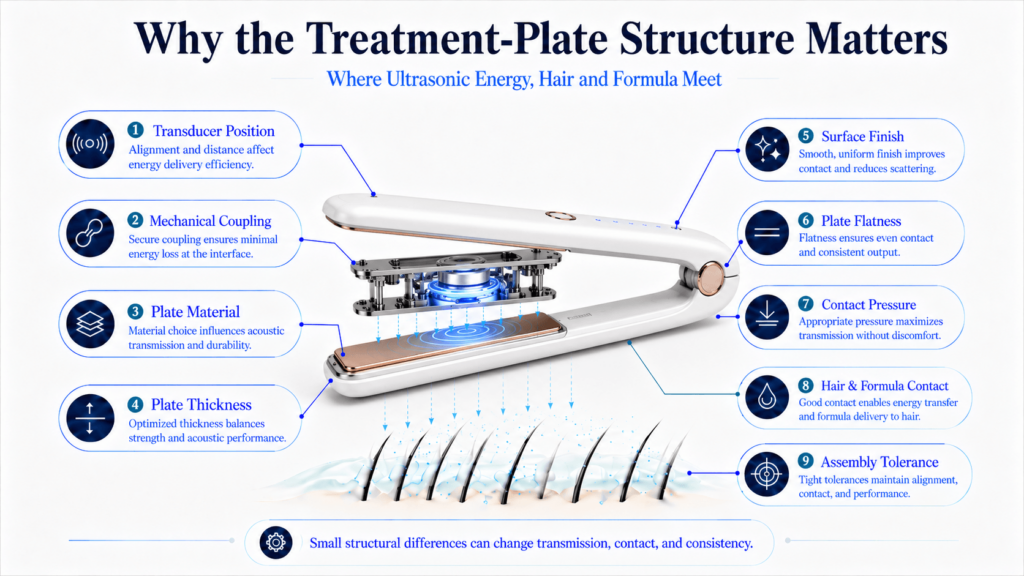
Their design may influence:
- Vibration transmission
- Hair contact
- Formula distribution
- Hair pulling or snagging
- Treatment efficiency
- Cleaning
- Output consistency
Important structural factors include:
- Plate material
- Plate thickness
- Surface finish
- Parallelism
- Contact pressure
- Flatness
- Mounting method
- Transducer position
- Mechanical coupling
- Assembly tolerance
Two products using a similar transducer and circuit can behave differently if their plate structures and assembly methods are different.
The ultrasonic module should therefore be evaluated as part of the complete mechanical structure.
6. External Formula Application vs an Internal Liquid System
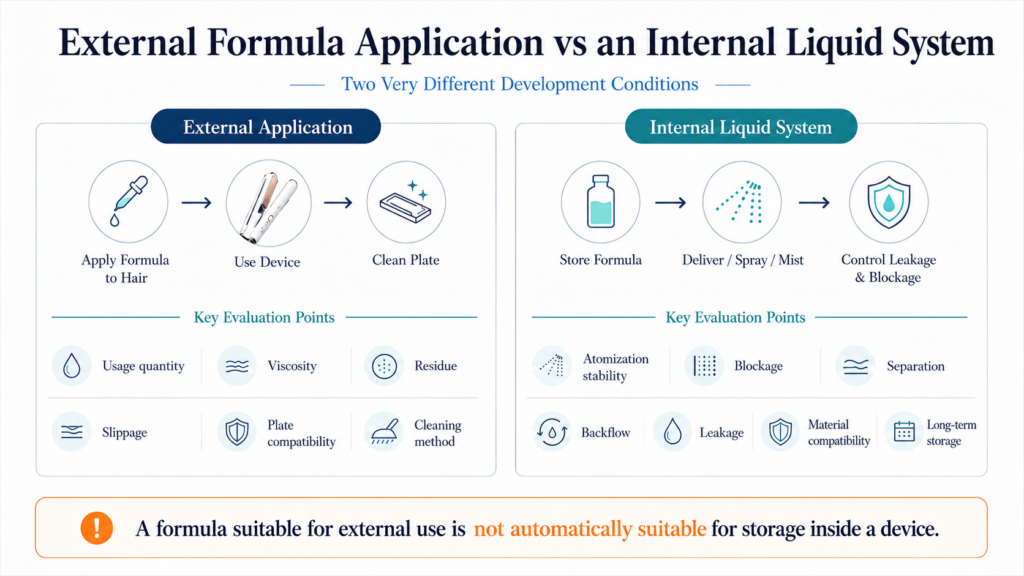
These are two very different product-development conditions.
Externally Applied Hair-Care Products
Many hair masks, treatments, conditioners, milk-type products and serums can be evaluated as externally applied media.
The formula is applied to the hair first, and the device is then used over the treated section.
Brands should still evaluate:
- Recommended usage quantity
- Viscosity
- Residue
- Plate-surface compatibility
- Cleaning method
- Slippage and hair contact
- Whether the formula affects seals or surface coatings
External application is generally simpler than storing the product inside the device.
Internal Tank, Spray or Mist Systems
A formula that works externally is not automatically suitable for storage, spraying or atomization inside a device.
Internal liquid systems may require evaluation of:
- Viscosity
- Surface tension
- Oil content
- Polymers
- Formula separation
- Atomization stability
- Blockage
- Long-term storage
- Material compatibility
- Backflow
- Leakage
- Cleaning
- Microbial or contamination considerations
A water-based demonstration liquid does not prove that the final treatment formula can remain stable inside the product.
The actual formula or a technically representative substitute should be evaluated during development.
7. Airtightness Testing, Waterproof Testing and IP Ratings
These terms are related but should not be treated as identical.
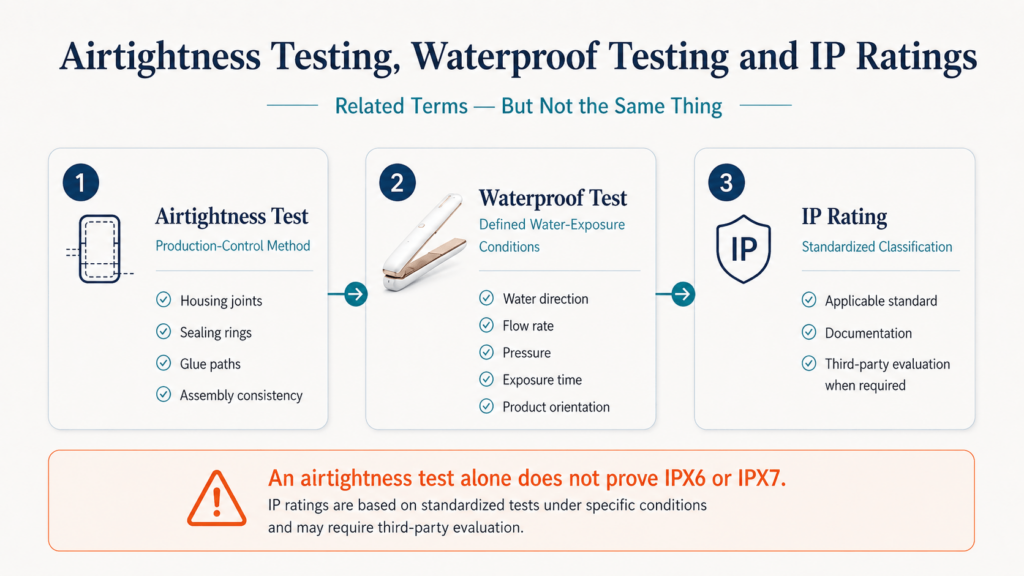
Airtightness Testing
Airtightness testing is commonly used as a production-control method to check whether the assembled structure has potential leakage paths.
It can help identify problems involving:
- Housing joints
- Sealing rings
- Glue paths
- Fasteners
- Liquid-contact structures
- Assembly consistency
The device is subjected to a defined pressure condition, and the pressure change is measured.
The exact pressure and allowable pressure drop should be defined according to the product structure and confirmed by engineering and quality teams.
Airtightness testing is especially useful for detecting variation between assembled units.
Waterproof Testing
Waterproof testing evaluates how the product responds to specified water-exposure conditions.
Depending on the target requirement, this may involve:
- Water direction
- Flow rate
- Pressure
- Distance
- Exposure time
- Product orientation
- Operating or non-operating condition
The method should match the intended claim and target market.
IP Rating
An IP rating is a standardized classification.
An internal airtightness test cannot by itself justify an IPX6 or IPX7 claim.
Formal claims should be based on:
- Testing according to the applicable standard
- Appropriate documentation
- Third-party evaluation when required by the brand or market
Key Principle
Airtightness testing supports sealing and production consistency, but it does not automatically replace formal IP waterproof evaluation.
8. Why Sealing Is a Mass-Production Issue
An engineering team may manually seal one prototype successfully.
The real challenge is reproducing the same sealing result across mass production.
Important factors include:
- Glue type
- Dispensing quantity
- Glue-path continuity
- Automatic or controlled dispensing
- Surface cleanliness
- Sealing-ring position
- Screw torque
- Curing conditions
- Component tolerances
- Inspection method
A small variation in glue quantity, component fit or assembly pressure can create leakage risk.
A repeatable process is therefore as important as the original structure.
9. Reliability Tests Before Mass Production
The final test plan should be based on:
- Product structure
- Target market
- Intended use
- Identified risks
- Customer standards
- Certification requirements
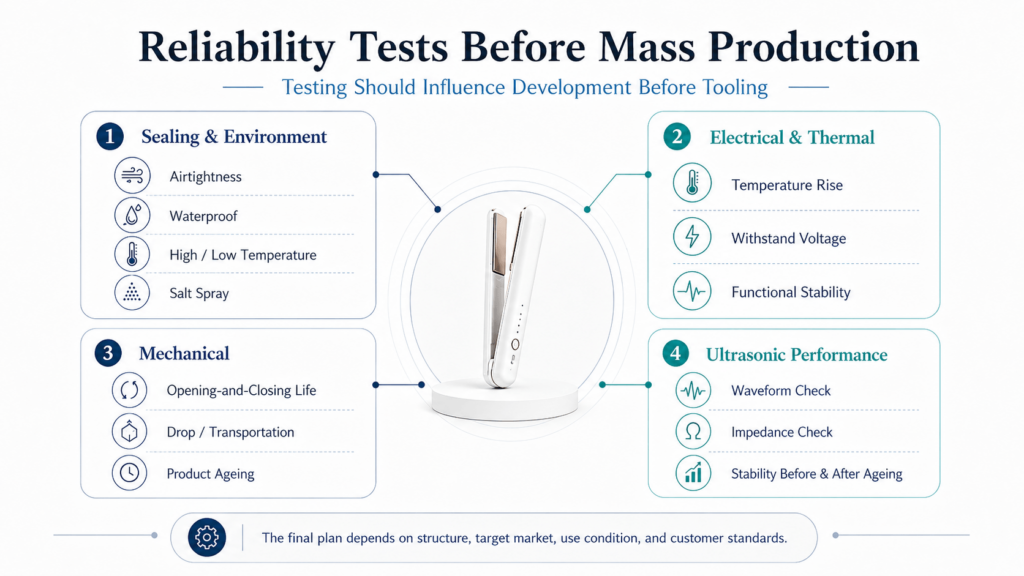
Depending on the project, relevant tests may include:
- Airtightness and waterproof evaluation
- Opening-and-closing life testing
- Battery cycle testing
- Product ageing
- Temperature-rise testing
- Electrical withstand-voltage testing
- High- and low-temperature testing
- Salt-spray corrosion testing
- Transportation vibration or drop testing
- Ultrasonic waveform and impedance checks
- Functional stability before and after ageing
Testing should not be treated only as a final inspection step.
It should influence development decisions before tooling and production release.
10. What Can a Functional Prototype Validate?
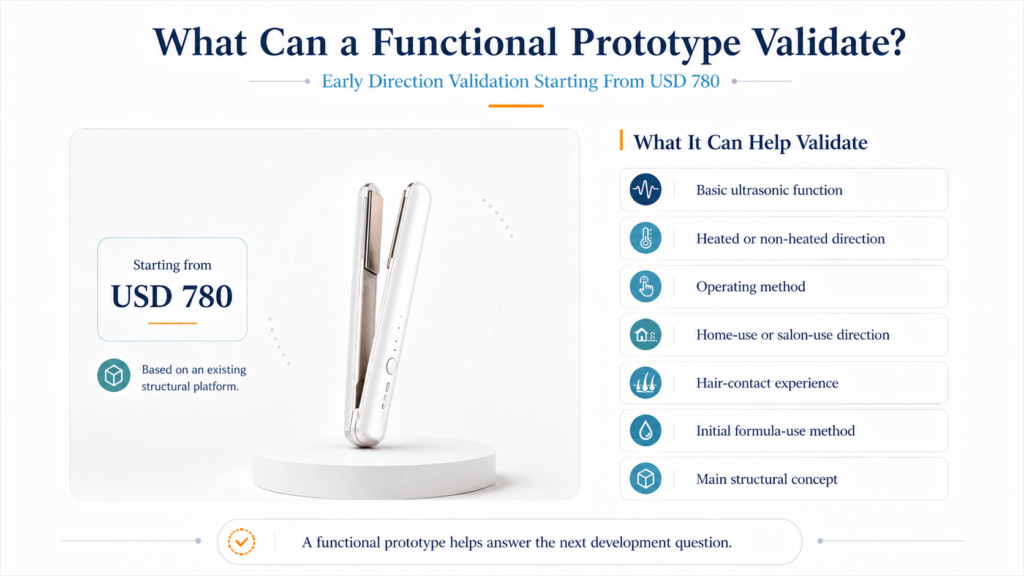
A functional prototype can help the brand determine whether the project direction is worth continuing.
For suitable projects, it may be used to review:
- Basic ultrasonic function
- Heated or non-heated experience
- Operating method
- Home-use or salon-use direction
- Approximate dimensions
- Hair-contact experience
- Initial formula-use method
- Main structural concept
- Whether further custom development is justified
For projects based on an existing structural platform, Qumei can provide functional prototype validation starting from USD 780.
The exact scope depends on the requested changes.
What a Functional Prototype Usually Cannot Fully Prove
An early prototype may not completely validate:
- Final injection-moulded appearance
- Final production materials
- Tooling-level sealing
- Formal IP rating
- Full certification
- Long-term production consistency
- Final cosmetic quality
- Hair-repair or formula-penetration claims
- Every reliability condition required for mass production
This distinction should be explained before the prototype is ordered.
The purpose is to answer the next development question—not to create the illusion that the entire product is already complete.
11. Technical Checklist for Brands
Before starting an ultrasonic hair care device project, brands should clarify:
- Is the product for home or salon use?
- Will the formula be applied externally or stored inside the device?
- Is heating required, optional or still undecided?
- What is the intended treatment time?
- Is the product cordless or corded?
- What waterproof or cleaning requirement is expected?
- What must the first prototype validate?
- Which performance claims require independent testing?
- Which risks must be resolved before tooling?
- How will mass-production consistency be verified?
Conclusion
Ultrasonic hair care device development does not begin by choosing 1.0 MHz or 1.2 MHz.
It begins by defining:
- Who will use the product
- Which treatment formula will be used
- How the device fits into the care process
- Whether heating supports the intended experience
- What sealing and waterproof requirements apply
- What must be verified before tooling
- How the approved result will be reproduced in mass production
The correct frequency, structure and test plan should follow from these decisions.
Brands may begin an initial discussion with:
- A reference device
- An existing hair-care product
- A design concept
- A description of the intended treatment experience
A complete technical specification is not required at the first stage.
Need support for your hair tool development project?
Qumei supports Japan-oriented hair tool ODM development from concept discussion to stable production.

Continue Exploring Qumei Insights
Explore more articles about hair tool development and Japan-market ODM strategy.