
The Most Expensive ODM Mistake Is Not Paying Too Much—It Is Developing the Wrong Product ?
Why successful ODM development depends on business-system fit, not product similarity or unit price
ODM product development is often misunderstood as a process of adding functions, changing an exterior design, opening tooling, and preparing mass production.
In reality, ODM development is a capital-allocation decision made under uncertainty.
Before a product reaches the market, the customer must invest in development, tooling, compliance, inventory, packaging, content, distribution, advertising, and after-sales support. The factory must also commit engineering resources, supplier capacity, quality systems, and production planning.
The most expensive mistake is therefore not necessarily paying a slightly higher unit price.
It is investing in a product that does not fit the customer’s business system.
A technically successful product can still become a commercial failure if:
- The channel cannot explain it
- The customer cannot promote it
- The target user does not understand its value
- The retail price cannot support the required cost structure
- The company cannot manage its after-sales complexity
- The product cannot pass future compliance requirements
- The first order is completed, but repeat orders never follow
This is why professional ODM development should not begin with the question:
“Which existing product do you want to copy?”
It should begin with a more difficult question:
“What role must this product play inside your business?”
ODM Development Is Business Design Translated Into Product Architecture
A product is not an isolated object.
It is the physical expression of several business decisions:
- Who the customer wants to serve
- What problem the product should solve
- How the product will be sold
- What price the market will accept
- What the company can realistically support
- How much risk the customer is willing to carry
- How the product must evolve over time
ODM development converts these decisions into:
- Product functions
- Structural design
- Material selection
- Battery configuration
- User interface
- Packaging
- Compliance planning
- Tooling strategy
- Quality standards
- Production processes
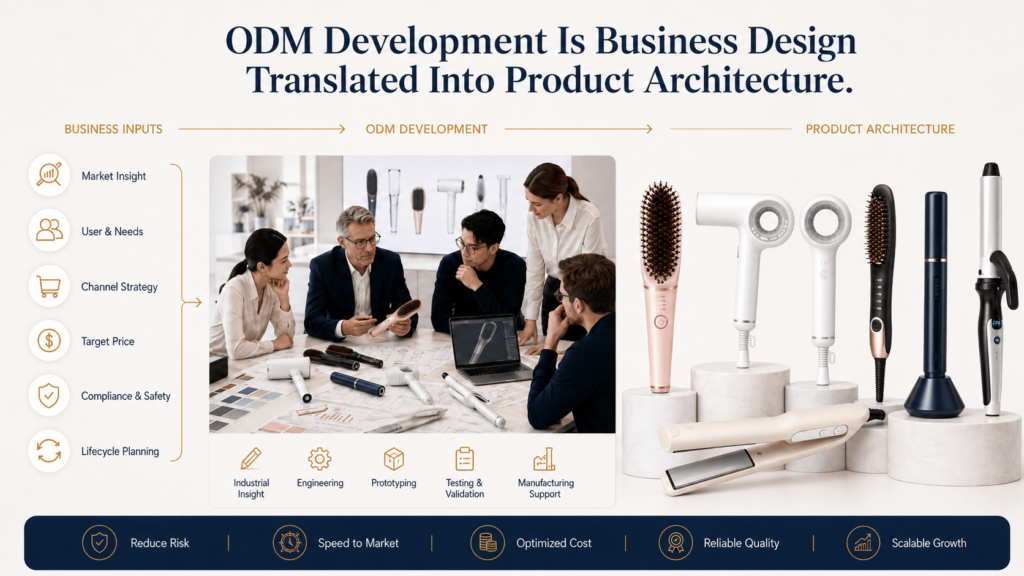
This means that the same product category may require completely different technical architectures.
A cordless hair-care device for a premium salon brand should not necessarily be developed in the same way as a device for a high-volume marketplace seller.
The visible product may appear similar, but the commercial responsibilities of the product are different.
The Real Question Is Not “What Does the Customer Want?”
Customers usually describe what they want in product language:
- A larger battery
- More functions
- A lower price
- A similar appearance to a best-selling model
- A faster delivery schedule
- A stronger mist output
- A more premium finish
However, the customer’s request is not always the same as the customer’s real business need.
For example:
“We need a larger battery.”
The underlying need may actually be:
- Longer perceived usage time in online reviews
- Fewer charging complaints
- A stronger premium positioning
- Better performance for professional users
But a larger battery may also increase:
- Product weight
- Charging time
- Shipping restrictions
- Certification complexity
- Heat-management risk
- Product cost
A good ODM developer does not simply accept the requested specification.
The developer identifies the business objective behind the request and evaluates whether the requested solution is the best way to achieve it.
That is the difference between product manufacturing and product development.
Four Types of Fit Determine Whether an ODM Product Can Succeed
A strong ODM project needs more than product-market fit.
It requires alignment across four systems.
1. Demand fit
The product must solve a problem that customers actually recognize and are willing to pay for.
Questions include:
- Is the problem urgent or optional?
- Does the customer already understand the product category?
- Will the market require education?
- Is the benefit visible and believable?
- Is the product replacing an existing solution or creating a new behavior?
A technically innovative product may fail if the market does not immediately understand why it is needed.
2. Channel fit
The product must work inside the way it will be sold.
A salon distributor, Amazon seller, department store, TikTok seller, and professional brand operate under different sales conditions.
Channel fit influences:
- Product demonstration
- Packaging size
- Retail storytelling
- Training requirements
- Review risk
- Sales margins
- Inventory turnover
- Return policy
- Content requirements
A product that performs well in a professional salon may be too difficult to explain in a 15-second video.
A product designed for social media may appear visually attractive but lack the durability required for professional channels.
3. Operational fit
The customer must be able to support the product after launch.
This includes:
- Forecast accuracy
- Inventory capacity
- Customer service
- Spare parts
- Returns management
- Technical training
- Regulatory documentation
- Product updates
- Cash-flow capacity
A product with many functions may create a stronger sales story, but it may also require more instructions, more testing, and more after-sales support.
If the customer has a small service team, a simpler product may create better long-term results.
4. Lifecycle fit
The product must remain viable beyond the first order.
ODM development should consider:
- Future regulatory changes
- Battery-replacement requirements
- Component availability
- Tooling life
- Software or firmware updates
- Material changes
- Supplier continuity
- Product-line expansion
- Replacement parts
- Second-generation development
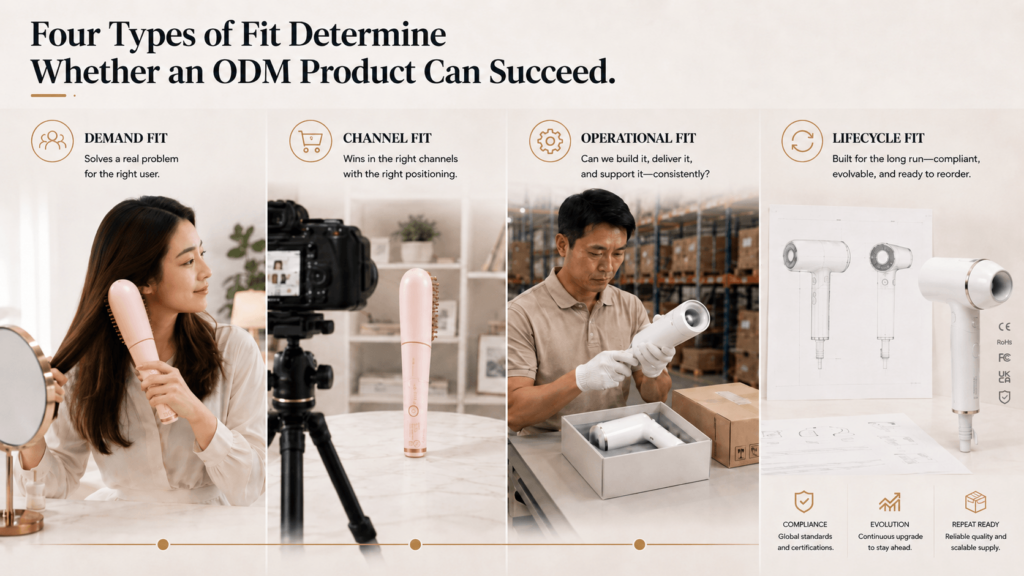
A product that can be launched today but requires major redesign before the next order may not be a sustainable development solution.
Different Customers Are Optimizing for Different Economic Outcomes
Customer classification is useful, but only when it explains the economics behind their decisions.
Brand owners are optimizing for ownership and defensibility
A brand customer is not only buying a product.
The brand is trying to create an asset that it can own, communicate, improve, and defend.
Its ODM priorities may include:
- Distinctive product positioning
- Exclusive industrial design
- Functional differentiation
- Consistent brand language
- Controlled user experience
- Intellectual-property awareness
- Product-line continuity
- Upgrade potential
- Long-term supply security
A brand may accept a higher development cost if that investment creates:
- Better customer recognition
- Higher retail pricing
- Stronger repeat purchase
- Lower competitive comparability
- A platform for future products
The key ODM question is not:
“How much customization does the brand want?”
It is:
“Which parts of the product must the brand own in order to create long-term value?”
Not every component needs to be customized.
Some parts should remain on a proven technical platform. Other parts may need exclusive design because they directly affect brand identity, user experience, or market differentiation.
Good ODM development separates meaningful differentiation from expensive but commercially weak customization.
Trading companies are optimizing for option value
Trading companies often serve multiple customers and markets.
Their main requirement may not be exclusivity. It may be the ability to adapt one technical platform to different projects.
They are often optimizing for:
- Speed of response
- Configuration flexibility
- Documentation completeness
- Multi-market usability
- Lower project-entry cost
- Controlled engineering risk
- Predictable delivery
- Reusability across customers
For trading companies, the best ODM platform may include:
- A stable core structure
- Interchangeable exterior components
- Different battery configurations
- Optional accessories
- Multiple packaging formats
- Region-specific compliance options
- Adjustable user interfaces
The economic value comes from flexibility.
A trading company may lose an opportunity if every new customer requires a completely new development process.
Therefore, its ODM product should preserve as much reusable engineering value as possible.
Offline wholesalers are optimizing for inventory velocity and service simplicity
Offline wholesalers earn money when products move efficiently through distribution networks.
Their real priorities often include:
- Fast product understanding
- Easy demonstration
- Low training requirements
- Strong durability
- Stable replenishment
- Low complaint rates
- Simple service procedures
- Consistent margin across channel levels
For this customer, excessive product complexity can become a commercial disadvantage.
Every additional function may require:
- More sales explanation
- More user education
- More possible misuse
- More after-sales handling
- More replacement inventory
The correct ODM solution may therefore prioritize fewer but clearer functions.
The question is not:
“How can we add more value?”
It is:
“Which product features improve sell-through without increasing service complexity?”
E-commerce customers are optimizing for conversion and review economics
An e-commerce product must perform twice:
- It must convince the consumer to buy
- It must avoid giving the consumer a reason to return it
This creates a unique ODM challenge.
The product must have:
- Strong first-impression value
- Clear visual demonstration
- Simple benefit communication
- Attractive content potential
- Easy operation
- Reliable packaging
- Consistent real-world performance
But every sales claim creates a future review expectation.
A feature that performs well in a promotional video but inconsistently in real use may increase conversion initially and then damage the product through negative reviews and returns.
For e-commerce development, the ODM team must evaluate:
- Can the benefit be filmed clearly?
- Can the average customer reproduce the result?
- Will the product survive transportation?
- Is the instruction clear enough?
- What are the likely return reasons?
- Can the performance remain consistent at scale?
The most important metric is not only conversion rate.
It is:
Conversion value minus return cost, complaint cost, and reputation damage.
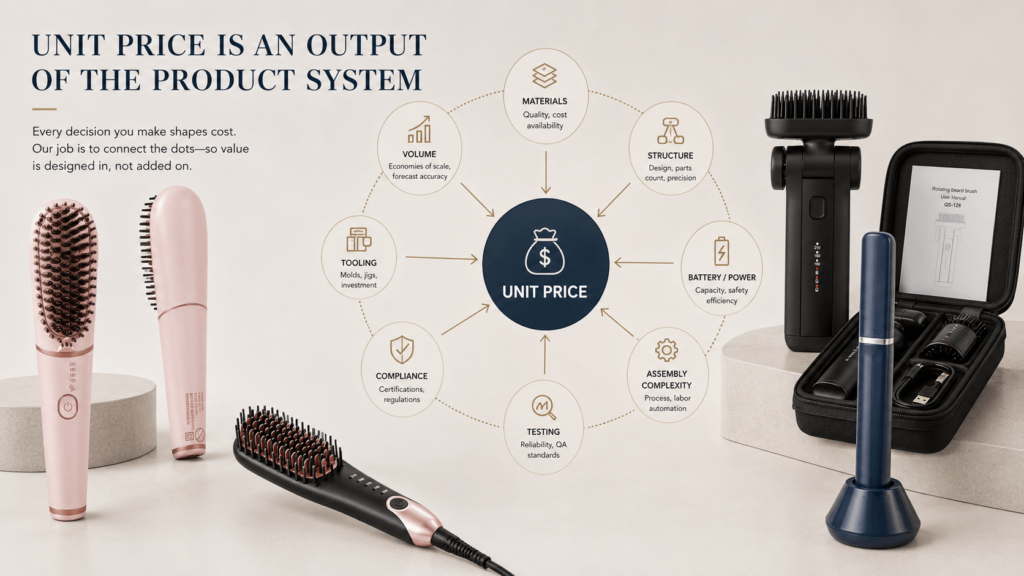
Unit Price Is an Output of the Product System
Customers sometimes treat price as an independent variable.
In ODM development, price is the result of many connected decisions.
Unit cost is influenced by:
- Materials
- Components
- Battery capacity
- Product architecture
- Assembly complexity
- Testing requirements
- Yield rate
- Packaging
- Warranty expectations
- Tooling amortization
- Order volume
- Forecast reliability
- Compliance requirements
- Supplier commitments
- Quality standards
A request to reduce price must therefore lead to a discussion about trade-offs.
The correct question is not:
“Can the price be lower?”
It is:
“Which product requirement can be changed without damaging the business objective?”
Possible cost optimization may come from:
- Simplifying hidden structures
- Reducing unnecessary functions
- Standardizing components
- Improving assembly efficiency
- Optimizing packaging volume
- Increasing order quantity
- Using a proven technical platform
- Separating essential and optional features
Cost reduction becomes dangerous when it removes value from the area that actually drives purchase, trust, or repeat orders.
Five Common ODM Failure Patterns
1. Copying the visible product but not the demand engine
A buyer sees a best-selling product and assumes that similar hardware will produce similar results.
But the original brand may already own:
- Audience trust
- Distribution
- Reviews
- Advertising data
- Influencer relationships
- Category education
The new customer copies the product but not the commercial system behind it.
The product then enters the market without a clear reason for consumers to choose it.
2. Opening tooling before validating the core assumption
A customer may invest in full tooling before confirming:
- Functional stability
- User demand
- Formula compatibility
- Battery performance
- Waterproofing
- Market acceptance
When the core assumption is wrong, tooling locks the project into an expensive direction.
This is why technical verification prototypes and limited market testing are valuable before full investment.
3. Reducing cost in the wrong area
The project reaches the target purchase price, but:
- Performance becomes inconsistent
- Materials feel cheap
- Battery life disappoints users
- Packaging fails in transportation
- The return rate increases
The unit price falls while the total business cost rises.
4. Designing for launch instead of repeat orders
The first batch can be produced, but the product is difficult to maintain because:
- Components are unstable
- Suppliers cannot support future quantities
- Regulatory requirements change
- The structure cannot be upgraded
- Quality depends on excessive manual control
A real ODM project must be designed for repeatability, not only first-order completion.
5. Treating compliance as paperwork instead of product design
Compliance is sometimes considered after the product structure has been confirmed.
But regulations may directly affect:
- Battery access
- Material selection
- Labels
- Chargers
- User instructions
- Recycling
- Product disassembly
- Safety structure
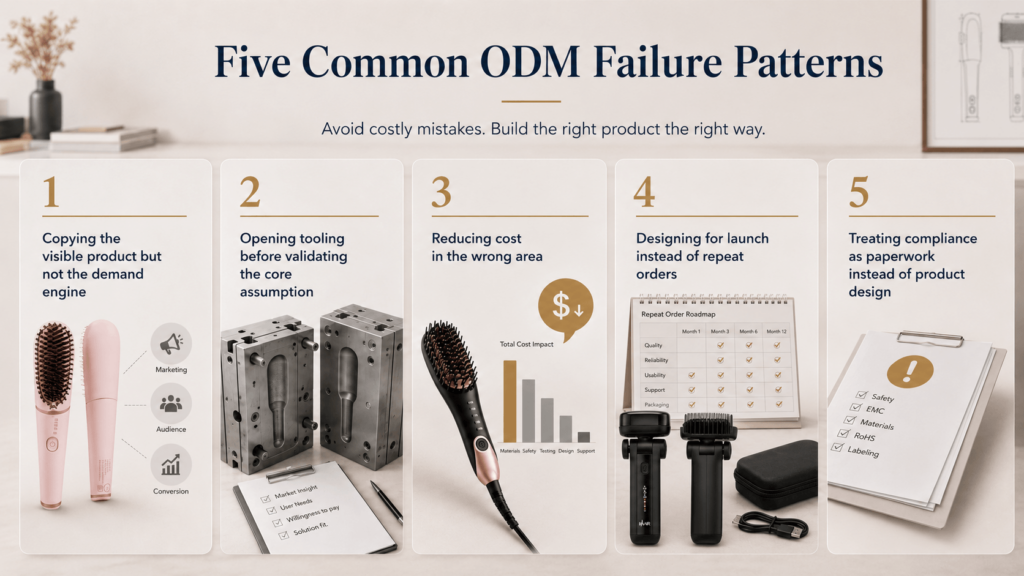
When compliance is considered too late, the result may be tooling modification, delays, retesting, and additional cost.
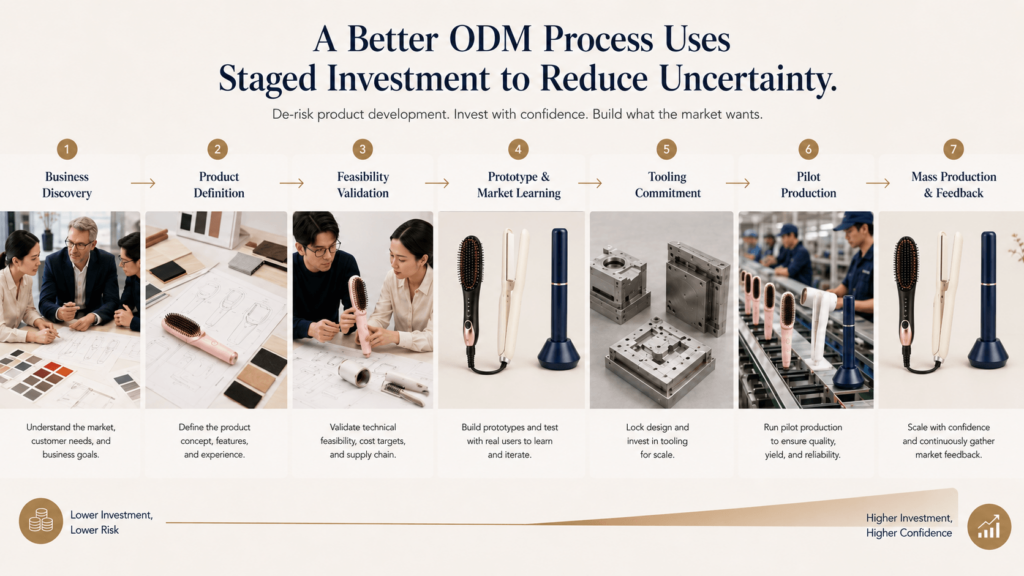
A Better ODM Process Uses Staged Investment
A professional ODM process should reduce uncertainty before increasing financial commitment.
Stage 1: Business discovery
Clarify:
- Customer type
- Target market
- Target user
- Sales channel
- Retail price
- Commercial objective
- Launch timing
Stage 2: Product definition
Decide:
- Core user problem
- Essential functions
- Differentiation strategy
- Quality level
- Target cost
- Compliance scope
Stage 3: Feasibility validation
Verify:
- Technical architecture
- Component availability
- Battery and power system
- Materials
- Safety
- Formula compatibility
- Manufacturing feasibility
Stage 4: Prototype and market learning
Use prototypes to test:
- Function
- User experience
- Content potential
- Market reaction
- Product positioning
- Price acceptance
Stage 5: Tooling commitment
Tooling begins after the major product assumptions have been sufficiently tested.
Stage 6: Pilot production
Confirm:
- Assembly process
- Yield
- Quality standards
- Packaging
- Transportation
- Inspection procedures
Stage 7: Mass production and feedback
The ODM process should continue after shipment through:
- Complaint analysis
- Return reasons
- User feedback
- Production improvement
- Next-generation planning
ODM development is not a straight line from idea to shipment.
It is a controlled learning process.
Case Example: Developing an Ultrasonic Hair-Care Device
Consider four customers interested in an ultrasonic hair-care device.
The product category is the same, but the correct development decisions are different.
Premium hair-care brand
The brand may need:
- Compatibility with its proprietary treatment
- Controlled application performance
- Premium materials
- Distinctive industrial design
- A device-and-formula system
- Long-term product exclusivity
The most important verification may be formula compatibility and consistent treatment performance.
Trading company
The trading company may need:
- A stable technical platform
- Different appearance options
- Multiple market configurations
- Flexible accessories
- Faster adaptation for different customers
The development priority is modularity.
Salon distributor
The distributor may need:
- Durable structure
- Simple operation
- Easy demonstration
- Replaceable wear parts
- Low service complexity
The development priority is professional usability and reliability.
E-commerce brand
The e-commerce customer may need:
- Visible mist performance
- Strong before-and-after content
- Easy instructions
- Compact packaging
- Low return risk
The development priority is conversion performance supported by repeatable real-world results.
If the same product is offered to all four customers without adjustment, the factory may deliver hardware but fail to deliver commercial suitability.
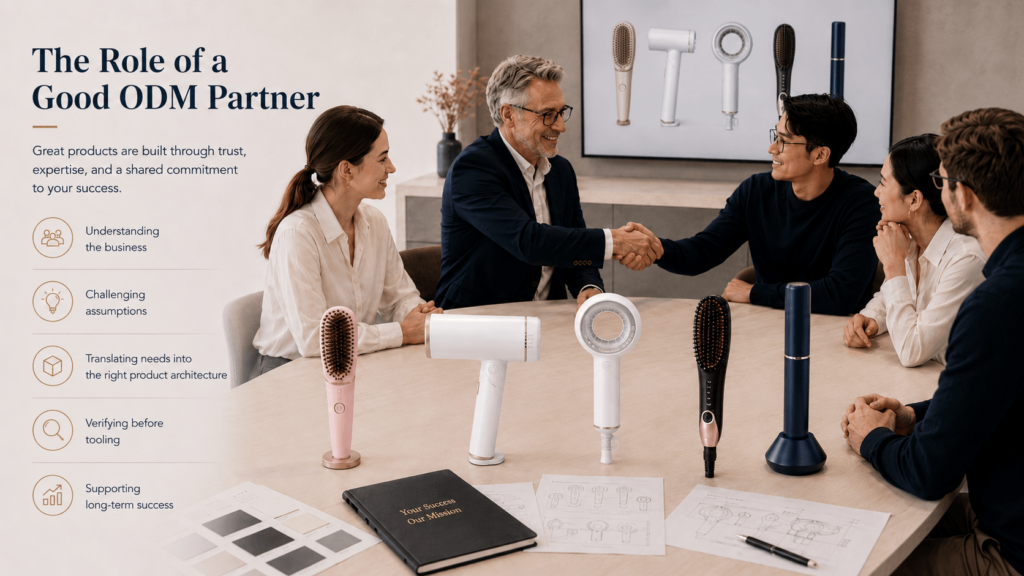
A Good ODM Partner Must Be Willing to Challenge the Brief
A manufacturer can accept every customer request and still be a weak development partner.
A strong ODM partner should be willing to say:
- This function adds cost but little user value
- This target price is inconsistent with the expected quality
- This tooling investment is too early
- This design increases production risk
- This battery structure may create future compliance problems
- This product is not well suited to the intended channel
- This feature should be validated before mass production
- This project may be better developed in phases
This does not mean resisting the customer.
It means protecting the customer’s investment.
The value of an ODM partner is not measured by how quickly it says yes.
It is measured by the quality of the decisions it helps the customer make.
Our View of ODM Development
At Qumei, we view ODM development as the process of connecting four areas:
Market need, product architecture, manufacturing reality, and long-term commercial value.
Before proposing a development solution, we want to understand:
- What business result the product must create
- Who the product is designed for
- How it will be sold
- What the customer can support operationally
- Which functions create real differentiation
- Which risks should be verified before tooling
- How the product may need to evolve after launch
Our goal is not to develop the most complicated product.
It is to develop the right product with the right level of investment.
Sometimes that means a completely new structure.
Sometimes it means adapting a proven technical platform.
Sometimes it means building a verification prototype before opening tooling.
Sometimes it means recommending that a customer simplify or delay a project.
The correct ODM solution is not the one with the most functions or the lowest quotation.
It is the one that can be manufactured reliably, accepted by the market, supported by the customer, and repeated over time.
Conclusion
ODM development is not simply a sourcing activity.
It is a business decision translated into a physical product.
The success of an ODM project depends on whether the product fits:
- The demand
- The channel
- The customer’s operating capability
- The economic model
- The regulatory lifecycle
- The long-term product strategy
Price matters, but price is only one output of the system.
The most important responsibility of an ODM developer is to help the customer avoid developing the wrong product.
Because the real cost of a poor ODM decision is not only the tooling fee or the first production order.
It is the lost time, inventory, market opportunity, customer trust, and organizational attention invested in a product that was never designed for the business that needed to sell it.
Frequently Asked Questions
What is the biggest risk in an ODM project?
The biggest risk is committing tooling, inventory, and market resources before confirming that the product fits the customer’s market, channel, operational capability, and compliance requirements.
Why can two customers need different versions of the same product?
Because different customers sell through different channels, serve different users, operate at different retail prices, and have different after-sales and compliance capabilities.
Is a lower unit price always better for an ODM project?
No. A lower price may increase failure rates, returns, service costs, or regulatory risks. The correct objective is to optimize total commercial value, not only factory price.
When should tooling begin?
Tooling should begin after the core product assumptions, technical feasibility, compliance direction, and major user requirements have been sufficiently validated.
What is the role of an ODM developer?
An ODM developer should translate business needs into product architecture, identify trade-offs, verify technical feasibility, reduce investment risk, and prepare the product for repeatable mass production.
What should be tested before tooling?
Depending on the product, testing may include structure, battery performance, heat management, waterproofing, material compatibility, liquid compatibility, safety, user experience, and production feasibility.
Need support for your hair tool development project?
Qumei supports Japan-oriented hair tool ODM development from concept discussion to stable production.

Continue Exploring Qumei Insights
Explore more articles about hair tool development and Japan-market ODM strategy.