
Meta Description
Before developing an ultrasonic hair care device, brands should evaluate formula compatibility, viscosity, residue, cleaning, waterproofing, and usage scenarios. Learn why Device + Formula development starts with the right formula check.
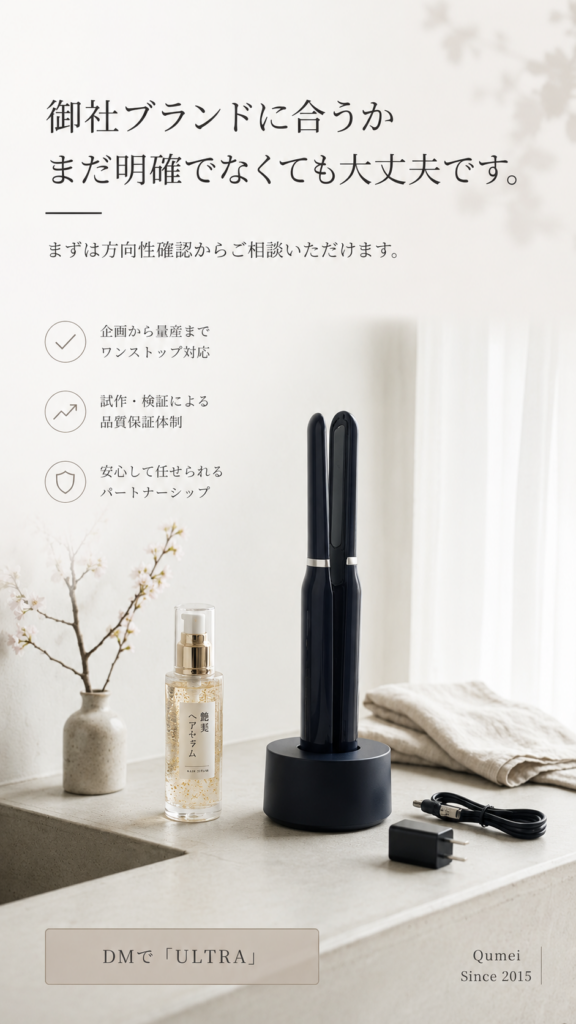
Ultrasonic Hair Care Device: Why Formula Compatibility Matters Before Development
Ultrasonic hair care devices are becoming an interesting direction for hair care brands, salon care brands, and D2C beauty companies.
For many brands, the first question is usually:
Can our existing hair mask, conditioner, hair serum, or treatment formula be used with an ultrasonic hair care device?
The answer is not simply yes or no.
An ultrasonic hair care device should not be treated as a machine that works equally with every hair care formula. Before development, the formula itself needs to be evaluated.
For a brand, the real question is:
Can this formula be extended into a Device + Formula hair care experience?
That means the formula, device structure, usage flow, sealing design, and consumer expectations need to work together.
Why Formula Compatibility Comes First
In many beauty device projects, brands start by asking about the device:
- What is the ultrasonic frequency?
- Is it cordless?
- How long can it be used?
- Does it have infrared light?
- Can it be customized?
These questions are important, but they are not the starting point.
For an ultrasonic hair care device, the more important questions are:
- What formula will be used with the device?
- Is the formula water-based or oil-based?
- Is it rinse-off or leave-in?
- Is it thick, sticky, or easy to clean?
- Does it contain particles, powder, capsules, or sediment?
- Will it affect the device surface, sealing, or long-term reliability?
If these questions are not checked early, the project may face issues later, such as poor user experience, difficult cleaning, residue buildup, unstable performance, or after-sales complaints.
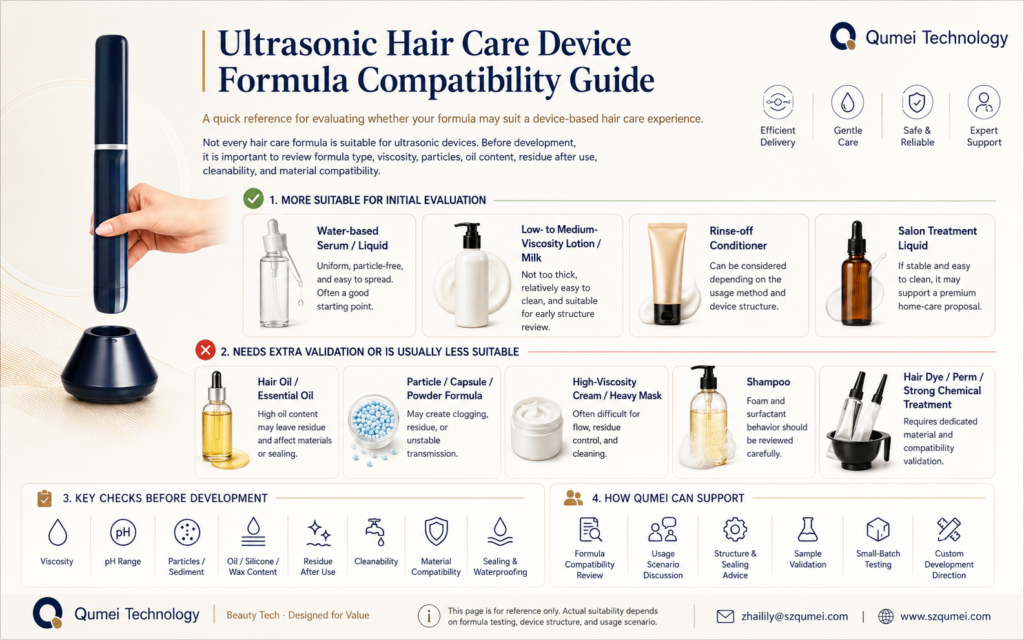
Which Formulas Are More Suitable for Initial Testing?
Not all formulas are equally suitable for ultrasonic hair care device development.
In general, the following formula types are more suitable for early evaluation.
1. Water-Based Hair Care Liquids or Serums
Water-based, uniform, particle-free formulas are usually easier to evaluate in the early stage.
They often have better fluidity and are easier to clean after use. For a brand, this type of formula may be a good starting point for testing a Device + Formula concept.
2. Low-to-Medium Viscosity Hair Care Lotions or Milks
Hair milks, lightweight treatment lotions, and low-to-medium viscosity formulas can also be considered.
However, the formula should be checked for:
- Residue after use
- Cleaning difficulty
- Oil or silicone content
- Compatibility with metal plates, plastic parts, and silicone seals
- User experience after repeated use
3. Rinse-Off Conditioners or Hair Masks
Rinse-off conditioners and hair masks can be tested when they are applied externally to the hair and used with a clamp-type ultrasonic treatment device.
However, they should not be poured directly into internal reservoirs, pumps, misting systems, or liquid channels unless the device is specifically designed for that use.
4. Salon Treatment Liquids
Salon treatment liquids may be suitable for premium home-care concepts if the formula is stable, particle-free, and easy to clean.
This is especially relevant for salon care brands that want to extend professional treatment into home care.
Which Formulas Require Caution?
Some formulas may look attractive from a marketing perspective, but they can create technical risks when combined with a device.
1. Formulas with Particles, Powder, Capsules, or Sediment
Formulas containing particles, plant powders, pearl powder, glitter, capsules, or sediment require caution.
They may cause:
- Residue buildup
- Clogging
- Unstable contact with the device surface
- Cleaning difficulty
- Higher after-sales risk
For this reason, particle-based formulas are usually not the first choice for ultrasonic device development.
2. High-Oil Hair Oils or Essential Oil Blends
High-oil formulas may leave residue on the device surface. They can also affect cleaning, sealing materials, plastic parts, and long-term reliability.
Hair oils can be tested only after material compatibility and cleaning performance are reviewed carefully.
3. High-Viscosity Creams or Heavy Hair Masks
Heavy masks and cream-type formulas may be difficult to spread evenly and clean after use.
They may be tested for external application, but they are not recommended for tanks, pumps, misting systems, or internal liquid channels.
4. Shampoo
Shampoo is usually not the first choice for ultrasonic hair care device development.
Foam, surfactants, rinse-off behavior, and residue control need to be evaluated carefully.
5. Hair Dye, Perm Solution, or Strong Chemical Treatment Liquids
Hair dye, perm solution, and strong chemical treatments are not recommended for standard ultrasonic hair care devices unless dedicated safety and material validation is performed.
These formulas may have stronger chemical activity and require a very different development approach.
Key Checks Before Development
Before developing an ultrasonic hair care device, brands should evaluate the formula from multiple angles.
A basic compatibility review may include:
- Formula viscosity
Is the formula too thick or easy to spread? - pH range
Could it affect metal plates, coatings, plastic parts, or sealing materials? - Particles or sediment
Does the formula contain powder, capsules, glitter, or unstable particles? - Oil, silicone, or wax content
Will it leave residue or make cleaning difficult? - Residue after use
Will the formula remain on the device surface, hinge, gap, or plate area? - Cleanability
Can users clean the device easily after use? - Material compatibility
Is the formula compatible with metal, plastic, silicone, coating, and sealing parts? - Waterproofing and sealing impact
Will repeated liquid contact affect the device’s sealing or long-term reliability?
These checks help brands avoid developing a product that looks attractive but creates problems in actual use.
Why Device + Formula Is a Better Development Approach
An ultrasonic hair care device should not be positioned only as a standalone machine.
For hair care brands, the stronger opportunity is:
Device + Formula
This means the device is developed around a specific treatment formula, usage scenario, and consumer experience.
For example:
- A hair mask brand may create a premium home-care set.
- A salon brand may extend professional treatment into home use.
- A D2C hair care brand may create a higher-value SKU.
- A treatment serum brand may improve the perceived value of its existing formula.
In this approach, the device is not replacing the formula.
It is helping the brand create a more complete hair care experience.
A Lower-Risk Development Path
For brands that are new to hair care devices, it is not necessary to start with full tooling immediately.
A safer development path can be:
- Review the formula type
- Check formula compatibility
- Define the usage scenario
- Test sample devices with the formula
- Evaluate cleaning, residue, and user experience
- Consider small-batch testing
- Decide whether custom development is necessary
This process helps reduce development risk before investing in full tooling or mass production.
How Qumei Supports Hair Care Brands
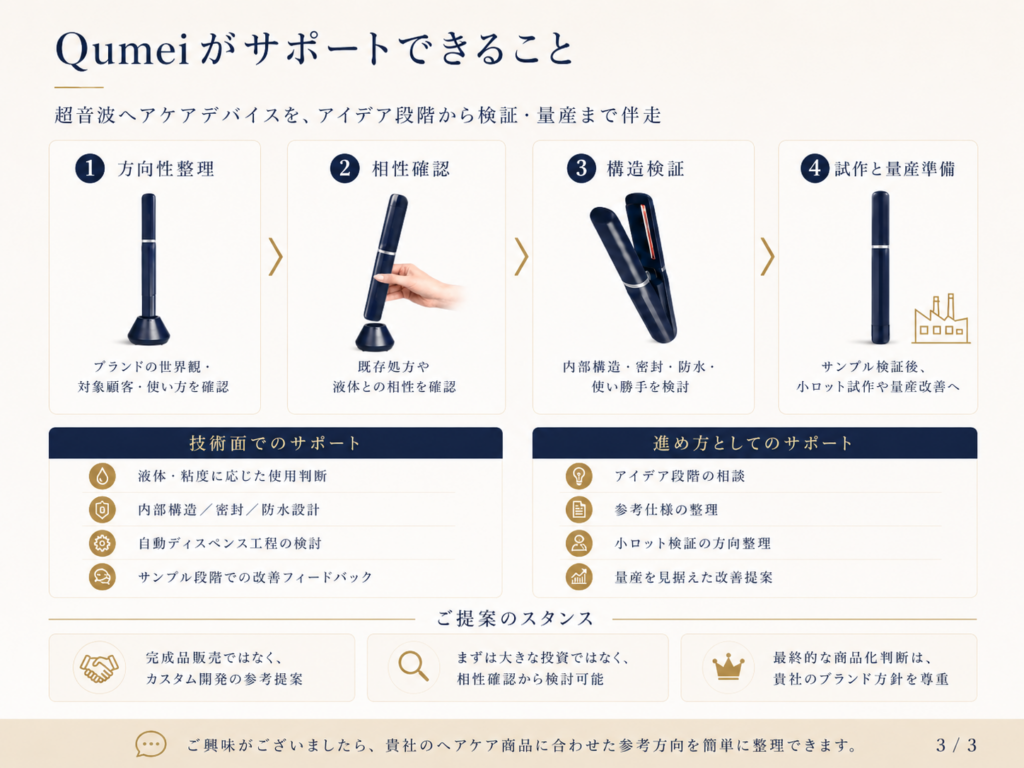
Qumei supports beauty and hair care brands in early-stage ultrasonic hair care device development.
Our support can include:
- Formula compatibility evaluation
- Usage scenario definition
- Structure and sealing design advice
- Waterproofing and cleanability review
- Sample validation
- Small-batch testing
- Custom development direction
We do not recommend treating ultrasonic hair care devices as machines suitable for all hair care products.
A more practical approach is to validate the formula first, then decide whether it is suitable for a Device + Formula concept.
FAQ
Can any hair conditioner be used with an ultrasonic hair care device?
Not always. Some rinse-off conditioners may be suitable for external application with a clamp-type device, but the formula still needs to be checked for viscosity, residue, cleaning, and material compatibility.
Can hair oil be used with an ultrasonic hair care device?
Hair oil requires caution. High-oil formulas may leave residue and may affect cleaning, sealing materials, and long-term reliability.
Are particle-based hair masks suitable?
Generally, particle-based formulas are not recommended as a first-choice direction. Particles, powders, capsules, or sediment may cause residue, clogging, or unstable contact.
Should brands develop the device first or test the formula first?
Formula compatibility should be checked early. The device, formula, usage flow, and cleaning method should be considered together.
Client Decision Checklist
Before starting an ultrasonic hair care device project, brands should ask:
- What formula will be used with the device?
- Is it rinse-off or leave-in?
- Is the formula water-based, oil-based, or cream-based?
- Does it contain particles, powder, capsules, or sediment?
- Is it easy to clean after use?
- Will it affect sealing, waterproofing, or long-term reliability?
- Can the formula and device create a clear consumer experience?
Discuss Your Ultrasonic Hair Care Device Project with Qumei
If you are considering extending your existing hair care formula into a device-based experience, Qumei can support early-stage evaluation, formula compatibility review, sample validation, sealing design, and small-batch testing.
Need support for your hair tool development project?
Qumei supports Japan-oriented hair tool ODM development from concept discussion to stable production.
 Discuss your project with Qumei
Continue Exploring Qumei Insights
Explore more articles about hair tool development and Japan-market ODM strategy.