
Meta description: For haircare brands, low-temperature styling is not a temperature label; it is a measurable performance question.
Why 160°C matters—and what it does not prove
In September 2026, Panasonic introduced the EH-HN30 straightener, reporting a one-stroke straightening result at a displayed 160°C setting compared with a previous model at 170°C. The company attributes its performance to a sensor-equipped ceramic heater that responds to temperature drop and a moving plate structure designed to improve hair contact. This is a manufacturer-specific comparison, not evidence that every straightener can style every hair type at 160°C.
L’Oréal’s infrared Light Straight + Multi-styler, unveiled at CES 2026, offers another research path. It remains a development program, with R&D completion anticipated by the end of 2027. These announcements should encourage product teams to ask for evidence rather than copy a temperature number.
Three questions that define performance
Is the temperature stable?
The display shows a setpoint; it does not show the full surface response while hair extracts heat. Record the largest surface temperature drop, recovery time and variation during consecutive passes.
Does heat reach the hair evenly?
Check temperature distribution across the plate and how the surfaces meet a controlled hair section. Plate flatness, floating movement, pressure and substrate construction can influence contact.
Does it actually style?
Evaluate the number of passes required for a target straightness, then measure how long the result survives a standardized humidity challenge. A lower setting that requires extra passes is not automatically a gentler result.
A practical screening protocol
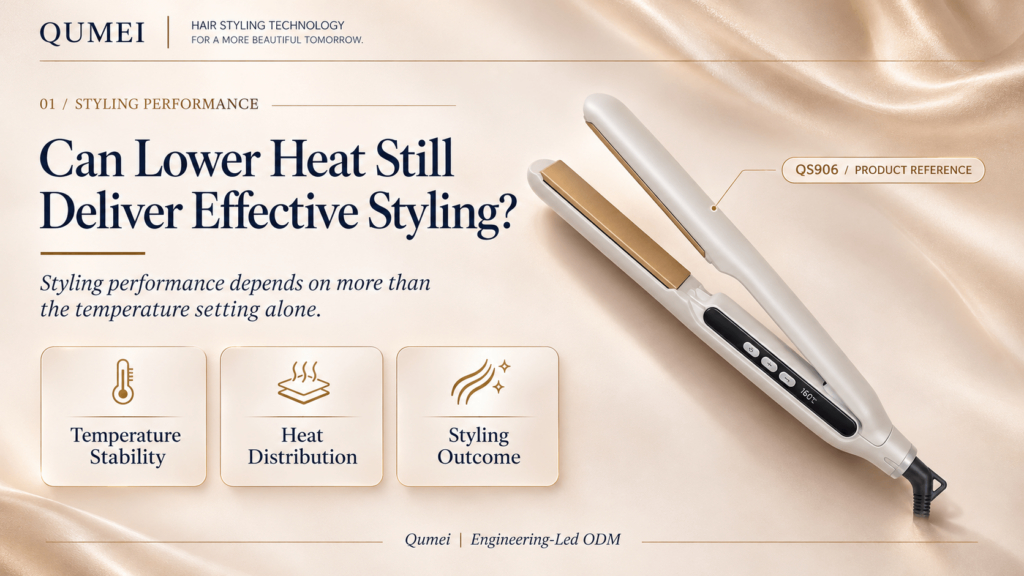
Start with 140, 160 and 180°C as trial settings, not universal consumer recommendations. Prepare consistent, clean, dry hair bundles, separate by hair type, and condition them in a defined environment. Use consistent bundle mass, length, pass speed and pressure. Record plate temperature during each pass. Photograph the bundles with fixed distance and lighting, measure straightness or curl retention, and repeat tests for reproducibility. If a promising condition emerges, expand to repeated-use hair-damage and mechanical tests before making care claims.
What claims can be supported?
A controlled test may support a narrow claim such as “achieved our defined straightness threshold in one pass under stated conditions.” It does not by itself establish lower breakage, improved moisture retention or overall hair safety. Those require suitable validated methods and comparative evidence.
What this means for an ODM brief
Instead of asking for the highest possible temperature, specify hair type, desired finish, allowed number of passes, runtime, tolerable temperature variation and the evidence the brand expects to review. Qumei can use that brief to plan feasibility testing and product development; performance of its existing models must be verified separately.
FAQ
Is 160°C enough?
For some devices, hair types and target results, yes; it is not guaranteed for every case.
Is MCH automatically better than PTC?
No. Heater design, temperature sensor placement, control, mass and plate contact determine system behavior.
Is lower temperature always safer?
No. Total exposure, repeated passes and the condition of the hair matter.
How should a new brand begin?
Define a target hair bundle and measurable finish, run a controlled temperature screen, then verify reliability and hair effects before marketing claims.
Source / verification: https://news.panasonic.com/jp/topics/206886; https://www.loreal.com/en/press-release/group/loreal-advances-leadership-in-beauty-tech-at-ces-2026