
Ceramic Coating vs PTFE-Based “Silk Plate”: How to Evaluate a Hair Straightener Surface
Quick answer
Ceramic-coated plates and PTFE-based film or tape surfaces are different surface-system options for hair straighteners. Neither name, by itself, proves smoother styling, lower hair damage or better durability. A credible comparison requires the actual material construction, working temperature, hair-contact behavior, repeated-use performance and appropriate safety review.
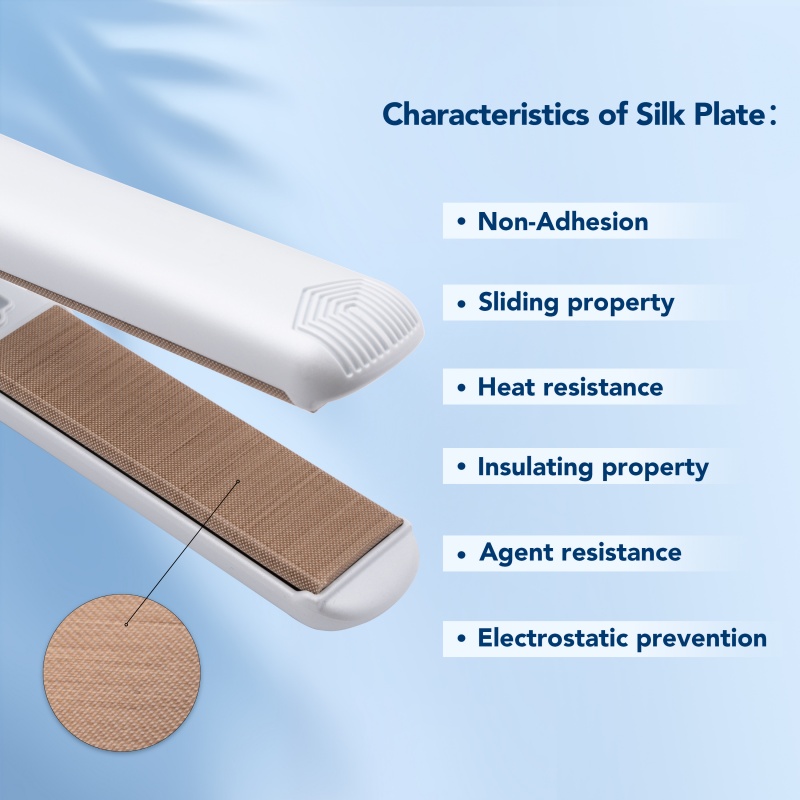
Qumei uses the internal development name “Silk Plate” for a PTFE-based tape surface option. The name is a product-positioning shorthand, not a scientific material category or a verified performance claim.
1. Separate the substrate from the surface
A straightener plate is not one homogeneous material. Its performance depends on the base plate, heater arrangement, surface layer, attachment or bonding method, plate geometry and control system.
A ceramic-coated product generally refers to a coating applied to a substrate. A PTFE-based option may use a film or tape system, with a different bonding and edge-treatment strategy. The exact formulation and construction vary by supplier; “ceramic” and “PTFE” alone are insufficient procurement specifications.
Before comparing samples, request a material declaration, intended temperature range, thickness or coating specification, attachment method, cleaning guidance and any applicable safety documentation. A familiar trade name is not a substitute for those records.
2. What does “smooth glide” actually mean?
Glide is a combined effect of the surface and the hair bundle. It can change with hair type, moisture state, product residue, pass speed, contact pressure and plate geometry. A sample that feels smooth in one demonstration may behave differently after repeated heating or on a different tress.
A practical test could use matched hair tresses, controlled humidity, fixed plate temperature, defined pass speed and repeatable pulling or friction measurements. Record both objective indicators and structured operator observations. For a new surface, include fresh and aged samples.
This is also why lower-damage claims need separate evidence. Less perceived drag is not identical to less cuticle damage or lower thermal exposure. Research on flat ironing has shown that temperature, movement speed, number of passes and exposure time interact with both styling result and hair-fibre outcomes. See Purdue’s thermal flat-ironing research (https://docs.lib.purdue.edu/open_access_dissertations/1736/).
3. Thermal performance belongs in the comparison
Two surfaces may be operated at the same set temperature while behaving differently at the hair-contact interface. The relevant questions include heat-up behavior, spatial uniformity, temperature recovery during passes and sensor placement.
A test should distinguish the device’s displayed setpoint from measured plate temperature. Measure multiple locations on the usable contact surface and record the conditions under which the readings were taken. If a film changes the thermal path, the control algorithm or sensor position may need review.
A single maximum-temperature screenshot is not enough. The goal is to understand how the plate behaves during realistic styling sequences.
4. Surface durability is more than a scratch test
A plate can look attractive when new but degrade at the edges, seams or contact area after repeated use. Depending on the construction, potential failure modes include coating wear, film lifting, discoloration, residue build-up, localized damage or changes in glide.
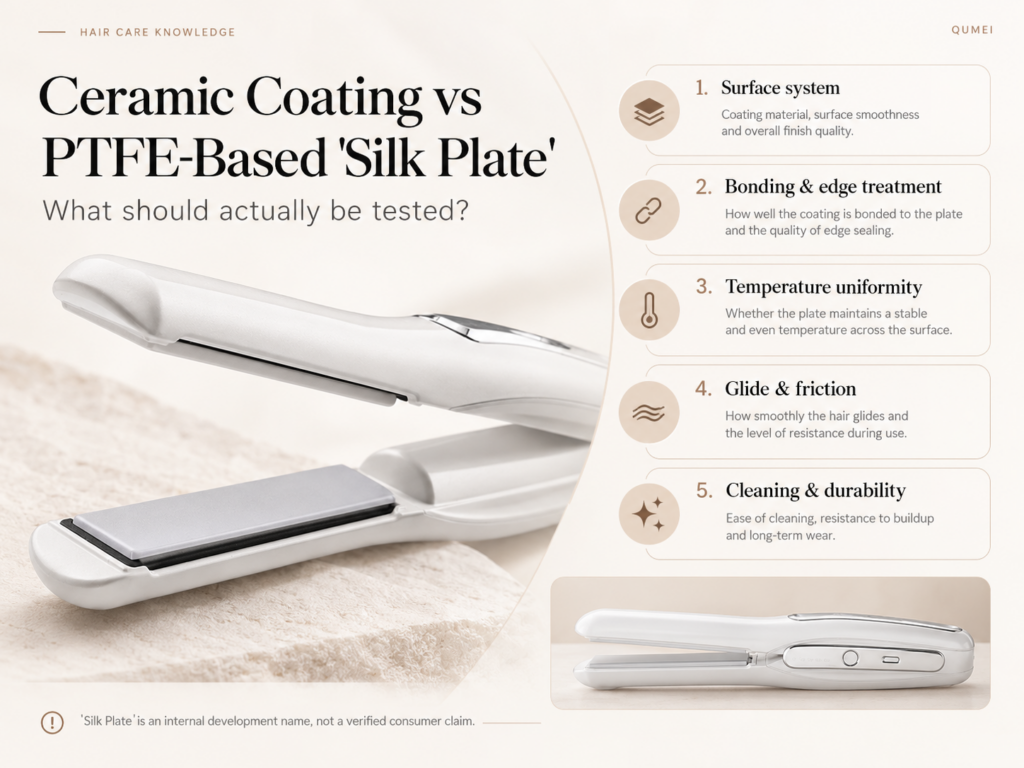
Useful evaluation categories include:
Area | What to define |
Heating cycles | Temperature, dwell time, number of cycles and inspection points |
Mechanical contact | Hair-tress method, contact load and repeated passes |
Cleaning | Approved cleaning method, residue type and repetition |
Edge/adhesion | Inspection of film or coating boundaries after use |
Appearance | Defined color, gloss, texture and acceptable changes |
Performance retention | Glide and thermal measurements before and after aging |
The correct thresholds depend on the actual material and product brief. It would be misleading to present one universal cycle count as a guarantee for all surfaces.
5. Material and formula compatibility require special care
A hair-care brand may wish to pair a straightener with a mist, milk, oil or serum. That does not mean the formula can safely be applied directly to a hot plate or used on hair under every thermal condition.
The relevant review includes ingredient behavior under heat, residue formation, inhalation exposure, surface compatibility, cleaning and instructions for use. Research has reported airborne particle formation during some heat-styling activities involving hair products; it does not establish the risk of any specific Qumei device or formula. See the 2025 research article (https://pubs.acs.org/doi/10.1021/acs.est.4c14384).
For existing high-temperature straighteners, do not claim formula-device compatibility without dedicated safety and performance testing. A separate care-device platform may be the better development route for certain formulations.
6. How to compare two surface samples fairly
Use the same product architecture wherever possible. If the substrate, heater, control software and geometry all change at once, it becomes difficult to attribute differences to the surface.
A staged comparison can work well:
Stage A — Documentation. Confirm material, process, supplier and intended operating conditions.
Stage B — Initial performance. Measure temperature behavior, glide and visual finish on defined samples.
Stage C — Repeated use. Apply a documented heating, hair-contact and cleaning sequence.
Stage D — Retest. Repeat the initial measurements and inspect for edge or adhesion changes.
Stage E — Brand decision. Compare the result with the desired styling experience, production yield, cost and after-sales risk.
This matrix is a proposal for evaluation, not a statement that any particular surface has already passed these tests.
7. What can a brand responsibly claim?
Without comparative evidence, descriptive claims such as “PTFE-based surface option,” “ceramic-coated plate” or “developed for smooth handling” may be more defensible than absolute claims about hair health. Even qualitative phrases should reflect the actual product and material documentation.
If a brand wants to claim “less pulling,” “fewer passes” or “less damage,” it should define the comparator, test method, sample size and statistical or practical significance before writing the marketing line.
Qumei’s development perspective
Qumei supports hair straightener platforms with different surface options, including an internal PTFE-based “Silk Plate” direction. We see the surface as part of the complete heating and user-contact system. A brand’s desired feel matters, but it must be connected to a repeatable verification method.
The useful question is not which surface sounds more premium? It is which surface can deliver the intended experience consistently, under defined conditions, with acceptable durability and production control?
FAQ
Is a PTFE-based plate automatically gentler on hair than ceramic?
No. Comparative hair-damage claims require controlled testing and cannot be inferred from the surface name.
Is “Silk Plate” a material standard?
No. In this article it is Qumei’s internal name for a PTFE-based tape surface option.
Should friction be measured on real hair?
For a meaningful styling comparison, matched hair tresses and controlled conditions are important; instrument-only material friction is not the whole experience.
Can a hot straightener be used with any hair serum?
No. Ingredient, temperature, residue, exposure and surface compatibility must be evaluated for the specific routine.
What should be retested after a plate-surface change?
Thermal behavior, glide, durability, adhesion or edge condition, cleaning and any affected safety requirements.
Sources / editorial evidence
S10 Hahn, Purdue thermal flat ironing study (2018) — https://docs.lib.purdue.edu/open_access_dissertations/1736/
S21 Heat transfer in human hair (2019) — https://onlinelibrary.wiley.com/doi/10.1111/ics.12553
S19 Heat styling with hair products nanoparticle study (2025) — https://pubs.acs.org/doi/10.1021/acs.est.4c14384
S16 Qumei Testing & Quality page (Current) —