
Meta Description
Recent Japanese hair-tool launches reveal a shift from simple heat styling toward care-assisted styling, morning refresh, compact use cases and formula-device routines. Here are four signals hair-care brands should watch before developing their next device.
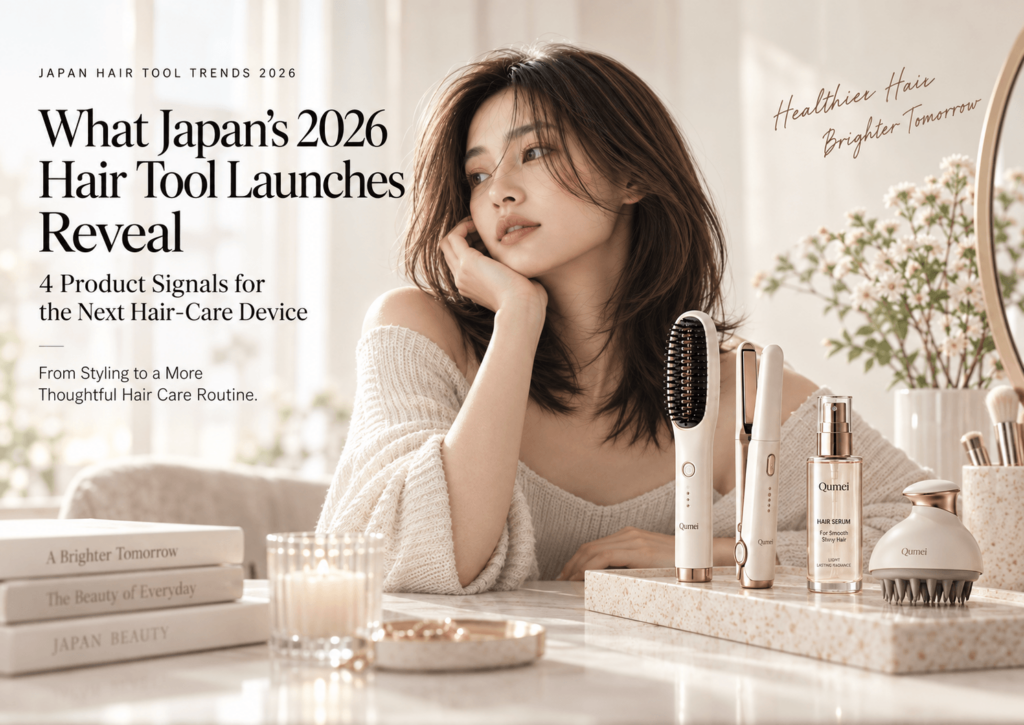
What Japan’s 2026 Hair Tool Launches Reveal: 4 Product Signals for the Next Hair-Care Device
The Japanese hair-tool market is not simply producing more straighteners, brushes and scalp devices.
A more interesting change is happening underneath the new launches.
The consumer problem being solved is gradually moving away from “How can I style my hair?” toward questions such as:
How can I refresh my hair quickly in the morning?
How can I style frequently without feeling that I am repeatedly exposing my hair to unnecessary heat?
How can I maintain bangs, face-framing sections and hair ends outside the home?
How can a hair-care formula and a tool work together as one routine?
Looking at several Japanese launches in 2026, we see four product signals that may be more useful to hair-care brands than simply following individual product trends.
These signals do not tell every brand to develop the same device. They help answer a more important question:
What kind of consumer job may deserve a new device in the first place?
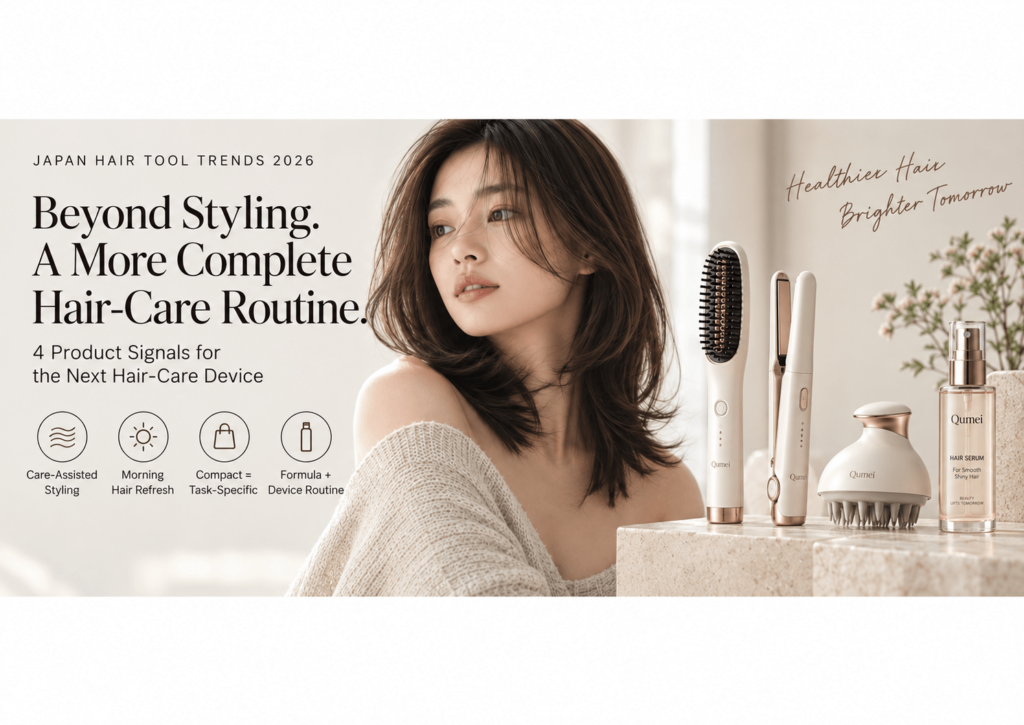
1. Styling Is Moving Toward Care-Assisted Styling
Traditional hair tools have usually competed around a familiar set of specifications: temperature, heating speed, plate performance, straightening power and styling result.
Those factors still matter.
However, several recent launches show brands trying to combine styling performance with a stronger “care” story.
In August 2026, icoelle launched its Care Steam Brush Iron around three very specific consumer problems: morning time efficiency, concern about hair damage and the return of unwanted texture caused by humidity or perspiration during the day. According to the company, the product subsequently achieved strong Rakuten ranking performance immediately after launch.
ReFa’s 2026 Straight Iron CS takes another route. Rather than increasing maximum temperature or making the device more powerful, the product combines a compact format with the brand’s existing plate and heat-sensing technologies, targeting both straight styling and more nuanced work around the face and hair ends.
The product-development signal is important.
Consumers still want styling results, but brands increasingly need to explain how the styling process fits into long-term hair care.
For a hair-care brand, this creates an opportunity beyond simply selling another straightener.
A future device may be designed around lower heat exposure, fewer passes through the same section, better heat control, reduced friction, improved moisture management or a combination of treatment and styling.
The important question is therefore no longer only:
“How well does the device straighten hair?”
It may also become:
“What is the minimum amount of heat and mechanical stress needed to achieve the consumer’s desired result?”
That change in question can lead to very different product architecture.
2. Morning Hair Refresh Is Becoming a Product Use Case of Its Own
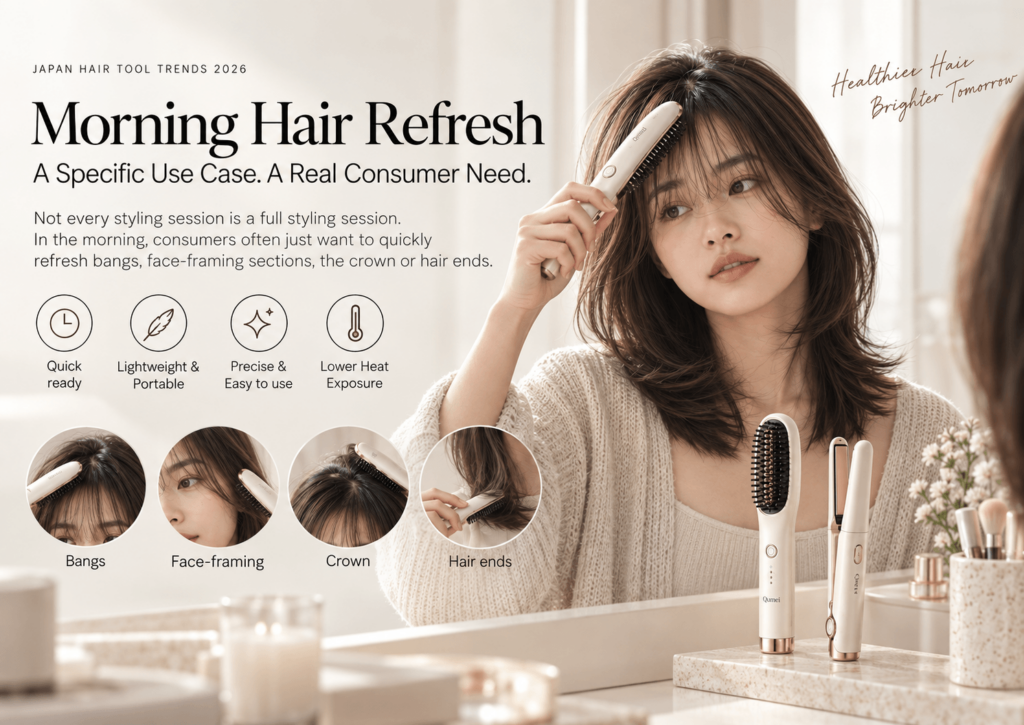
Not every styling session is a full styling session.
This sounds obvious, but it has major implications for device development.
A consumer styling her entire head before an event has very different requirements from someone who has five minutes in the morning and only wants to correct bangs, a flattened crown, face-framing sections or outward-turning hair ends.
SALONIA’s renewed Cordless Straight Hair Iron illustrates this distinction. Its 2026 update shortened the time required to reach 140°C to approximately 60 seconds and added a 160°C setting between the existing temperature options. The brand explicitly positions the product around convenient styling outside the home and bangs touch-up.
ReFa’s compact Straight Iron CS similarly responds to requests for easier portability and travel use.
These products suggest that morning refresh and touch-up should be treated as their own consumer job, rather than as a smaller version of full-head styling.
Once the job changes, the product priorities change too.
For full styling, power and sustained performance may dominate.
For morning refresh, consumers may value fast readiness, low weight, easy handling, face-framing precision and reduced heat exposure more than maximum runtime or maximum temperature.
This opens an interesting space for hair-care brands.
A brand that already owns the consumer’s night treatment routine may not need to compete directly with professional styling tools. It may instead extend into the next moment of the consumer journey:
Night care → sleep → morning refresh → finishing care.
That can create a much more natural reason for a device to exist.
3. “Compact” Should Mean a Different Product Definition, Not Just a Smaller Body
One of the most common mistakes in compact-device development is to begin with a successful full-size product and simply make it smaller.
That approach often produces compromises rather than a better product.
A compact tool has different constraints.
The hand position changes.
The distance between the user’s hand and the styling area changes.
The heating surface becomes smaller.
Battery space becomes limited.
The relationship between heating speed, runtime and weight becomes more difficult.
Most importantly, the consumer often uses the product differently.
This is why we believe the most useful development question is not:
“How can we make this straightener 30% smaller?”
It is:
“What styling task does the compact device need to perform exceptionally well?”
For example, a device designed mainly for bangs and hair ends may not need the same battery capacity as a tool intended for full-head styling.
A travel refresh tool may benefit more from being genuinely light and easy to store than from having long continuous runtime.
A face-framing tool may need better plate visibility and control rather than a wider heating area.
Once the use case is defined clearly, decisions about size, battery, plate width, temperature, charging and weight become much easier.
Compact development is therefore not a dimension-reduction exercise.
It is a product-definition exercise.
4. Hair-Care Brands Are Beginning to Build Routines, Not Isolated Products
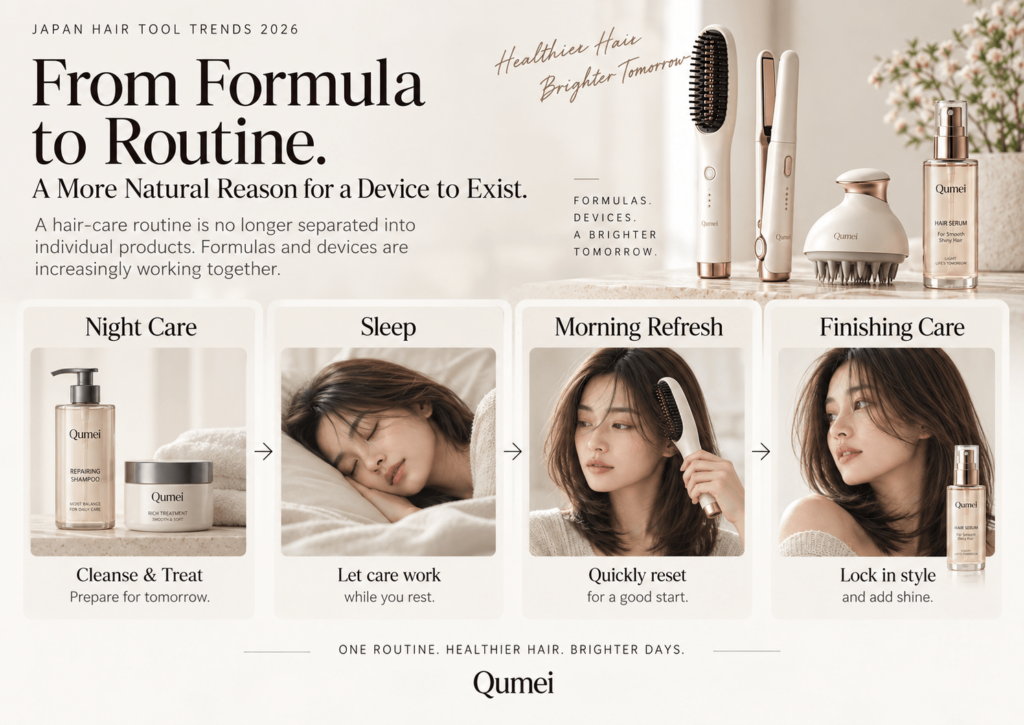
Perhaps the most important signal is happening outside conventional hair irons.
Several 2026 launches show hair-care brands extending formulas into brushes and devices.
Kracie’s new Hareca brand originally launched with shampoo, treatment and scalp serum. It later introduced an in-bath brush and a “Perfect Set” combining the brush with the existing formulas, turning a product line into a more complete scalp-and-hair routine.
SNOW FOX introduced a Hair & Scalp Serum together with a premium infrared brush and explicitly presents the routine as serum first, followed by brushing and warming.
ANGFA is also extending its scalp-care expertise into home devices. Its Scalp D Electroshot Pro, announced in August 2026 for an October launch, brings a dedicated device into a brand already strongly associated with scalp-care products.
These examples do not all use the same technology.
That is exactly the point.
The opportunity is not necessarily “electrification.”
The opportunity is to identify a missing physical action inside an existing hair-care routine.
A formula may provide lubrication, conditioning, moisture or scalp ingredients.
A device may improve access, distribution, brushing, controlled heating, massage, atomization or application consistency.
When these roles are clearly separated, a tool can strengthen the existing product line rather than compete with it.
What This Means for a Hair-Care Brand Planning Its Next Device
Before choosing a technology, we believe a brand should answer four questions.
Question 1: Which existing consumer routine already belongs to the brand?
Is the brand strongest in shower care, intensive treatment, scalp care, morning styling or finishing?
The closer the device is to a routine consumers already associate with the brand, the lower the education burden.
Question 2: What consumer action remains inconvenient?
It may be uneven application, difficult scalp access, repeated heat styling, long morning preparation, humidity-related style loss or difficulty treating the back of the head.
This action is often a more valuable starting point than a technology.
Question 3: Does the device create a meaningful new value?
A device should ideally improve at least one of three things:
The consumer experience.
The functional performance of the routine.
The commercial value of the product system.
If it does none of these and exists only because “beauty devices are growing,” the project may not deserve the additional complexity.
Question 4: Can the value be explained in one sentence?
A strong concept is usually easy to explain.
For example:
“Refresh bangs and hair ends quickly without a full styling session.”
“Help distribute the treatment more consistently through the hair.”
“Extend a night-care routine into morning hair refresh.”
If the value requires a long technical explanation before consumers understand why the product exists, the product definition may still be too complicated.
Four Product Directions Worth Watching
The first direction is low-heat hair refresh.
This is especially relevant to brands already associated with damage care, moisture care or daily treatment. The opportunity is not necessarily a stronger styling tool, but a tool designed specifically for frequent, low-burden correction.
The second direction is formula-assisted styling.
This includes mist, serum, treatment or other formula systems where the device contributes to distribution, controlled heat or application.
The third direction is scalp formula plus physical action.
Scalp essences and serums already exist in many portfolios. Brushes, applicators or devices can potentially solve access, application consistency and routine-building problems.
The fourth direction is compact task-specific tools.
Instead of shrinking an existing product, brands can define a narrow consumer task first and design the device around it.
The Opportunity for ODM Development Is Changing Too
For an ODM manufacturer, this market shift changes the job.
The traditional process often begins when a buyer sends a reference image and asks for price, specification and tooling cost.
That process still exists.
But more differentiated projects increasingly begin earlier.
A brand may know the consumer problem but not yet know whether it needs a brush, a heated tool, a mist system or an ultrasonic device.
In this situation, the first development task is not engineering.
It is product definition.
At Qumei, we believe the useful sequence is:
Consumer Job → Routine → Device Role → Technology → Prototype → Validation → Tooling.
Starting from the technology and trying to find a consumer story afterward usually creates a weaker product.
Final Thought
The most interesting change in Japan’s 2026 hair-tool market is not one specific technology.
It is the shift from isolated hardware toward devices designed around smaller, more specific moments in the consumer’s hair-care routine.
Styling is becoming more care-aware.
Morning refresh is becoming its own use case.
Compact devices are being defined around specific tasks.
Hair-care formulas and physical tools are beginning to form connected routines.
For brands considering a new device category, the opportunity may therefore be less about asking:
“What beauty device is trending?”
and more about asking:
“Which part of our consumer’s current hair routine is still difficult, repetitive or incomplete?”
That question often leads to a much stronger product.
FAQ
What hair-device opportunities are growing in Japan in 2026?
Recent launches suggest growing attention to care-assisted styling, morning and out-of-home refresh, compact task-specific devices and routines that connect hair-care formulas with brushes or electronic devices.
Should a hair-care brand develop a device even if it has never sold beauty electronics?
Not necessarily. The first question should be whether a physical tool can meaningfully improve an existing consumer routine. A simple brush or applicator may sometimes create more value than a complex electronic device.
Is a compact hair tool simply a smaller version of a full-size product?
Usually it should not be. Compact products often serve different use cases, such as bangs, face-framing sections, hair ends, travel or quick refresh. These use cases should determine battery, temperature, size and handling requirements.
What should a brand define before contacting an ODM manufacturer?
The most useful starting information is the target consumer, use moment, current routine, problem to solve and the role the device is expected to play. Technology selection can follow afterward.