Meta Description
Learn when beauty brands should choose a ready product, Semi-ODM or Full ODM for a new hair device, and how to reduce development risk before investing in tooling.
Ready Product, Semi-ODM or Full ODM? How Beauty Brands Can Reduce Device Development Risk
When a beauty or hair-care brand decides to launch a device, one of the first questions is often:
Should we use an existing product, customize an existing platform, or develop a completely new device?
There is no single correct answer.
A first-time device launch with uncertain demand should not necessarily follow the same development path as a proven product category that the brand expects to sell for many years.
The right level of customization depends on:
market certainty
expected sales volume
brand strategy
existing formula portfolio
required differentiation
product performance requirements
development budget
acceptable risk
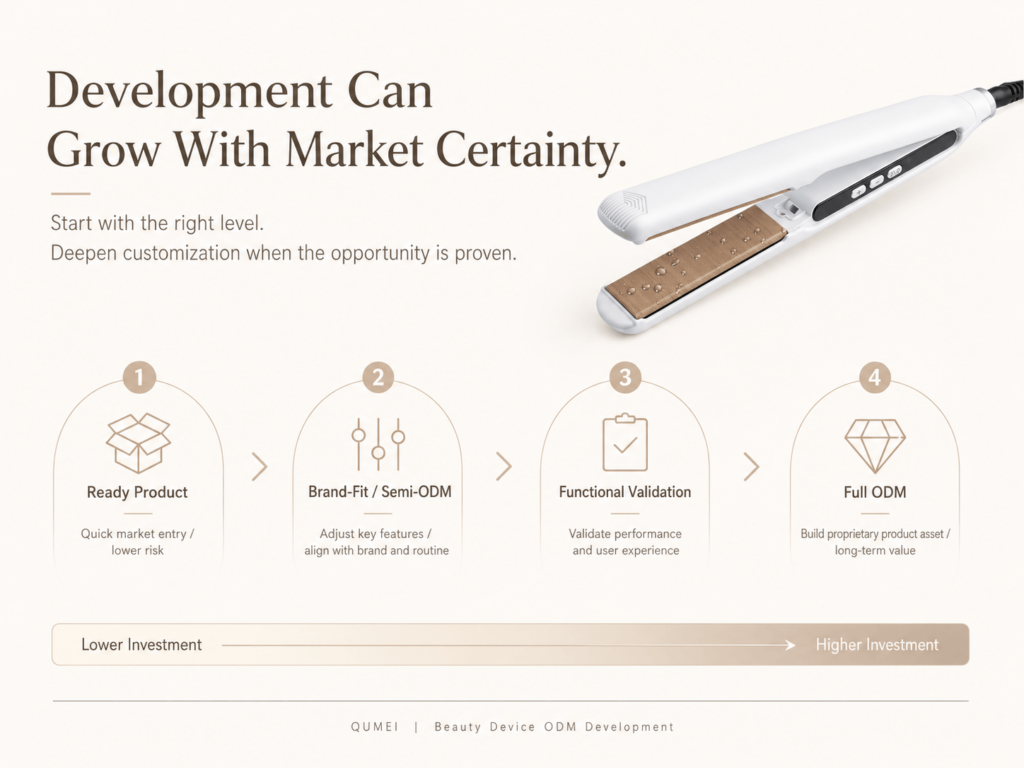
For this reason, we prefer to think about device development as a progression:
Ready Product
↓
Brand-Fit / Semi-ODM
↓
Functional Validation
↓
Full ODM
The key principle is simple:
Customization should grow together with market certainty.
A brand does not need to invest in the deepest level of customization before it has evidence that the product opportunity deserves that investment.
1. Why Full ODM Is Not Always the Best First Step
Full ODM can create strong product differentiation.
But it also introduces more uncertainty at the beginning of the project.
A completely new device may require:
industrial design
structural engineering
new tooling
electronic development
component development
certification
production testing
MOQ commitment
inventory
launch investment
If the brand has already proven the category, this investment may make strategic sense.
But if the brand is:
launching its first beauty device
testing a new category
unsure about annual volume
still validating consumer demand
still defining the usage routine
then a full custom project may create unnecessary early risk.
The better question is not:
“Can we make a completely new device?”
It is:
“How much customization is justified at this stage?”
2. What Is a Ready Product?
A Ready Product is an existing, validated product platform that can be offered with relatively limited customization.
Typical adjustments may include:
logo
color
packaging
basic accessories
instructions
limited cosmetic changes
The main structure and function already exist.
This usually means the brand can enter the market with lower development complexity.
When a Ready Product Makes Sense
A Ready Product can be useful when:
The Brand Is Entering Devices for the First Time
The biggest uncertainty may not be product engineering.
It may simply be:
Will our customers buy a device from our brand?
In this situation, the brand may first want to understand:
consumer acceptance
sales channel response
price range
return rate
customer-service burden
repeat demand
before investing deeply in a proprietary platform.
Market Demand Is Still Uncertain
If the category is new to the brand, a mature platform can act as a lower-risk market test.
Speed Matters More Than Maximum Differentiation
A Ready Product can also be appropriate when the objective is:
faster launch
seasonal opportunity
retail test
channel test
limited edition
Limitations of a Ready Product
The trade-off is differentiation.
If several brands use the same platform, consumers may compare products more easily based on:
price
color
packaging
promotion
The brand also has less control over the deeper user experience.
So a Ready Product can be useful for validation, but it may not always be the best long-term brand asset.
3. What Is Semi-ODM?
Semi-ODM sits between a Ready Product and a completely new Full ODM project.
The core platform already exists.
But the product is adjusted more deeply to fit the brand’s:
consumer
routine
formula
performance target
product philosophy
This is an important distinction.
Semi-ODM should not mean:
“Change the color and logo.”
A stronger Semi-ODM project may change:
temperature range
heating curve
brush geometry
plate or contact structure
surface treatment
coating
friction
button logic
operating mode
weight balance
grip feel
CMF
formula compatibility
user routine
In other words:
Semi-ODM can change how a product behaves, not only how it looks.
For many beauty brands, this can provide a useful balance between differentiation and development risk.
4. Why Semi-ODM Can Be a Strong Starting Point
Imagine two brands begin with the same basic straightening-device platform.
Brand A changes:
logo
color
box
Brand B adjusts:
temperature settings
heating logic
surface specification
styling routine
formula compatibility
user instructions
The exterior may still share a similar engineering foundation.
But the consumer experience can become significantly different.
This is especially relevant for hair-care brands.
A device does not always need to become proprietary through exterior design first.
It may become more brand-specific through:
Formula × Device × Routine
For example:
Serum Mist
↓
Temperature-Tuned Styling Device
↓
Morning Hair Refresh Routine
This can be more meaningful than simply creating a new shell around a generic high-temperature tool.
You can read more about this logic in our Formula-to-Device development guide.
5. What Is Full ODM?
Full ODM involves creating a much more proprietary product.
Depending on the project, this may include:
new industrial design
new housing
new structure
new tooling
new internal layout
new functional architecture
customized electronics
specialized formula-delivery structure
proprietary user experience
Full ODM is most valuable when the device is expected to become part of the brand’s long-term product strategy.
Full ODM May Make Sense When:
The Category Is Already Proven
The brand already knows that consumers want this type of device.
The question is no longer:
“Will it sell?”
It becomes:
“How do we own this category more strongly?”
Existing Products Conflict With the Brand Concept
Sometimes a brand has a clear product idea, but existing platforms cannot support it.
For example:
product too large
wrong usage method
unsuitable temperature logic
wrong brush geometry
reservoir architecture does not fit the formula
existing structure feels inconsistent with the brand
At that point, deeper structural development may become necessary.
The Device Is Strategically Important
If the brand expects the product to remain in the market for several years, a proprietary platform can become a long-term product asset.
The Brand Has a Strong Formula Opportunity
A brand with a Hero Treatment, Serum Mist or Scalp Essence may eventually want a device specifically built around that formula and routine.
This can justify deeper ODM.
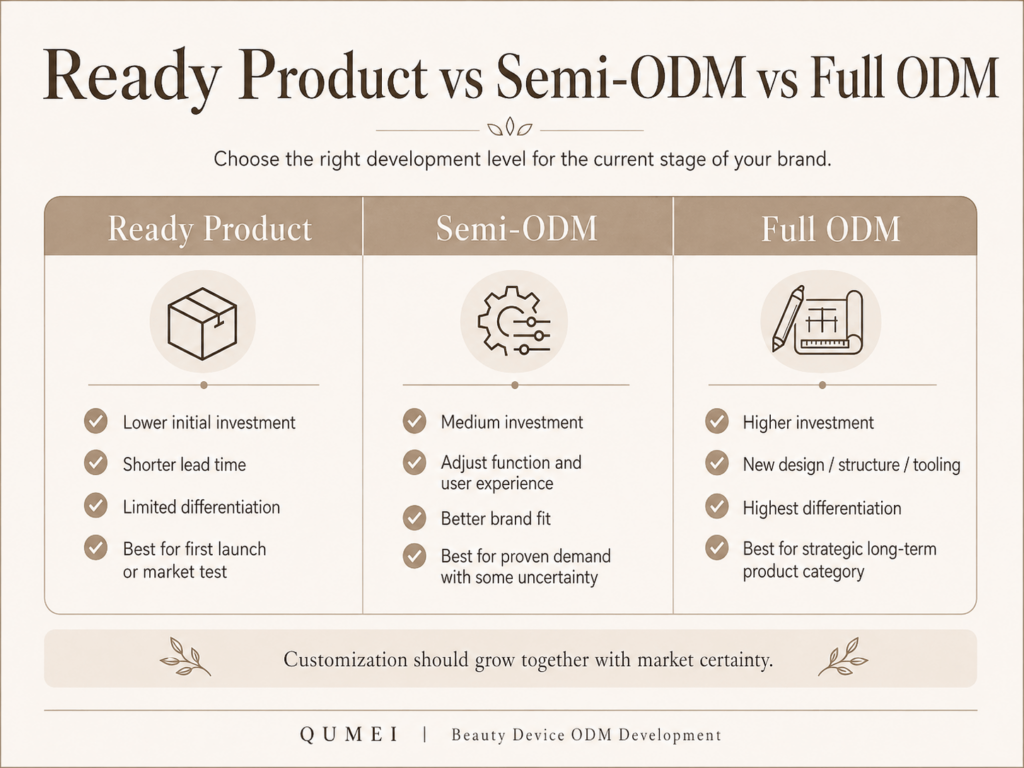
6. Ready Product vs Semi-ODM vs Full ODM
A simple comparison can help clarify the differences.
Development Level
Ready Product
Semi-ODM
Full ODM
Initial investment
Lower
Medium
↓
Higher
↓
Development time
↓
Shorter
↓
Medium
↓
Longer
↓
Engineering uncertainty
↓
Lower
↓
Medium
↓
Higher
↓
Brand differentiation
↓
Limited
↓
Medium–High
↓
Highest
↓
New tooling
↓
Usually no
↓
Sometimes limited
↓
Usually yes
↓
Function customization
↓
Limited
↓
Moderate–High
↓
High
↓
Formula integration
↓
Limited
↓
Possible
↓
Strong potential
↓
Suitable for market test
↓
Strong
↓
Strong
↓
Lower
↓
Suitable for long-term proprietary platform
↓
Limited
↓
Medium
↓
Strong
The goal is not to label one level as “better.”
The goal is to choose the right level for the current stage.
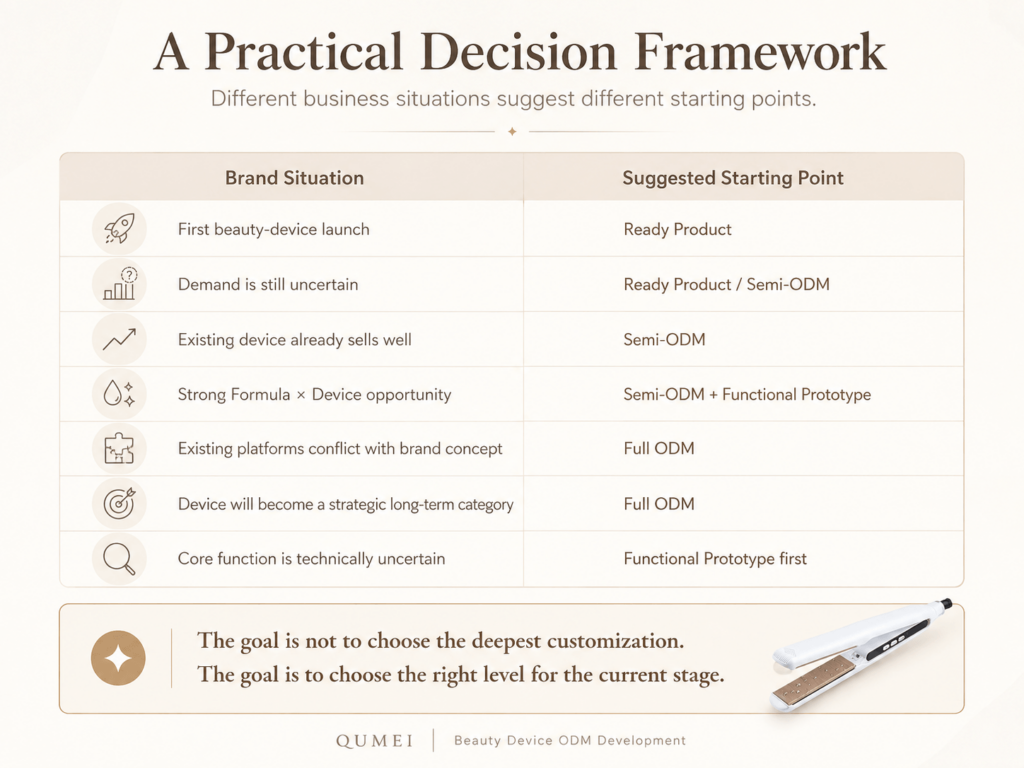
7. A Practical Decision Framework
Different commercial situations suggest different starting points.
Brand Situation
↓
Suggested Starting Point
↓
First beauty-device launch
↓
Ready Product
↓
Demand is still uncertain
↓
Ready Product / Semi-ODM
↓
Existing device already sells well
↓
Semi-ODM
↓
Brand needs better differentiation
↓
Semi-ODM
↓
Strong Formula × Device opportunity
↓
Sem-ODM + Functional Prototype
↓
Existing platforms conflict with brand concept
↓
Full ODM
↓
Device will become a strategic long-term category
↓
Full ODM
↓
Expected annual volume is very low
↓
Avoid heavy Full ODM investment
↓
Consumer routine is still unclear
↓
Validate before tooling
↓
Core function is technically uncertain
↓
Functional Prototype first
This framework is not a rule.
It is a way to align development investment with uncertainty.
8. What Does Semi-ODM Actually Change?
This is where many device projects are misunderstood.
There are two different layers of customization.
Visible Customization
logo
color
packaging
surface appearance
accessories
These are important for brand presentation.
But they do not necessarily change the product experience.
Product-Level Customization
This can include:
Temperature
Not every brand needs the same maximum temperature or temperature steps.
Heating Curve
How quickly does the product reach target temperature?
How stable is the temperature during use?
Brush Geometry
For brush-type devices:
pin spacing
pin height
tension
contact area
can change user experience.
Surface Specification
coating
surface smoothness
friction
plate treatment
can influence hair feel and styling behavior.
Weight and Balance
Two devices with the same weight can feel different depending on the center of gravity.
Controls
button placement
mode switching
display
automatic shutoff
memory function
can be tuned for the intended routine.
Formula Compatibility
If the brand already owns a Serum Mist, Treatment or other formula, the device can be validated around how consumers actually use that formula.
This is where Semi-ODM can become strategically useful.
The strongest differentiation is often found in how the product behaves — not only how it looks.
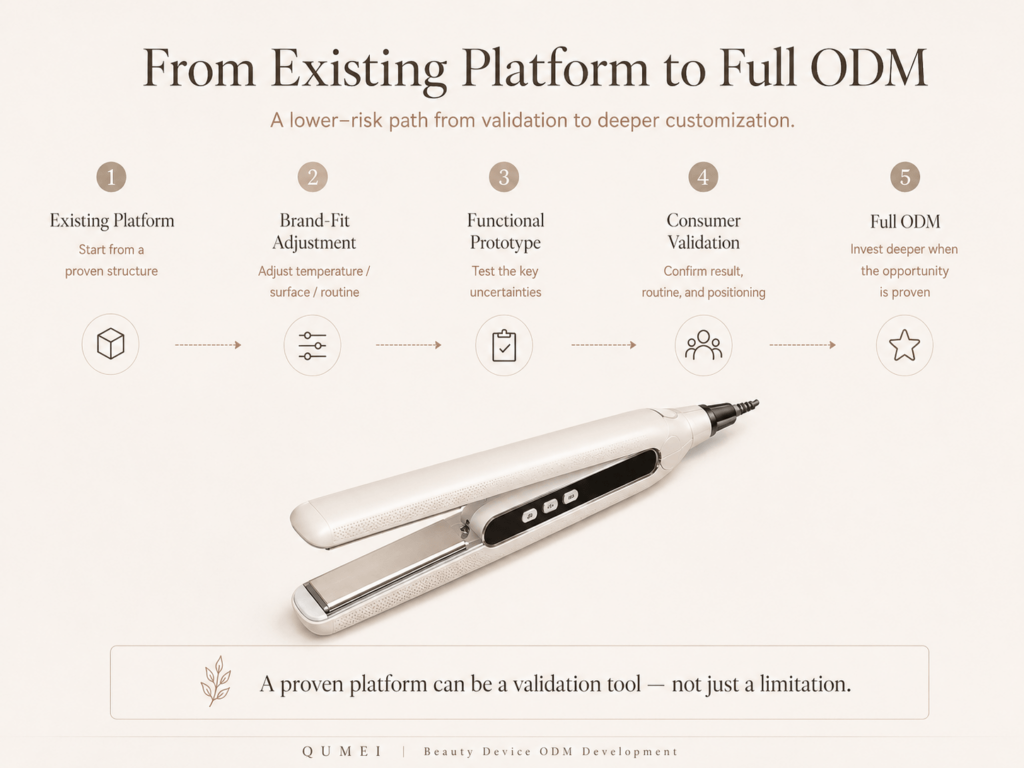
9. Example: From Ready Platform to Hair Refresh ODM
Consider a hair-care brand that already sells:
Shampoo
Treatment
Hair Mask
Serum Mist
Hair Milk
Hair Oil
The brand identifies a morning consumer problem:
bed hair
light waves
puffiness
messy bangs
dry-looking ends
The opportunity may be a Hair Refresh device.
The brand does not necessarily need to create a completely new product immediately.
A lower-risk path could be:
Stage 1 — Existing Platform
Select an existing straightening brush or iron platform.
Test whether the basic device category fits the brand.
Stage 2 — Brand-Fit Adjustment
Adjust:
temperature
surface
friction
pass count
grip
user routine
and test it with the brand’s Serum Mist.
Stage 3 — Functional Prototype
Validate whether the product delivers a meaningful Hair Refresh result.
You can read more about this stage in Functional Prototype Before Tooling.
Stage 4 — Consumer Validation
Ask:
Is the result noticeable?
Is the routine convenient?
Does the formula improve the experience?
Is the target price acceptable?
Do consumers understand the concept?
Stage 5 — Full ODM
If the concept proves strategically important, the brand may then invest in:
proprietary industrial design
new structure
new tooling
deeper formula-device integration
This is what we mean by:
Customization can grow with market certainty.
10. Example: Treatment + Ultrasonic Device
The same principle applies to treatment devices.
Imagine a brand already has a premium Treatment or Hair Mask.
The brand may consider an ultrasonic care device.
Instead of immediately opening a completely new mold, it can first validate:
whether the treatment works naturally with the device
usage time
heating vs non-heating
ultrasonic settings
plate contact
consumer-perceived difference
salon or home-use positioning
If the Treatment + Device combination does not create enough additional value, deeper ODM may not be justified.
If it does, the brand can then determine whether the next step should be:
existing platform
Semi-ODM
proprietary Full ODM
This is a better sequence than assuming that “new device” automatically means “new tooling.”
11. Example: Formula-Integrated Device
Formula-integrated devices can create strong differentiation.
But they also create higher engineering risk.
For example, a brand may want to place a Serum inside the device.
This introduces questions such as:
viscosity
pump selection
outlet size
clogging
leakage
residue
refill
cleaning
sealing
material compatibility
In this case, a Ready Product may not fully represent the final concept.
But Full ODM should still not begin before the key formula-device questions are validated.
A possible path is:
Formula Analysis
↓
Delivery-System Test
↓
Functional Prototype
↓
User Routine Validation
↓
Tooling Decision
The principle remains the same:
Development investment should follow validated product logic.
12. When Does Full ODM Become Strategically Valuable?
Full ODM becomes more meaningful when it creates value beyond a new appearance.
We see five important layers.
12.1 Product Differentiation
If competitors can easily buy the same ready-made product, direct price comparison becomes easier.
A proprietary product can reduce that comparison.
12.2 Brand Fit
The device can behave in a way that reflects the brand’s philosophy.
For example:
A brand built around gentle daily care may want different:
heat settings
contact logic
surface behavior
usage instructions
than a professional high-performance styling brand.
12.3 Formula × Device
A proprietary routine can connect an existing formula with a dedicated device.
This can create a stronger ecosystem than a standalone electrical product.
12.4 Product Asset
Over time, the device can become part of the brand’s own product platform.
The brand can own:
defined structure
key parameters
user experience
specifications
product standards
12.5 Long-Term Stability
A long-term ODM project can also establish stronger controls around:
critical dimensions
temperature tolerance
component specification
surface requirements
golden samples
testing
change management
At this stage, ODM is no longer only a launch decision.
It becomes a long-term product-management strategy.
For more information, see our Testing & Quality approach.
13. Why Functional Prototype Belongs Between Idea and Tooling
A common mistake is to treat tooling as the first real validation step.
But tooling is expensive to use as an experiment.
A Functional Prototype can help answer questions such as:
Does the core function work?
Does the routine make sense?
Is the temperature appropriate?
Is the structure practical?
Does the formula work with the device?
Is the consumer result meaningful enough?
The prototype can lead to three possible decisions:
Proceed
The direction is strong enough to continue.
Adjust
The idea has value, but important parameters need refinement.
Stop
The product does not create enough additional value.
All three outcomes can be useful.
A “Stop” decision discovered before tooling can prevent much larger investment later.
Prototype should answer a decision — not simply demonstrate a function.
14. Development Cost Should Follow Market Certainty
The amount of money invested into product development should ideally increase as uncertainty decreases.
At the beginning of a project, uncertainty may include:
market demand
product category
user routine
formula compatibility
function
price
expected volume
This is not the ideal moment to lock every design decision into a new mold.
Instead:
High Uncertainty
→ Lower-Cost Validation
Medium Certainty
→ Semi-ODM / Prototype
Higher Certainty
→ Full ODM / Tooling
This is not about avoiding investment.
It is about investing at the right time.
The right question is not “How much can we customize?” but “How much customization is justified at this stage?”
15. A Proven Platform Can Be a Validation Tool — Not Just a Limitation
Existing platforms are often viewed negatively because they are not completely proprietary.
But a proven platform can also have strategic value.
It already gives the brand:
known engineering architecture
established components
basic production experience
shorter development time
lower initial risk
This can allow the brand to test the part that is actually uncertain.
For example:
If the uncertainty is whether consumers want a Serum Mist + Hair Refresh routine, there may be no need to redesign every internal component before validating the routine.
An existing platform can therefore function as a development tool.
Once the brand has evidence that the direction matters, deeper customization can follow.
16. How Qumei Approaches Different ODM Levels
At Qumei, we do not believe every project should begin at the same development level.
We generally look at three possible starting points.
Level 1 — Ready Platform
Suitable when:
speed matters
market demand is uncertain
the brand is entering devices for the first time
differentiation requirements are still limited
Typical work may involve:
existing product selection
logo
CMF
packaging
basic configuration
Level 2 — Brand-Fit / Semi-ODM
Suitable when:
the brand already understands the category
existing platforms are close but not ideal
user experience needs adjustment
formula or routine needs to be considered
Possible adjustments may include:
temperature
heating logic
surface
geometry
material
handling
controls
formula compatibility
Level 3 — Full ODM
Suitable when:
the product is strategically important
differentiation must be stronger
existing platforms cannot support the concept
annual volume justifies deeper investment
the brand wants to build a long-term proprietary product asset
The goal is not to push every brand toward Level 3.
It is to find the development level that matches the business reality of the project.
17. A Better Beauty-Device Development Sequence
A practical development sequence can look like this:
Market / Brand Opportunity
What consumer problem are we trying to solve?
↓
Formula and Routine
How does this connect to products the brand already owns?
↓
Existing Platform Assessment
Can an existing device answer most of the requirement?
↓
Ready Product or Semi-ODM
Start at the lowest-risk practical level.
↓
Functional Prototype
Validate uncertain product questions.
↓
Consumer / Business Validation
Does the concept justify further investment?
↓
Full ODM
Only when deeper differentiation becomes strategically justified.
↓
Tooling
↓
Testing & Quality
↓
Stable Mass Production
This sequence does not guarantee that every product will succeed.
But it can reduce the chance of making large investments around assumptions that have not yet been tested.
FAQ
What is the difference between Ready Product, Semi-ODM and Full ODM?
A Ready Product uses an existing mature platform with relatively light customization.
Semi-ODM uses an existing engineering platform but adjusts product-level elements such as temperature, geometry, surface, controls, routine or formula compatibility.
Full ODM involves deeper proprietary development such as new industrial design, structure, tooling and product architecture.
Is Full ODM always better for a beauty brand?
No.
Full ODM can create stronger differentiation, but it also requires more development investment and higher certainty.
For a first device launch or an uncertain category, a Ready Product or Semi-ODM approach may be more rational.
Does Semi-ODM only mean changing color and logo?
No.
A useful Semi-ODM project can modify how the product behaves, including:
temperature
heating curve
brush or plate geometry
friction
surface specification
controls
ergonomics
formula compatibility
Color and logo are only one layer.
When should a beauty brand consider Full ODM?
Full ODM becomes more attractive when:
the category is already proven
expected volume is sufficient
existing products do not fit the brand concept
differentiation is strategically important
Formula × Device creates a proprietary routine
the device will become a long-term brand asset
Can a brand start from a Ready Product and later move to Full ODM?
Yes.
This can be an effective development strategy.
A brand can first test the category with an existing platform, move into Semi-ODM as it understands the market better, and invest in proprietary ODM once the opportunity is validated.
Should a brand build a Functional Prototype before Full ODM tooling?
If there are important uncertainties around function, routine, ergonomics, formula compatibility or consumer result, a Functional Prototype can help reduce risk before tooling.
Read more in Functional Prototype Before Tooling.
How should a hair-care brand choose between Ready Product and Semi-ODM?
If the main objective is simply to test device demand, a Ready Product may be enough.
If the brand already knows that temperature, formula, routine, styling result or user experience needs to be different, Semi-ODM may create more value.
Conclusion
Beauty-device development does not need to begin with the deepest possible level of customization.
The better starting point is the level that matches the brand’s current certainty.
If demand is uncertain:
validate first.
If the category is proven but the experience needs improvement:
consider Semi-ODM.
If the device has become a strategic long-term category:
Full ODM may become worthwhile.
The development path can therefore grow from:
Ready Product
↓
Brand-Fit / Semi-ODM
↓
Functional Validation
↓
Full ODM
↓
Stable Mass Production
The purpose is not to customize as much as possible.
It is to invest more deeply only when the product opportunity justifies it.
Customization should grow together with market certainty.
And ultimately:
The right question is not “How much can we customize?”
It is “How much customization is justified at this stage?”
Exploring a New Hair Device Project?
If your brand is considering a:
Hair Refresh Device
Straightening Brush
Professional Straightener
Cordless Styling Device
Ultrasonic Treatment Device
Formula-Connected Device
Scalp Care Device
but you are unsure whether to start from a Ready Product, Semi-ODM or Full ODM, Qumei can help evaluate the development level before larger investment.
We can begin by discussing:
target market
consumer routine
existing formula portfolio
device category
expected volume
customization priorities
functional prototype needs
tooling strategy
About the Author
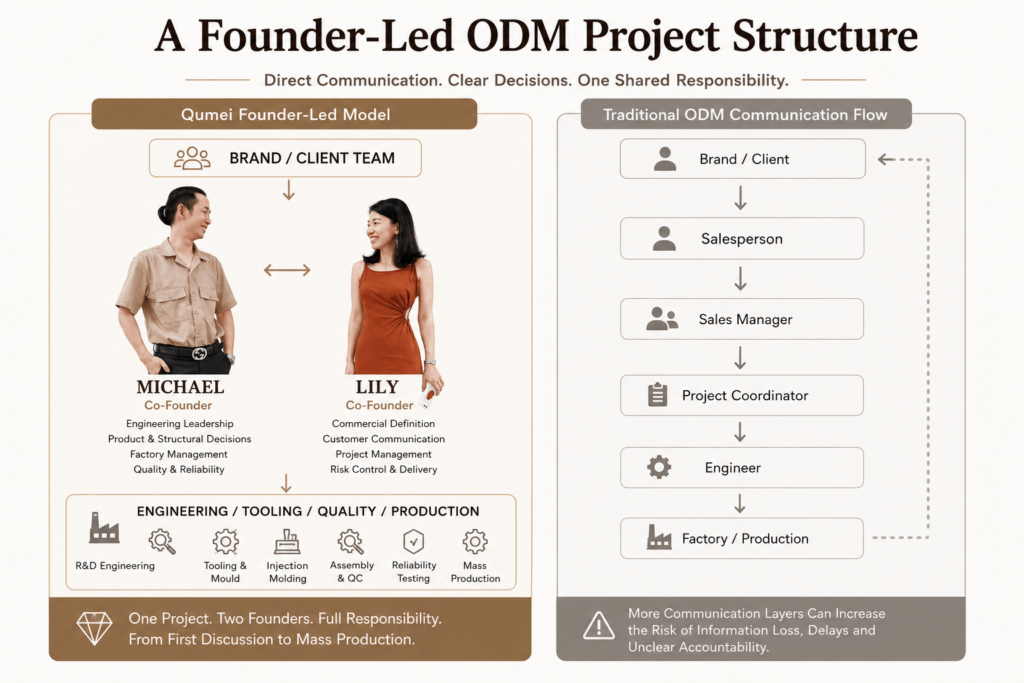
Lily | Shenzhen Qumei Technology Co., Ltd.
Lily works with beauty and hair-care brands on ODM product development, with long-term experience supporting projects for the Japanese market. Her work focuses on connecting consumer routines, hair-care formulas and manufacturable device solutions.
Technical Review:
Michael | Product Development, Qumei