Hair Refresh Device Development for Hair-Care Brands | Qumei
Meta Description
Explore the Hair Refresh framework for beauty brands: gentle heat, fewer passes, formula-device matching, platform customization and ODM validation.
How Hair-Care Brands Can Turn Daily Hair Care into a Device Opportunity: The Hair Refresh Framework
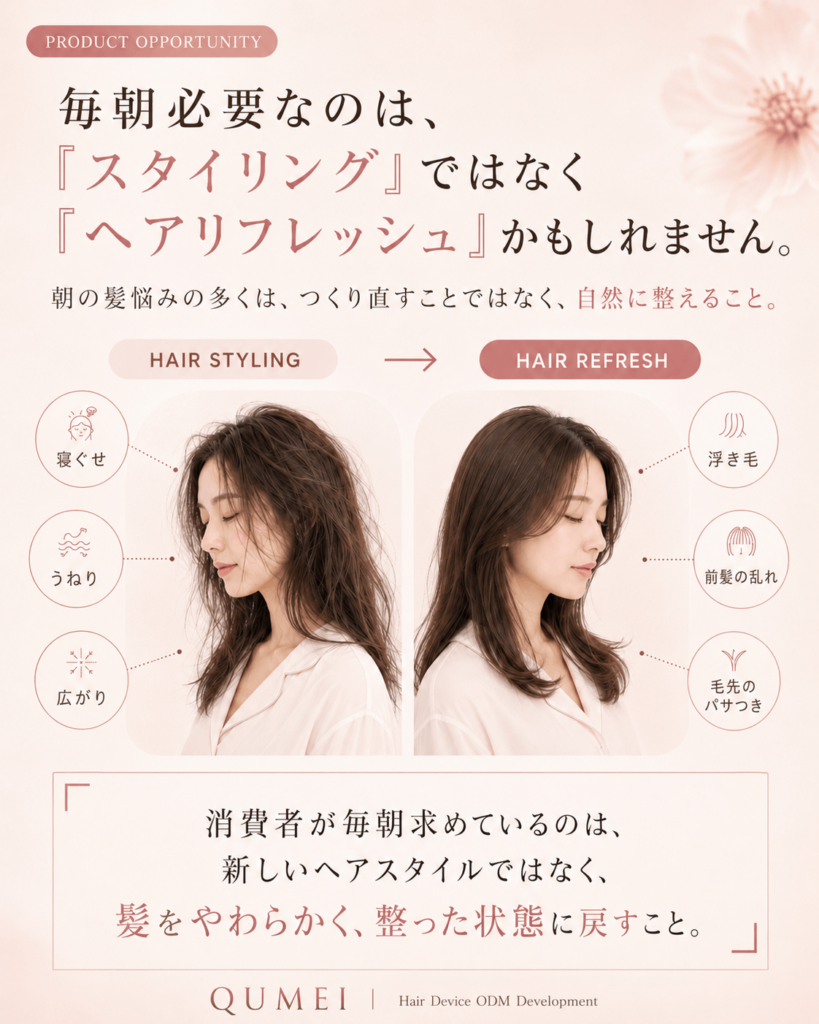
Many consumers do not need to create a new hairstyle every morning.
They simply want to correct bed hair, light waves, frizz, puffiness, flyaways, messy bangs or dry-looking ends — and bring their hair back to a naturally neat, manageable condition.
At Qumei, we describe this everyday use case as Hair Refresh.
For hair-care brands, Hair Refresh may create a product opportunity between traditional treatment and high-performance styling.
Instead of asking how to create stronger styling performance, the more useful question may be:
How can a device help consumers refresh their hair with less unnecessary heat exposure, fewer passes, lower friction and enough performance for daily use?
This article explains how hair-care brands can evaluate that opportunity, how different formulas may connect to different devices, and how a brand can move from an existing product platform toward a more distinctive ODM solution without taking full development risk from the beginning.
1. What Is Hair Refresh?
Hair Refresh is the daily process of bringing hair back to a naturally neat, manageable condition without necessarily creating a new hairstyle.
This is different from traditional styling.
A consumer may not want to straighten all of her hair, create curls or change her hairstyle every morning.
She may simply want to fix:
- bed hair
- light waves
- puffiness
- frizz
- flyaways
- messy bangs
- face-framing hair
- dry-looking or uneven ends
That difference matters because the product logic may also need to change.
Traditional Styling | Hair Refresh |
Create or change a hairstyle | Restore a neat condition |
Strong shaping performance | Sufficient daily correction |
Straighten, curl or reshape | Smooth, tidy and refresh |
Higher styling intensity | Lower unnecessary styling load |
Often occasion-driven | Frequently used in daily routines |
Performance-first | Balance between performance and daily care |
For a hair-tool brand, this may simply be another styling category.
For a hair-care brand, however, Hair Refresh may be more meaningful because it creates a bridge between daily care products and the moment when consumers begin styling.
2. Why Hair Refresh Requires a Different Device Logic
The first instinct is often:
“If daily styling should be gentler, we should simply lower the temperature.”
But lower temperature alone does not necessarily mean a better daily-use product.
A device operating at 120°C but requiring five or six passes may expose the hair to more repeated contact and friction than a device that achieves the desired result in one or two efficient passes at a different temperature.
For product development, we prefer to think about four variables together:
Temperature × Contact Time × Friction × Number of Passes
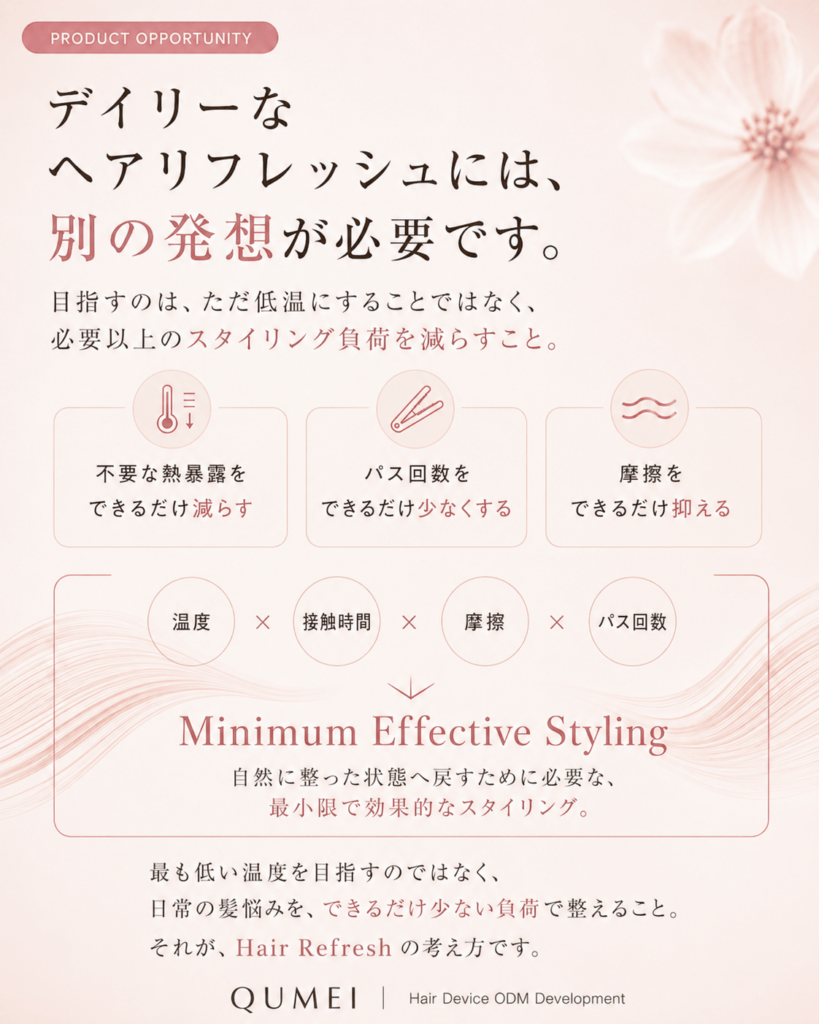
This is not intended as a scientific equation.
It is a product-development framework for thinking about the total styling exposure a consumer experiences.
Temperature
How much heat is applied to the hair?
Higher temperature may provide stronger styling performance, but for daily refresh, maximum styling power may not be necessary.
Contact Time
How long does the hair remain in contact with the heated surface?
The same temperature can create a different user experience depending on how slowly or quickly the consumer uses the device.
Friction
How much resistance does the hair experience when moving through the brush, plate or heated surface?
Brush geometry, pin design, coating, surface treatment and pressure can all influence this.
Number of Passes
How many times must the consumer repeat the same movement before the hair looks acceptable?
For a daily-use Hair Refresh device, reducing unnecessary repeated passes can be just as important as reducing temperature.
This leads to the concept we call:
Minimum Effective Styling
The minimum styling exposure required to return the hair to the desired naturally neat condition.
The goal is therefore not simply:
“Use the lowest possible temperature.”
The better question is:
What combination of temperature, contact time, friction and pass count can achieve an acceptable daily refresh with the least unnecessary styling load?
3. Three Possible Device Forms for Hair Refresh
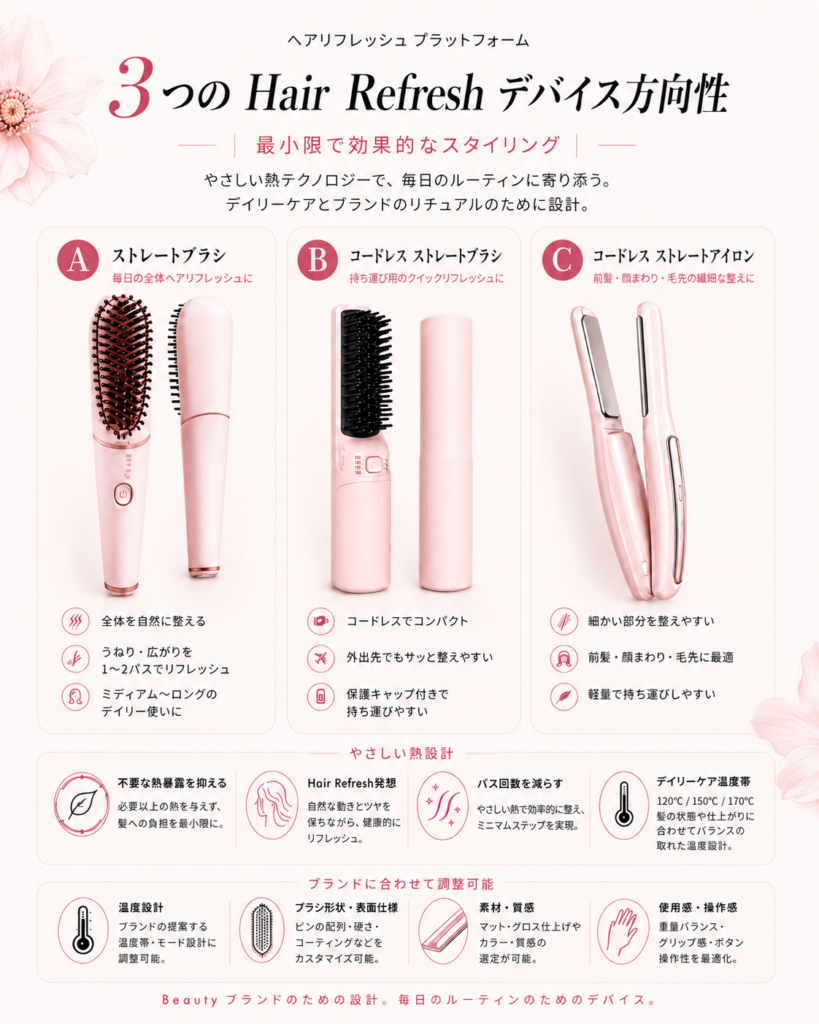
Hair Refresh does not need to be represented by one single device form.
Different consumer situations may require different product structures.
A. Straightening Brush — Overall Hair Refresh
A straightening brush may be suitable for consumers who want to quickly organize the overall hair condition rather than create a perfectly straight hairstyle.
Typical use cases may include:
- light waves
- puffiness
- general frizz
- uneven hair after sleeping
- medium to long hair
- quick overall smoothing before going out
The development objective can therefore shift from:
Maximum straightening performance
to:
Fast, natural smoothing for daily use.
The product may then be optimized around:
- moderate temperature ranges
- brush tension
- pin spacing
- friction
- surface treatment
- pass count
- easy handling
rather than simply increasing peak temperature.
B. Cordless Straight Brush — Portable Hair Refresh
Portable use creates a different requirement.
A consumer using a device in the office, during travel or after exposure to humidity may not need salon-level styling performance.
She may care more about:
- compact size
- low weight
- cordless use
- protective cap
- fast touch-up
- easy storage
- simple temperature control
In this case, portability may be more important than maximum styling power.
The product should solve a narrow but frequent problem:
“My hair became slightly messy. I want to make it look neat again in a few minutes.”
That is a different product proposition from a traditional full-size straightener.
C. Cordless Straight Iron — Precision Hair Refresh
Some daily hair problems only involve small areas.
For example:
- bangs
- face-framing hair
- ends
- hair around the ears
- small sections affected by humidity
A compact cordless straight iron may therefore be positioned as a precision refresh tool, rather than a replacement for a full-size salon-style straightener.
The smaller contact area may be more appropriate when the consumer only wants to correct specific sections of hair.
4. Hair Refresh Becomes More Valuable When Connected to Existing Hair-Care Products
For a hair-tool company, the device itself may be the main product.
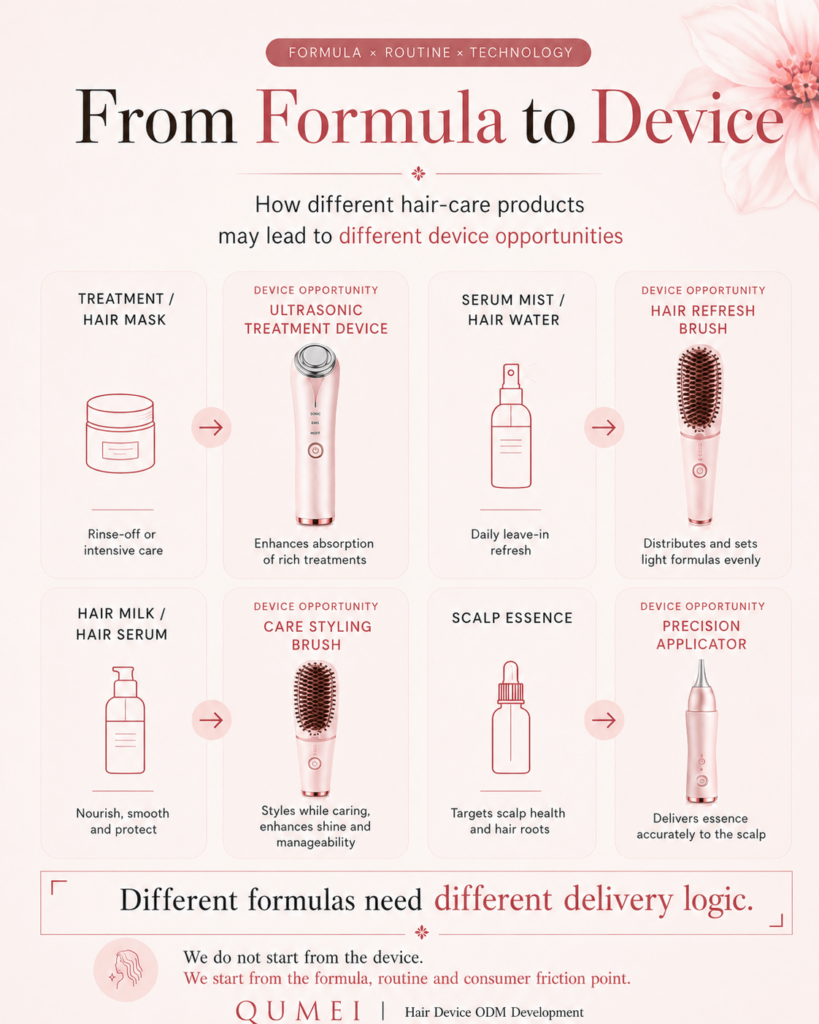
For a hair-care brand, the stronger opportunity may be:
Formula + Device + Routine
Many hair-care brands already have products that consumers use immediately before or after drying and styling.
This creates a natural opportunity to connect the formula with a device experience.
Existing Hair-Care Product | Typical Routine | Possible Device Opportunity |
Serum Mist / Hair Water | Spray → Style | Gentle Heat Hair Refresh Brush |
Heat Protectant | Apply → Heat style | Temperature-tuned Brush or Iron |
Hair Milk | Apply → Dry / Smooth | Care Styling Brush |
Hair Serum | Apply → Smooth | External application + Care Device |
Hair Oil | Apply to ends → Finish | External application + Styling Tool |
Treatment / Hair Mask | Apply → Treatment step | Ultrasonic Treatment Device |
Scalp Essence | Apply directly to scalp | Precision Scalp Applicator |
The important point is that the device should not exist separately from the brand’s current routine unless there is a clear reason to do so.
A strong device concept should ideally extend something the brand already owns:
- a formula
- a treatment philosophy
- a consumer problem
- a usage ritual
- a distinctive brand promise
5. Why Different Hair-Care Formulas Need Different Device Structures
One common development mistake is to begin with a device and then try to force every formula into the same structure.
We believe the process should work in the opposite direction.
The formula should help define the delivery mechanism.
Different hair-care products behave very differently.
A water-like mist, serum, milk, oil and treatment have different:
- viscosity
- oil content
- polymer content
- flow behavior
- residue
- cleaning requirements
- pump requirements
- nozzle requirements
- sealing requirements
- material compatibility
Therefore, the same liquid reservoir or spray system cannot automatically be used for every hair-care formula.
For example:
Hair Mist / Hair Water
Low-viscosity, water-like formulas may be suitable for spray or micro-pump delivery.
Hair Serum
A slightly more viscous formula may require a different pump and outlet structure.
Hair Milk
Hair milk may not atomize well through a conventional fine-mist nozzle.
A controlled dispensing structure, comb-channel system or external application may be more appropriate.
Hair Oil
Oil-based formulas can create different leakage, residue and cleaning issues.
For many products, external application may be more practical than placing oil inside the device.
Treatment / Hair Mask
High-viscosity treatments are usually better applied directly to the hair first.
The device then interacts with the treated hair rather than attempting to store and dispense the treatment.
This is one reason ultrasonic treatment devices are structurally different from mist styling devices.
6. Should the Hair-Care Formula Be Built Into the Device?
There are three common development directions.
Option 1: External Formula + Device
Example:
Serum Mist → Gentle Heat Hair Refresh Brush
The consumer applies the brand’s existing formula first, then uses the device.
Advantages include:
- smaller device size
- lower structural complexity
- easier cleaning
- less risk of clogging
- lower leakage risk
- easier portability
- easier first-stage validation
For many Japanese-market portable products, this can be a highly practical starting point.
Option 2: Water Reservoir + Device
The reservoir contains water rather than the brand’s formula.
This may support:
- steam styling
- moisture-assisted styling
- hair refresh
However, the commercial connection between the brand’s existing hair-care formula and the device becomes weaker.
The consumer may simply see it as a styling tool with steam.
Option 3: Brand Formula Inside the Device
This creates the strongest connection between the consumable and the device.
Potential benefits may include:
- proprietary usage routine
- stronger brand differentiation
- formula repurchase
- controlled dispensing
- device-and-consumable ecosystem
However, it also requires significantly more engineering validation.
Typical development questions include:
- Is the formula compatible with the pump?
- Will the nozzle clog?
- What outlet size is required?
- Does the formula leave residue?
- Can the liquid path be cleaned?
- Is the reservoir leak-resistant?
- Are the sealing materials chemically compatible?
- Does viscosity change under temperature?
- Can consumers refill the system easily?
This is why we do not automatically recommend adding a reservoir.
Integrated liquid delivery is valuable only when it improves the consumer routine enough to justify the added size, cost and engineering complexity.
7. Development Can Grow With Market Certainty
Many beauty brands like the idea of launching a distinctive device but hesitate to begin with full ODM.
That is understandable.
A completely new tool can require:
- industrial design
- structural development
- new tooling
- engineering validation
- certification
- MOQ
- inventory commitment
- launch investment
For a brand entering a new device category, this can be a significant risk.
A more flexible path is:
Existing Platform
↓
Brand-Fit Adjustment
↓
Functional Prototype
↓
Consumer Validation
↓
Full ODM
A brand does not necessarily need to begin with a completely new mold.
In many cases, a more flexible ODM development process can begin with an existing platform and move gradually toward deeper customization.
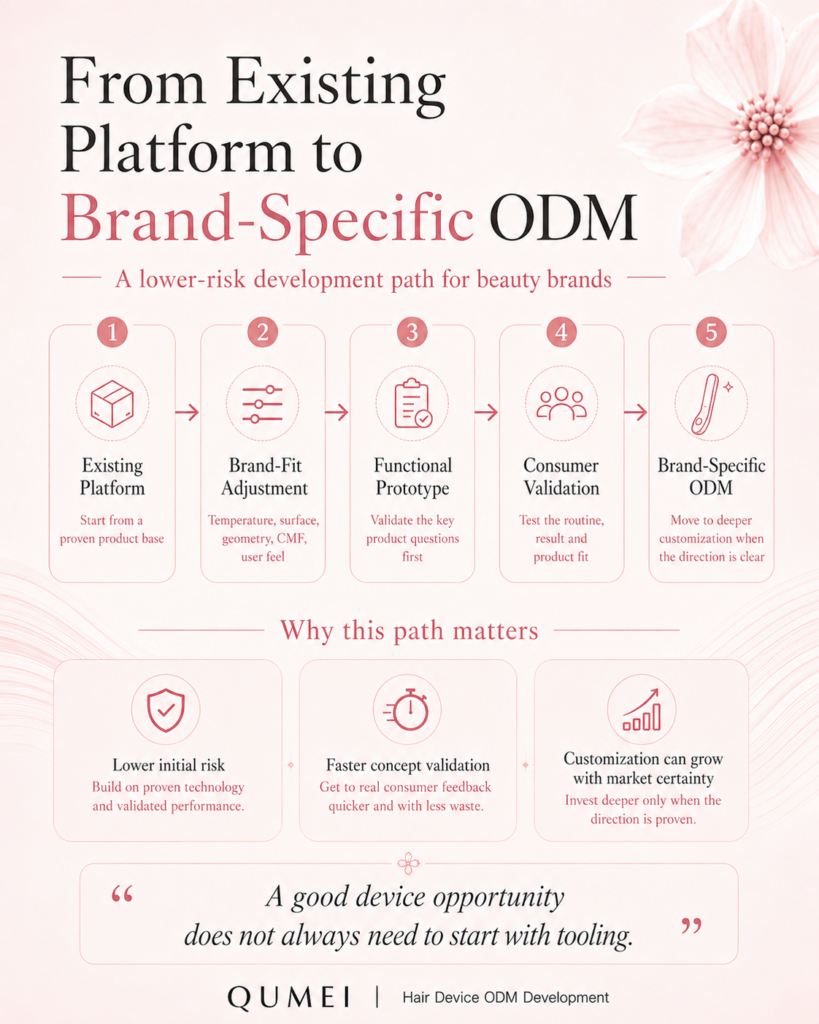
An existing platform can first be adjusted in areas such as:
- temperature range
- heating logic
- brush geometry
- surface treatment
- coating
- materials
- CMF
- weight balance
- button layout
- grip feel
- usage routine
This allows the product concept to become more brand-specific while the underlying market assumption is still being validated.
If the category later proves important to the brand, customization can gradually move toward a fully proprietary product.
8. What Can Be Customized Beyond Color and Logo?
ODM is often misunderstood as:
- new color
- new logo
- new packaging
- new outer shape
These are visible forms of customization, but they are not necessarily the most valuable ones.
For a hair-care brand, deeper differentiation may come from how the product behaves.
Visible Customization
- Logo
- Color
- Packaging
- Surface finish
Product-Level Customization
- Temperature range
- Heating curve
- Brush pin layout
- Brush firmness
- Plate or contact geometry
- Surface coating
- Friction characteristics
- Weight balance
- Grip design
- Button logic
- Formula compatibility
- Consumer routine
- Usage time
- Testing standards
The strongest ODM differentiation is often found in:
How the product works — not only how it looks.
For example, two straightening brushes can appear similar from a distance but provide very different user experiences because of differences in:
- pin spacing
- heat distribution
- temperature logic
- contact pressure
- surface treatment
- weight
- friction
- pass efficiency
This is where a brand philosophy can begin to exist inside the product itself.
9. What Should Be Validated Before Tooling?
Before a brand invests in full tooling, the most uncertain questions should ideally be tested first.
For a Hair Refresh brush, typical validation questions may include:
Temperature
What temperature range is actually needed for the target use case?
Pass Count
Can the desired hair condition be achieved in one or two passes?
Brush Geometry
Does the brush create enough tension to organize the hair without unnecessary pulling?
Friction
Does the surface feel smooth during repeated use?
Formula Compatibility
If the consumer applies Serum Mist or Heat Protectant first, does the product still operate effectively?
Hair Feel
Does the result feel natural and manageable rather than over-styled?
Handling
Is the device still comfortable and convenient enough for frequent use?
Size and Weight
Does the design remain consistent with the target market and usage environment?
This is why we often prefer functional prototype validation before moving to tooling.
A prototype does not need to look like the final commercial product.
Its job is to answer the important functional questions before larger investments are made.
10. A Practical Example: Serum Mist + Hair Refresh Brush
Consider a hair-care brand that already has:
- Shampoo
- Treatment
- Hair Mask
- Hair Milk
- Hair Oil
- Serum Mist
The brand already supports the consumer through:
washing
↓
treatment
↓
drying
↓
leave-in care
But the next morning, the consumer wakes up with:
- bed hair
- light waves
- puffiness
- messy bangs
She may then leave the brand’s care routine and use a conventional styling tool from another company.
This creates a possible gap.
The routine could instead become:
Serum Mist
↓
Gentle Heat Hair Refresh Brush
↓
Naturally Neat Finish
The value of the device is not necessarily to replace the brand’s existing products.
Its value may be to:
Make those products part of a more complete daily routine.
This changes the business logic.
Instead of selling:
another styling device
the brand may begin building:
its own Hair Refresh ritual.
11. When Does Hair Refresh ODM Make Strategic Sense?
Full ODM is not always necessary.
But it can become strategically valuable under certain conditions.
1. When Direct Price Comparison Becomes a Problem
If many brands sell the same ready-made structure with different logos, consumers can easily compare them by price.
ODM allows the brand to move away from that comparison.
2. When the Brand Has a Strong Hair-Care Philosophy
If a brand is built around:
- damage care
- heat care
- moisture balance
- frizz control
- smoothness
- daily gentle care
the device can be designed to reflect that philosophy through product behavior.
3. When Formula + Device Creates a Stronger Routine
A device can help turn an existing consumable into a larger usage system.
For example:
Serum Mist
+
Hair Refresh Brush
or:
Treatment
+
Ultrasonic Device
4. When the Device Category Is Becoming a Long-Term Brand Asset
Once the brand decides that devices will become a permanent category, relying on the same public platform as competitors may become less attractive.
A proprietary platform can gradually become part of the brand’s product assets.
5. When Long-Term Product Stability Matters
For a product intended to remain in the market for several years, ODM can help establish stable specifications such as:
- critical dimensions
- temperature tolerance
- heating performance
- battery specification
- surface requirements
- golden samples
- testing standards
- component control
- change management
Long-term consistency depends not only on final inspection, but also on how critical parameters, components and changes are controlled throughout production. You can learn more about our Testing & Quality approach.
ODM therefore becomes more than a launch decision.
It can become a long-term product management decision.
At the same time, if demand is still highly uncertain, starting from a validated existing platform may be more rational than immediately investing in full ODM.
12. How Qumei Approaches Hair Refresh Device Development
At Qumei, we do not believe every hair-care brand needs a new device.
And we do not believe every device project should begin with new tooling.
Our development process usually begins with understanding three things:
Brand
Formula
Consumer Routine
From there, we evaluate whether a device can create meaningful additional value.
A typical process may include:
1. Understand the Brand Portfolio
What does the brand already sell?
Treatment?
Mist?
Milk?
Oil?
Scalp Essence?
2. Understand the Consumer Routine
When is the product used?
Morning?
After washing?
Before drying?
Before styling?
Weekly treatment?
3. Review the Formula if Relevant
We consider factors such as:
- viscosity
- oil content
- application method
- rinse-off or leave-in use
- wet hair or dry hair
- interaction with heat
4. Define the Device Opportunity
Would the consumer benefit more from:
- Hair Refresh Brush
- Cordless Brush
- Straight Iron
- Ultrasonic Treatment Device
- Formula Applicator
or perhaps no device at all?
5. Start From an Existing Platform Where Possible
If a Qumei platform already addresses most of the product requirement, we may use it as the starting point.
6. Adjust the Product Experience
Depending on the project, this can include:
- temperature
- brush design
- surface material
- product dimensions
- handling
- CMF
- controls
- formula compatibility
7. Build a Functional Prototype
The prototype is used to answer the uncertain questions before tooling.
8. Validate Before Moving to Full ODM
Once the product direction, user experience and market logic become clearer, the brand can decide whether deeper structural customization and tooling are justified.
Our starting question is therefore not:
“Which device do we want to sell?”
It is:
“What device, if any, makes sense for this formula, consumer routine and brand?”
FAQ
What is Hair Refresh?
Hair Refresh is the daily process of returning hair to a naturally neat, manageable condition without necessarily creating a new hairstyle. Typical use cases include correcting bed hair, light waves, puffiness, flyaways, messy bangs and uneven ends.
Is lower temperature always better for hair?
Not necessarily.
Temperature is only one part of the styling experience. Contact time, friction and the number of passes also matter.
A lower-temperature tool that requires many repeated passes is not automatically gentler than a device that achieves the desired daily result more efficiently.
For product development, the better objective is Minimum Effective Styling — enough performance to achieve the target result with the least unnecessary styling exposure.
Can a hair serum or mist be used with a heated styling device?
Potentially, yes, but compatibility should be evaluated based on the formula and intended usage.
A brand should consider:
- whether the product is intended for heat use
- whether it is used on wet or dry hair
- the formula’s viscosity
- residue on the device surface
- required styling temperature
- cleaning requirements
For many projects, external application of the formula followed by device use is a simpler first step than integrating the liquid into the device.
Should a hair-care formula be placed inside the device?
Not always.
Integrated formula delivery can create a strong brand experience, but it also adds engineering complexity.
Pump design, sealing, clogging, cleaning, material compatibility and formula viscosity all need to be validated.
For portable Japanese-market products, an external formula + compact device routine may often be a more practical first development direction.
Does a hair-care brand need full ODM to launch a Hair Refresh device?
No.
A brand can begin with an existing platform and validate:
- the category
- consumer response
- temperature
- usage routine
- formula compatibility
- styling performance
before investing in full tooling.
Customization can increase gradually as market certainty increases.
Conclusion
Hair-care brands do not always need to enter the device category by launching another high-temperature straightener or complicated beauty appliance.
There may be a simpler opportunity hidden inside the consumer’s existing daily routine.
Consumers frequently need to:
refresh, smooth, tidy and restore
rather than completely restyle their hair.
That is the opportunity behind Hair Refresh.
For brands, the deeper value appears when that device is connected to:
- an existing formula
- a consumer problem
- a daily routine
- a distinctive care philosophy
The most valuable device may therefore not be the one with the most functions.
It may be the one that fits the brand’s existing hair-care system most naturally.
At Qumei, our role is to help beauty and hair-care brands evaluate that connection — from product concept and functional validation to ODM development and stable mass production.
CTA
Exploring a Hair-Care Device Opportunity?
If your brand already has a Treatment, Serum Mist, Hair Milk, Hair Oil or Scalp Essence and you are considering whether a device could extend the consumer routine, Qumei can help evaluate the product direction before full tooling.
Send us your existing formula, reference product or product idea.
We can begin by discussing:
- consumer routine
- device form
- temperature
- formula compatibility
- functional prototype
- customization level
Author
About the Author
Lily | Shenzhen Qumei Technology Co., Ltd.
Lily works with beauty and hair-care brands on ODM product development, with long-term experience supporting projects for the Japanese market. Her work focuses on connecting consumer routines, hair-care formulas and manufacturable device solutions.
Technical Review:
Michael | Product Development, Qumei