
Before We Quote: What Beauty Brands Should Prepare Before a Hair Tool ODM Project
For beauty brands planning a new hair styling tool, asking for a quotation too early can sometimes create confusion.
A product photo, a competitor model, or a target price may help start the discussion, but they are not enough to define a reliable ODM project.
Before an ODM supplier can evaluate cost, tooling, structure, testing, and production risk, the product direction needs to be clear.
This is especially important for hair styling tools such as straightening brushes, hair straighteners, curling irons, hair dryers, cordless styling tools, and ultrasonic hair care devices.
For Japanese beauty brands, product clarity before quotation can help reduce development risk, avoid repeated sample changes, and make the project move forward more efficiently.
Why a Product Photo Is Not Enough for Quotation
Many new projects begin with a simple request:
“We want to make something similar to this product. Can you quote it?”
A reference product is useful.
It helps the supplier understand the appearance direction, size, category, and basic market positioning.
But a photo or competitor sample does not fully explain the product strategy.
It does not clearly define:
- who the product is designed for
- what styling result matters most
- which function makes the product different
- what quality level the brand expects
- which market requirements must be considered
- what testing standards are needed
- whether the product needs prototype validation
- what packaging and delivery risks may exist
For hair tools, the same appearance can hide very different internal structures, heating systems, materials, safety designs, and cost levels.
That is why a quotation based only on appearance may not reflect the real development difficulty.
A better quotation starts with better product definition.
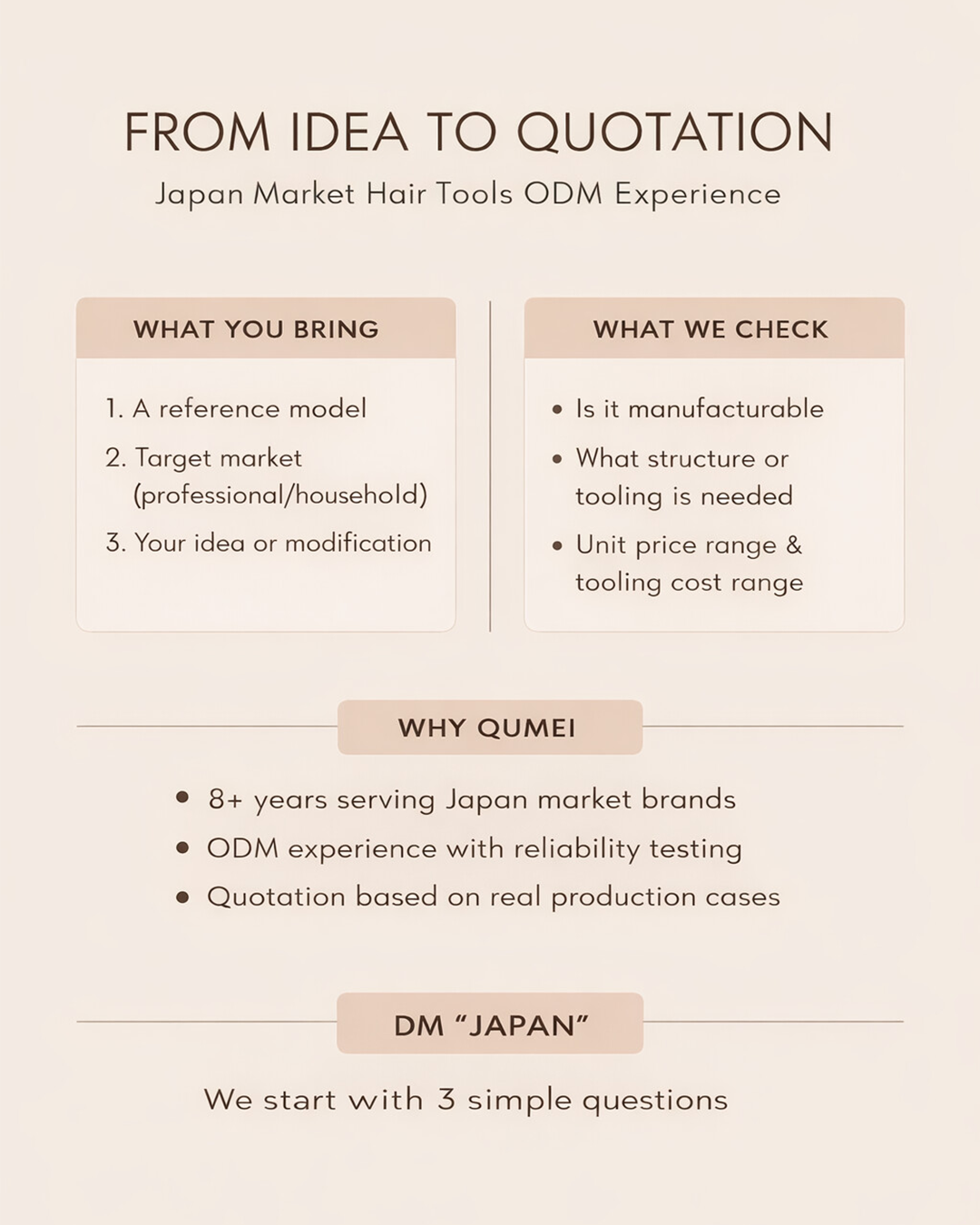
Three Questions Brands Should Clarify Before Requesting a Quote
Before requesting a formal quotation, beauty brands can clarify three important questions.
These questions help both the brand and the ODM supplier understand the project more accurately.
1. Who Is the Product For?
The first question is not about price.
It is about the user.
Is the product designed for:
- home users
- professional salons
- chain salons
- travel users
- e-commerce customers
- hair care brand customers
- first-time beauty device users
Different users have different priorities.
Home users may care more about appearance, ease of use, storage, and daily comfort.
Salon users may care more about repeated performance, stable temperature, long working sessions, low fatigue, and workflow compatibility.
A product for Japanese salon use may require a different design logic from a product for general home use.
When the target user is unclear, the product specification can easily become unclear as well.
2. What Result Matters Most?
The second question is about the result the product should deliver.
For example, does the brand want the product to support:
- smoother hair
- reduced frizz
- faster styling
- more volume
- better shine
- color care
- less heat damage
- scalp comfort
- salon-like finish at home
For hair styling tools, function should not only sound attractive.
It should connect to a real user result.
For example, if a brand wants to develop a “color care dryer,” the product should not only use this phrase as a marketing concept.
The team should clarify what “color care” means in the product:
- lower hair surface temperature
- more stable airflow
- gentler heat distribution
- real-time temperature monitoring
- reduced overheating risk
- suitable drying experience for colored hair
When the desired result is clear, the ODM supplier can better evaluate structure, heating design, airflow, components, and testing requirements.
3. What Function Makes the Concept Credible?
The third question is about the key function.
A product concept becomes stronger when the function supports the claim.
For example:
- a straightening brush may need stable heat distribution and safe comb design
- a hair dryer may need airflow and noise balance
- a cordless tool may need battery safety and reasonable usage time
- an ultrasonic hair care device may need sealing, waterproof validation, and functional verification
- a dual-voltage dryer may need voltage recognition, heat control, and internal layout planning
A function should not be added only because it looks attractive.
It should be technically reasonable, testable, and suitable for the target user.
This is where early ODM discussion becomes valuable.
A supplier with engineering experience can help the brand judge whether the function is realistic before tooling begins.
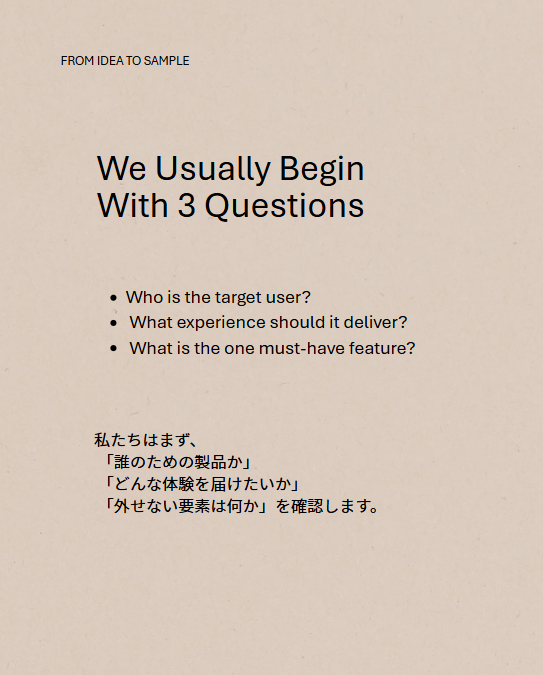
Why This Matters More in the Japanese Market
For the Japanese market, product clarity is especially important.
Japanese users often value:
- stable daily performance
- safety feeling
- clean appearance
- careful details
- low failure risk
- long-term consistency
- clear product purpose
A product that only looks similar to a competitor may not be enough.
Japanese beauty brands often need to consider whether the product can support repeated use, stable temperature, safe handling, good packaging condition, and reliable after-sales performance.
This is why product definition before quotation is not just a communication step.
It is part of risk control.
When the product direction is clear, the supplier can better judge:
- whether the concept is suitable for ODM development
- whether a functional prototype is needed
- what parts may create quality risk
- what testing should be planned
- whether tooling should begin now or later
- how to reduce uncertainty before mass production
What Information Helps an ODM Supplier Evaluate the Project?
To receive a more accurate quotation, brands can prepare the following information before contacting an ODM supplier.
| Information | Why It Matters |
|---|---|
| Product category | Different hair tools have different structures, risks, and testing requirements. |
| Target user | Home users, salons, travel users, and e-commerce customers may need different design priorities. |
| Target market | Japan, Europe, the US, and other markets may have different expectations and compliance considerations. |
| Reference product | Helps explain appearance, size, function direction, and market positioning. |
| Expected result | Helps define the real user benefit behind the product. |
| Key function | Affects structure, components, cost, and testing. |
| Target price range | Helps the supplier evaluate whether the concept matches the cost structure. |
| First order quantity | Affects tooling, production planning, and cost evaluation. |
| Certification needs | Helps identify electrical, material, and safety-related design considerations early. |
| Packaging method | Affects transport risk, storage risk, and customer experience. |
| Sales channel | E-commerce, salon distribution, retail, and individual delivery may require different packaging validation. |
| Prototype needs | Helps reduce risk before tooling and mass production. |
| Testing expectations | Helps define quality control and reliability validation requirements. |
The more clearly this information is prepared, the more practical and realistic the quotation will be.
Buyer Decision Checklist: Before Requesting a Hair Tool ODM Quote
Before requesting a quotation from an ODM supplier, beauty brands can use the following checklist to evaluate whether the project is ready for a more accurate discussion.
- Have we clearly defined the target user?
- Is the product for home users, professional salons, chain salons, travel users, or e-commerce customers?
- Have we clarified the main result the product should deliver?
- Do we know whether the product should focus on smoothness, volume, reduced frizz, quick styling, color care, shine, or hair damage reduction?
- Have we identified the key function that makes this product credible?
- Are we using a competitor product only for appearance reference, or do we also understand its structure and performance requirements?
- Have we considered the target market, especially if the product is intended for Japanese users?
- Do we need a functional prototype before tooling?
- Have we considered testing requirements such as temperature stability, power cord durability, hipot testing, packaging validation, or surface durability?
- Are there any safety, certification, or market-specific requirements that should be considered before development?
- Have we considered the packaging and sales channel?
- Do we have a realistic target price range, first order quantity, and long-term sales plan?
If several points are still unclear, it may be more practical to start with product clarification or a functional prototype before asking for a final mass production quotation.
Why a Functional Prototype May Be Better Than Starting with Tooling
For new product concepts, starting directly with mold tooling can be risky.
A functional prototype allows the brand to verify whether the core function, structure, heating performance, airflow, battery system, sealing design, or user experience is realistic before making a larger tooling investment.
This is especially useful for:
- new hair tool concepts
- Japan-specific product ideas
- ultrasonic hair care devices
- cordless styling tools
- dual-voltage hair dryers
- products with new heating or airflow structures
- products that combine liquid, battery, heat, or sealing requirements
A prototype does not solve every problem.
But it helps the brand and supplier identify important risks earlier.
For many ODM projects, this can reduce unnecessary tooling changes and repeated sample revisions later.
How Product Clarity Helps Reduce Development Risk
A clearer product definition helps the project in several ways.
First, it helps the supplier evaluate feasibility.
Some product ideas look simple, but may involve difficult internal structure, heat management, waterproof sealing, battery safety, or packaging risk.
Second, it helps the brand understand cost more realistically.
A low quotation may look attractive, but if the product definition is unclear, the quotation may not include the real cost of quality, testing, tooling, or reliability validation.
Third, it helps both sides communicate more efficiently.
When the user, result, function, market, and testing expectations are clear, discussions become more practical.
Finally, it helps prevent problems from being pushed into later stages.
Many quality issues do not begin during mass production.
They begin when the product direction, structure, or testing plan is not clear enough at the early stage.
How Qumei Supports Early ODM Project Evaluation
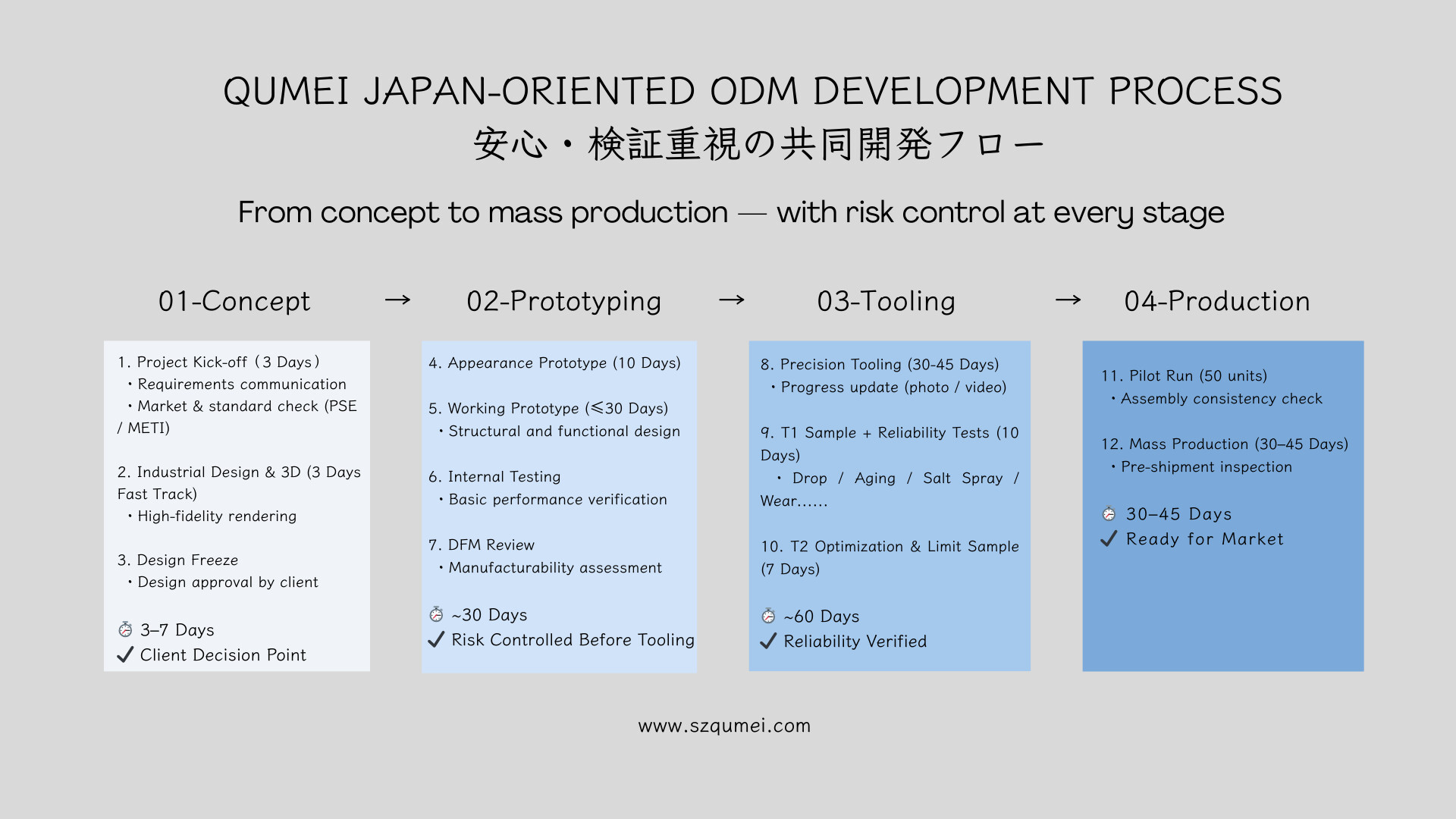
Qumei supports early-stage hair tool ODM discussions by helping beauty brands evaluate product feasibility, prototype needs, structure risks, testing requirements, and mass production considerations.
For Japan-oriented hair tool projects, we usually focus on practical questions such as:
- Who is the product designed for?
- What result should the product deliver?
- What function makes the concept credible?
- Does the product need a functional prototype before tooling?
- What reliability tests should be considered?
- What quality risks may appear during production, storage, transport, or long-term use?
This approach may be suitable for beauty brands that want to develop reliable hair styling tools with clearer product definition before tooling.
Qumei supports ODM development for straightening brushes, hair straighteners, curling irons, hair dryers, cordless hair styling tools, and ultrasonic hair care devices.
FAQ
What should a beauty brand prepare before requesting a hair tool ODM quote?
A beauty brand should prepare the target user, product category, expected function, reference product, target market, sales channel, certification needs, order quantity, packaging expectations, and whether a functional prototype is needed before tooling.
Why is product clarity important before quotation?
Product clarity helps the ODM supplier evaluate structure, materials, components, testing, tooling, cost, and production risks more accurately. Without clear product definition, the quotation may not reflect the real development difficulty.
Is a competitor sample enough for quotation?
A competitor sample can help explain appearance direction, size, and category. However, it does not fully define the target user, function, quality level, testing requirements, packaging method, or long-term reliability expectations.
Should brands start with a prototype before tooling?
For new concepts or Japan-specific products, starting with a functional prototype can reduce tooling risk. It allows the brand to validate core function, structure, heating performance, airflow, sealing, battery design, or user experience before mold investment.
Why is this especially important for the Japanese market?
Japanese users and brands often care about stable daily performance, safety feeling, clean appearance, careful details, and long-term consistency. Clear product definition helps reduce the risk of developing a product that looks acceptable but does not perform reliably over time.
How does Qumei support early ODM evaluation?
Qumei helps brands clarify product direction, evaluate technical feasibility, identify risk points, develop functional prototypes, and plan reliability testing and mass production for hair styling tools.
Continue Exploring Qumei Insights
Learn more about hair tool ODM development, reliability testing, and Japan-market product decisions.
Planning a Hair Tool Project for the Japanese Market?
Before moving into tooling or mass production, it may be helpful to evaluate product positioning, prototype needs, reliability testing, and long-term quality risks.
Qumei supports Japan-oriented hair tool ODM development from concept discussion and functional prototype to reliability testing and stable production.
Discuss your hair tool project with Qumei.
 シルクプレートのサンプル請求・開発相談はこちら